
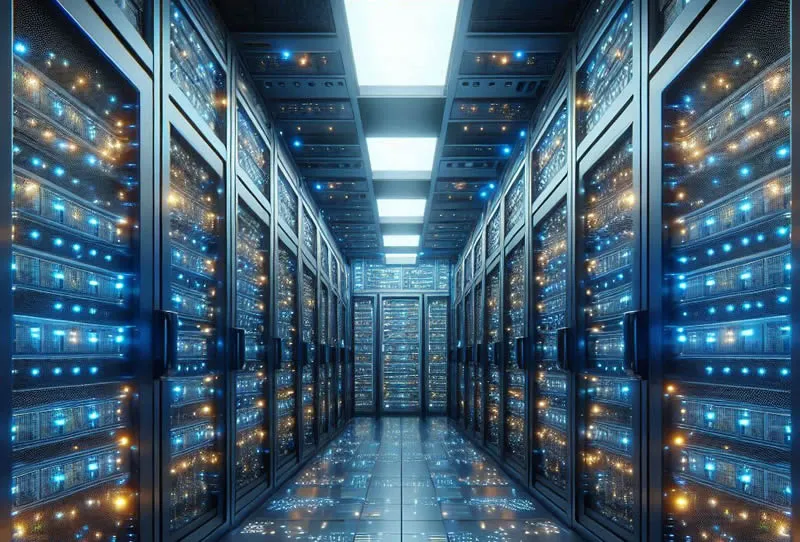
The report states that Russian server market prices will rise sharply in the first half of 2026 “VedomostiThe main reason is that memory manufacturers are turning back to artificial intelligence, causing a global parts shortage. Meanwhile, experts don’t expect any price cuts until the end of the year.
Image source: Grok
According to the company Yadro, based on monitoring of purchases under 44-FZ and 223-FZ, the average price of a typical server increased by 25% in the first half of 2026, to about 500,000 rubles excluding VAT. Alexander Selyaninov, solutions architect at Jet Infosystems’ pre-sales and supply control department, estimates that the cost of servers in Russia has increased by an average of 35%. According to Vedomosti estimates, the current price of a Yadro server is about 2 million rubles.
Alexander Malinin, head of supplier development and supply chain at OpenYard, pointed out that RAM and storage devices are the main factors (about 80%) in the increase in server costs. Meanwhile, Evgeniy Achkasov, director of the enterprise solutions, network equipment and telecommunications company division from Merlion, explained that the more modules installed in a server, the greater the impact on the final price of the equipment. At the same time, the price situation for DDR5 memory remains tight. According to Graviton commercial director Alexander Stolyarov, the cost of 64 GB modules has increased approximately 20 times to 253,000-295,000 rubles, compared with 12,000-16,000 rubles a year ago. Alexander Malinin clarified that after reaching a peak of 338,000 rubles in February, prices adjusted slightly by June.
According to OpenYard statistics, in the first half of 2026, the price of a set of 16 DDR5 memory modules with a capacity of 64GB increased 7.4 times, reaching approximately 4 million rubles. Drives also saw sharp growth: the price of a 480 GB SATA SSD increased by 7.3 times (up to 59,000 rubles), and the price of a 3.84 TB SAS SSD increased by 3.1 times (to more than 236,000 rubles). Stolyarov said the price of processors has increased by 40%, and that of graphics accelerators by 20% to 80%, depending on the model.
Experts attribute the shortage to global industry restructuring to meet the demand for artificial intelligence. Roman Bobryshev, head of the Computing Systems Competence Center and T1 IT Holdings, explained that the manufacturer is massively adjusting its production capacity to produce high-margin HBM memory for AI accelerators. The shift triggered shortages and significant price increases for standard DDR4 and DDR5 modules, which had previously been prioritized in factories’ production schedules.
Mikhail Kostsov, head of K2Tech’s computing infrastructure, data storage systems (DSS) and backup systems (BSS) business, pointed out that Russian server manufacturers are particularly vulnerable to global supply shortages due to their reliance on imported processors, memory and controllers. Since key parts are purchased abroad, although there are domestic assembly facilities, fluctuations in international prices directly affect the cost of domestic equipment. The situation has been exacerbated by a sharp increase in lead times, which more than doubled in the first half of 2026 – from 10 weeks to 24 weeks. Experts believe that the final price of a server now also includes additional costs arising from increased shipping duties, difficulties with cross-border payments, and the risk of guaranteed contract failure.
Market participants are unanimous in forecasting that server costs will not fall significantly until the end of 2026. Malinin and Bobryshev predict that configuration costs will increase by a further 15-25%, and Achkasov links the lack of prerequisites for lower prices to the continued shortage of memory. Stolyarov pointed out that the market has reached a price platform, with fluctuations that may be as high as 30%, and emphasized that all 2027 production capacity of major manufacturers such as Samsung, Hynix and Micron has been sold out, so prices of RAM, drives and GPUs will not drop next year. Still, Malinin noted that while manufacturers continue to prioritize AI components, memory price growth has slowed. Yadro expects supply and demand to begin to level off in the second half of 2026, which will lead to stabilizing costs for certain categories of parts.
Manufacturers continue to review price lists regularly, which is why suppliers are advised to budget around 40% of current prices when planning purchases for 2027 to avoid shortfalls when purchasing. The top priority for Russian companies is to advance purchases and determine the costs of maintaining existing infrastructure, as experts believe expectations of price cuts in the foreseeable future are pointless.
If you find an error, select it with your mouse and press CTRL+ENTER.