
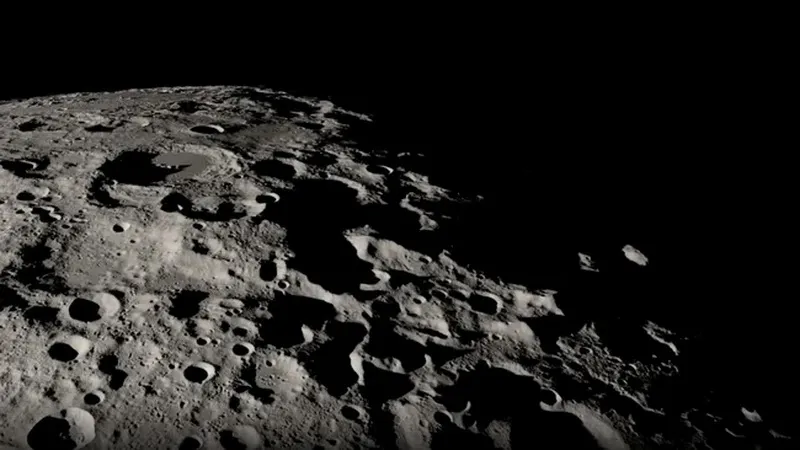
Results of a new study suggest that Earth’s microbes can survive on the Moon’s unforgiving surface, albeit in a state of suspended animation. The portal writes about this Space Network Citing research published in the journal Science Advances on August 19.
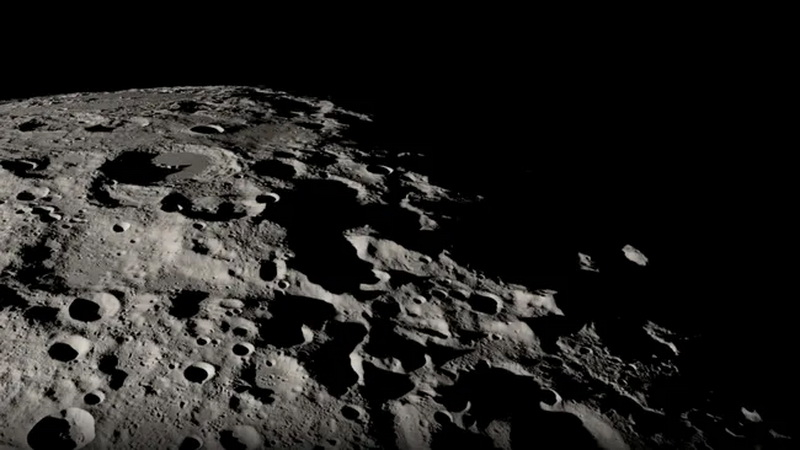
Image source: NASA Scientific Visualization Studio/Ernie Wright
Previous research has shown that the lunar surface environment is too harsh for microorganisms to survive. In particular, a study conducted in 2019 concluded that UV rays and heat from the sun are major obstacles to microbial life on the lunar surface. However, this work did not take into account that the hills and valleys on the moon might provide natural shelters for microorganisms. They may be especially important at the lunar poles, where the sun never rises above the horizon, creating permanently shadowed areas where ice and possibly other objects can accumulate.
In the new study, scientists analyzed three bacteria and two fungi. All are common in human space missions, including microorganisms that previous research has shown are particularly resistant to the harsh conditions of space (vacuum, cold, and energetic particles). The scientists compared previously collected data on the survival of these microorganisms with lunar maps recording ultraviolet radiation and temperature. They found that there may be areas at both poles of the moon where microorganisms can survive, albeit in a state of suspended animation known as “cryptobiosis.” In this state, they cannot move or grow unless more favorable conditions arise.
Microbes wouldn’t even need much shelter to survive on the moon. “Even the footprints of a boot or the feet of a lunar rover can create a habitable zone”Study co-author Prabal Saxena, a planetary scientist at NASA’s Goddard Space Flight Center in Greenbelt, Maryland, told Space.com.
NASA’s Artemis 4 mission plans to be the first human exploration of the Moon’s South Pole. “Our results suggest that we need to think more carefully about the materials we may inadvertently bring into space, and the possible consequences of these actions.”“Study co-author Heather Graham, an organic geochemist at NASA’s Goddard Space Flight Center, told Space.com.
Scientists add that microorganisms could not only reach the moon as part of manned space missions. Microbes on our satellites may also be the result of ancient space objects colliding with the Earth’s surface. “The moon could be like a refrigerator for Earth, and if it colonized its poles, it would preserve very interesting evidence of Earth’s past.”“Saxena said.
Future experiments could show the ability of different species of microbes to survive on the moon, Saxena said. “We have a great opportunity to really think about the limits of life and how resilient it is even under very extreme conditions. The moon is a really diverse and interesting object, and the lunar poles are unique regions in terms of their ability to capture volatiles like water and sustain life.”he pointed out.
If you find an error, select it with your mouse and press CTRL+ENTER.