

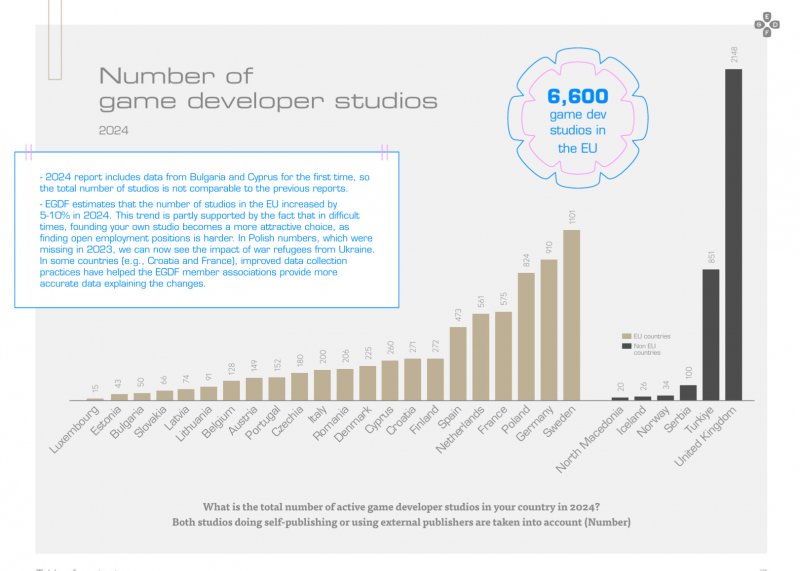
European video game industry Despite the difficulties the industry has faced in recent years, it has shown some resilience. according to 2024 European Video Game Industry Insight ReportData released by the European Game Developers Federation (EGDF) in partnership with Video Games Europe (VGE) shows that in 2024, the EU has about 6,600 studios, capable of employing more than 95,000 people, with a total turnover of 24 billion euros.
grow
The report, presented in Brussels on August 21, 2026, collects aggregated data for 28 European countries in 2024: Austria, Belgium, Bulgaria, Croatia, Cyprus, Czech Republic, Denmark, Estonia, Finland, France, Germany, Iceland, ItalyLatvia, Lithuania, Luxembourg, the Netherlands, North Macedonia, Norway, Poland, Portugal, Romania, Serbia, Slovakia, Spain, Sweden, the United Kingdom and Turkey.

The study, submitted by two organizations, is the only comprehensive report dedicated to the state of the gambling industry in Europe and constitutes one of the main sources Monitoring the evolution of mainland’s video game development ecosystem.
Ubisoft CEO says abandoning discs ‘won’t disrupt’ video game industry


Data for 2024 show a mixed picture. In some countries, the industry continues Increase in turnover and number of studiescontributing to overall results that improve European standards. On the employment front, however, the picture is less optimistic: layoffs, corporate consolidation and reduced employment have led to a significant economic shutdown and, in some markets, slight reductions in headcount. The report said it was the first employment decline in the industry after several years of growth.
The 2024 edition also includes the following data for the first time: Bulgaria and Cyprus. The latter is particularly prominent in terms of the total amount of economic activity related to video games, with a total turnover of 4.3 billion euros, which makes it occupy an important position in the center of the EU video game industry.
Sweden However, it holds the European record for the number of studies within the EU, with more than 1,100 companies and development entities. However, this figure is significantly lower than in the UK, which has around 2,100 studios and confirms itself as the main European center in this regard.
In terms of human capital, Poland is the EU’s main talent poolwith nearly 15,000 game industry employees. Outside the EU, Türkiye has also reached considerable size. However, the UK remains a clear leader across the continent, with over 28,000 professionals in the field.
The geographical distribution of talent also confirms the importance of some large centers. Istanbul is the main European hub with over 9,300 professionals, followed by Warsaw with approximately 6,300 professionals, London and Stockholm with approximately 5,900 professionals each, Barcelona with 5,300 professionals and Paris with approximately 5,000 professionals.
As for Italy, by 2024 it will be positioned as a growing market with positive signs in terms of employment, turnover and training. However, it still Behind major European players in terms of scale and public support instruments, especially in R&D and new start-ups. However, the Italian industry shows some potential for development, especially if supported by further incentive policies and investment.