
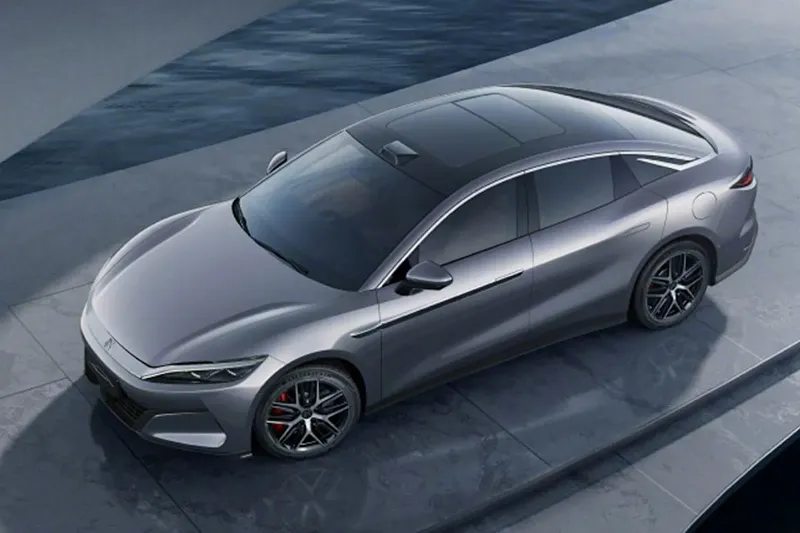
TrendForce data shows that China’s BYD has once again become the world’s largest seller of electric vehicles and will surpass Tesla again in the second quarter of 2026. The American company’s global sales of electric vehicles increased by 25% year-on-year, but even that was not enough to retain first place.
Notably, Tesla only recently returned to the top spot. By the end of the first quarter of 2026, it will be able to lead BYD, which is facing declining sales in China’s domestic market. However, by the second quarter, the positions of the two companies had changed again: BYD returned to the first place among pure electric vehicle (BEV) manufacturers, while Tesla fell to second place.
At the same time, BYD’s electric vehicle sales were still lower than last year’s level, but the decline was significantly narrower than in the first quarter. One of the key factors for the Chinese automaker is expansion beyond the domestic market. In the first half of 2026, BYD’s exports accounted for 44% of its output, highlighting the increasing importance of overseas sales to the company.
Overall, China, as the world’s largest new energy vehicle market, is experiencing a period of relatively weak demand. In the second quarter, China accounted for 56% of global sales of electric vehicles, plug-in hybrids and fuel cell vehicles, up from 66% in the same period last year. TrendForce said that it is increasingly difficult for Chinese manufacturers to grow solely on domestic demand, and expanding sales capabilities overseas is becoming one of the main factors in competitiveness.

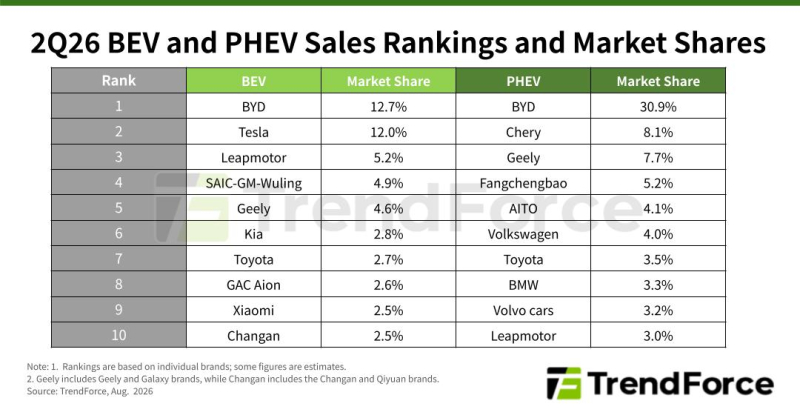
Against this background, the balance of power among other electric vehicle manufacturers is also changing. China’s Zero sports car rose to third place in the world for the first time, although its sales are still mainly concentrated in China. Stellantis, the company’s largest shareholder, provides the company with European production, sales and distribution infrastructure, which will support further international expansion.
Toyota’s sales of electric vehicles are growing particularly rapidly. In the second quarter, the Japanese company ranked seventh, with sales growing 143% compared with the same period last year. TrendForce attributes this achievement to Toyota’s well-developed global dealer network, which allows it to quickly launch new models into various markets. Meanwhile, Volkswagen fell out of the top 10 global electric car sales for the first time, which analysts said raised questions about the German group’s electrification strategy.
BYD also maintained its leading position in the global plug-in hybrid (PHEV) market and expanded its lead over competitors. The battle for second place and subsequent positions is even fiercer: most manufacturers after BYD have shares separated by less than one percentage point.
Europe is becoming a particularly important market for Chinese plug-in hybrid manufacturers. Domestic sales of Chinese plug-in hybrids are declining, and the EU has not imposed additional tariffs on Chinese-made plug-in hybrids. In the second quarter, excluding Geely’s Volvo Cars, Chinese brands accounted for nearly 30% of the plug-in hybrid market in Western Europe. TrendForce believes that this shows that European buyers’ attitudes towards Chinese cars have changed and that the traditional advantages of local manufacturers have gradually weakened.
Overall, global new energy vehicle (NEV) sales (pure electric vehicles, plug-in hybrid vehicles and hydrogen fuel cell vehicles) reached 5.37 million units in the second quarter, an increase of 10.4% compared with the same period last year. If traditional hybrid vehicles (HEVs) are included, these four categories of electric vehicles account for 33.2% of global car sales, a record high.
If you find an error, select it with your mouse and press CTRL+ENTER.