

According to Live Direct Marketing, the number of large organizations with self-hosted email servers has halved over the past 10 years. If DNS records are to be believed, they’ve essentially been replaced by Google Workspace and Microsoft 365. Report Register.
researcher analyzed MX, DMARC, and SPF records in the dataset collected by OpenINTEL, taking into account Tranco’s list of most popular domains. Email service providers, email platforms and SaaS are all considered. The data used covers the period since 2016, but it is still not possible to get a complete picture of all mail servers used. However, it can be concluded that in 2016, 44.6% of the million most popular domains used their own mail servers, whereas now we are talking about only 22.4%.
The number of owned mail servers is declining rapidly, down 0.5 percentage points. Once every 30 days. They still dominate the overall population, but are closely followed by Google Workspace (21.8% share) and Microsoft 365 (16.8% share). The company highlighted the fact that these two tech giants accounted for a staggering 38.6% share of email. The closest competitors, Proofpoint and Yandex 360, accounted for only 1.9% and 1.6% respectively.

Photo credit: Brett Jordan/unsplash.com
It’s important to stress that there has been discussion for years about the over-centralization of DNS and CDNs, but email-related services are evolving along the same path, although this is less obvious from the outside. When more than one-third of popular domains rely on two providers for their email functionality to receive and send mail, a failure, filtering change, or policy change in either one can immediately impact the entire ecosystem. Unlike CDNs, email has few fallbacks—rejected messages simply disappear.

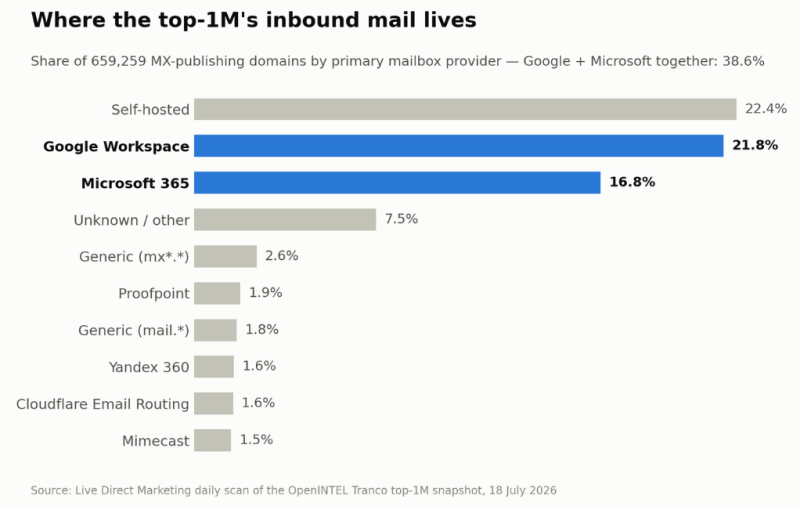
Image source: RIPE Labs
Furthermore, as the world’s email delivery system becomes increasingly optimized for the two largest players, the fewer independent operators left, the more problems the remaining operators face. Anyone trying to deploy their own email server in 2026 knows the challenges they face. Google and Microsoft use filters to identify messages from sources they consider unreliable. If they don’t accept messages from self-configured servers, their own services will become increasingly attractive, as companies that value email delivery accuracy will switch to providers who are more likely to deliver their messages.
Another cause for concern is the careless handling of DMARC records. Research shows that more than half of the records either have no real strategy for filtering emails or simply “monitor” for violations without requiring blocking of suspicious emails. Although Google and Yahoo changed their requirements for bulk email senders to require corresponding records in 2024, DMARC adoption remains low.
source: