
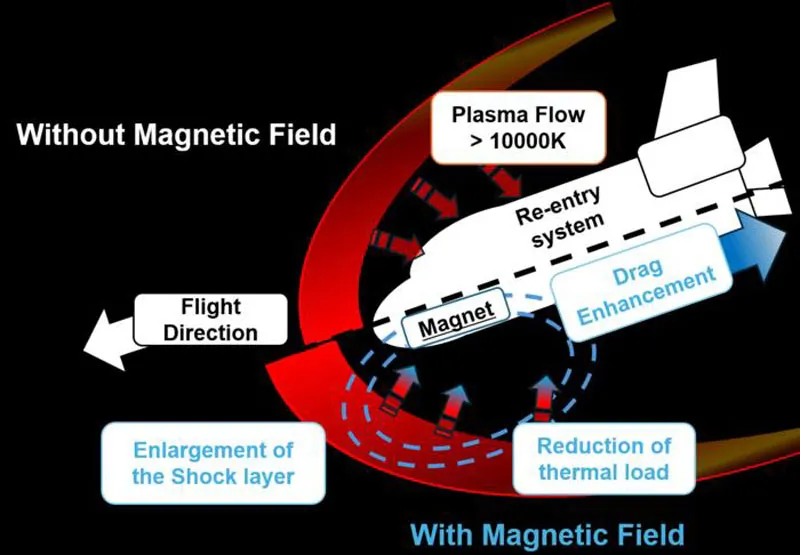
Researcher at Tokyo Metropolitan University Created A ground-based experimental facility for testing magnetohydrodynamic braking (MHD) of spacecraft during re-entry. The idea is to use the ship’s magnetic field to protect the craft from heat and provide additional braking, like a force field from science fiction, and it works.
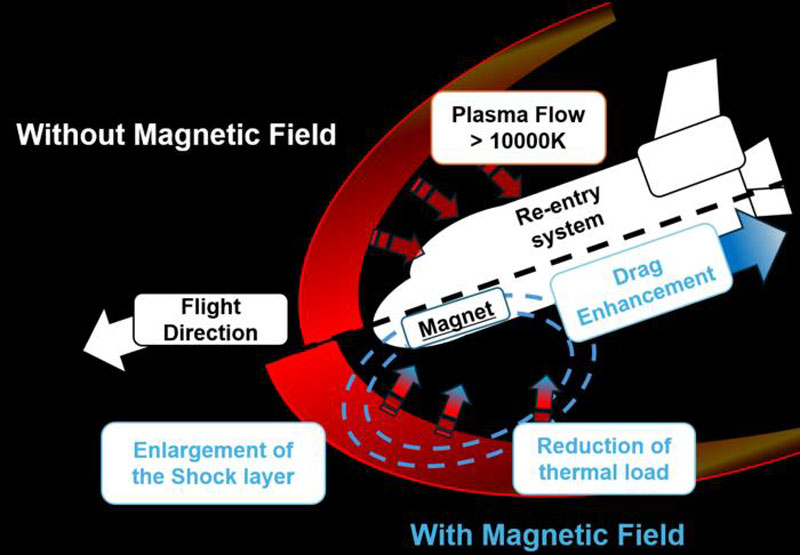
Image source: Tokyo Metropolitan University
After entering the atmosphere, a shock wave forms in front of the descending aircraft, and the air in the shock layer is heated to thousands of degrees and partially ionized. The spacecraft’s magnetic field is able to interact with this flow of weakly ionized plasma, pushing the thermal shock layer farther away from the vehicle’s surface while increasing its aerodynamic drag. This reduces the increased heat shield requirements for the reentry vehicle and creates free resources for deceleration.
In all previous experiments, scientists placed permanent magnets inside small models to simulate the ship’s magnetic field. This limits the range of the magnetic fields and does not allow them to change their configuration quickly. A team led by Kohei Shimamura replaced the permanent magnets with pulsed electromagnets composed of a set of specially selected coils. To power it, a pulse circuit is used, capable of delivering high current for a short period of time.
The test platform synchronizes the activation of the magnet with the passage of the shock wave. In this case, the ship model was placed in a hypersonic wind tunnel with airflow speeds exceeding 7 km/s, which is equivalent to the speed of the surrounding gas when the ship actually enters the atmosphere. In experiments, the impact of traffic on the model lasted only tens of microseconds, but this was enough to identify trends.
During testing, two models with different geometries were used with different coil configurations. Pulsed electromagnets produce magnetic fields of 1.24 and 1.58 Tesla. The latter value is more than twice the magnetic field of a conventional neodymium magnet, which significantly expands the range of experimental parameters. High-speed cameras operate in sync with the shock waves, recording the glow of the heated shock layer itself. When the magnetic field is turned on, the thickness of this luminescent layer increases by more than 15% – experimental evidence that the plasma region is indeed moving away from the model surface.
For reentry spacecraft, this development could have a dual effect: The magnetic field could increase the distance between an object and the hottest parts of the shock layer, reducing heat flow to the surface, while increasing aerodynamic drag and redirecting some of the vehicle’s kinetic energy to heat the atmosphere. Unlike traditional thermal protection based on heavy tiles and ablative materials, the MHD Air Brake theoretically reduces the weight and wear of thermal protection, which is very interesting for reusable devices.
However, at the moment we are talking about laboratory tests of miniature models, but the authors believe that the creation of electromagnets with controlled magnetic fields up to 1.58 Tesla is the next step in conducting larger-scale model experiments and a transition in the future to testing the technology when real spacecraft return to the atmosphere.
If you find an error, select it with your mouse and press CTRL+ENTER.