
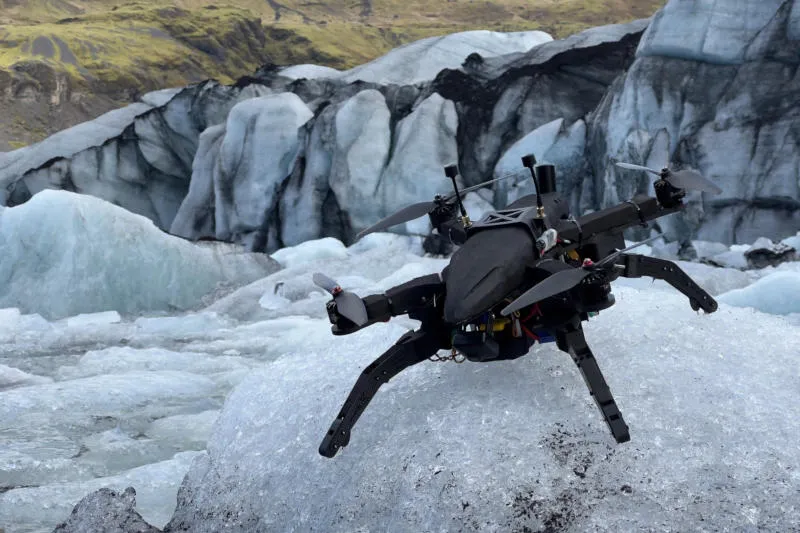
Engineers at the University of Sherbrooke (Quebec, Canada) have developed a drone that can land on a variety of surfaces, even icy cliffs with steep slopes – and it uses cat-claw-shaped spikes to attach.
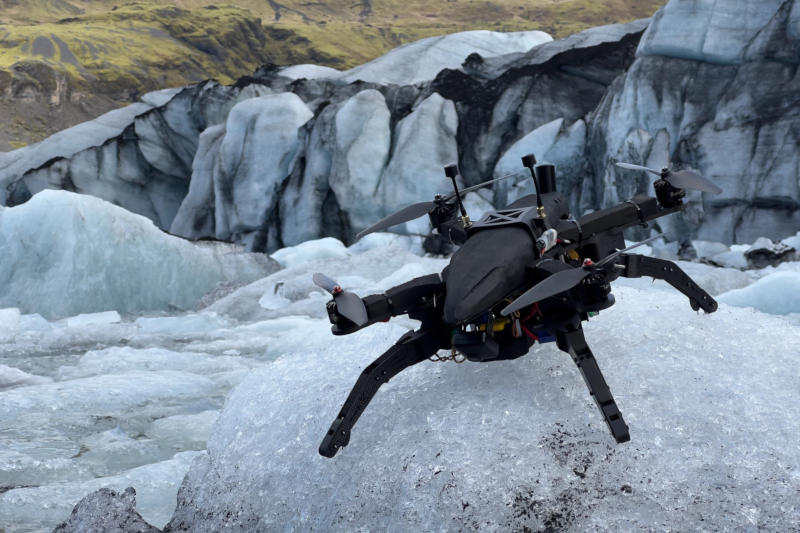
Image source: University of Sherbrooke
Three technologies ensure the Ice Dart has a tight fit on steeply sloping ice. First, the drone is equipped with four cross-shaped carbon fiber legs, weighing 2.65 kilograms, with spring spikes at the ends that point in different directions. When landing in different directions, one or the other spike is activated and the operator does not need to calculate the ideal approach angle.

Secondly, it is a shock-absorbing chassis with 28 friction discs that can absorb impact and prevent the drone from bouncing. This is important because if the support is still pressed against the ice, the nails will be able to dig into the ice. Third, upon contact, the propellers briefly change the direction of their thrust, pushing the drone away from the wall and helping the pegs to hold themselves in place, which is important on particularly steep slopes where gravity alone isn’t enough.
The Ice Dart was tested on a glacier in Iceland, with temperatures ranging from 0 to 10°C and wind gusts in excess of 30km/h, and it completed 24 landings on slopes up to 58° without any errors. In controlled laboratory tests on slopes up to 60°, it was able to cope with the task at a landing speed of 3 m/s. In fact, such equipment could be used to track icebergs – drones fixed to the ice could operate for long periods of time. Indeed, during testing the Ice Dart was observed using a second navigation drone, and the car has not yet been tested on a real iceberg.
If you find an error, select it with your mouse and press CTRL+ENTER.