
The boom in artificial intelligence systems has driven strong demand for many types of semiconductor components, many of which are produced by contract manufacturers, whose revenue last quarter increased 11.5% quarter-on-quarter to $53.49 billion, ranking among the top 10 in the market.
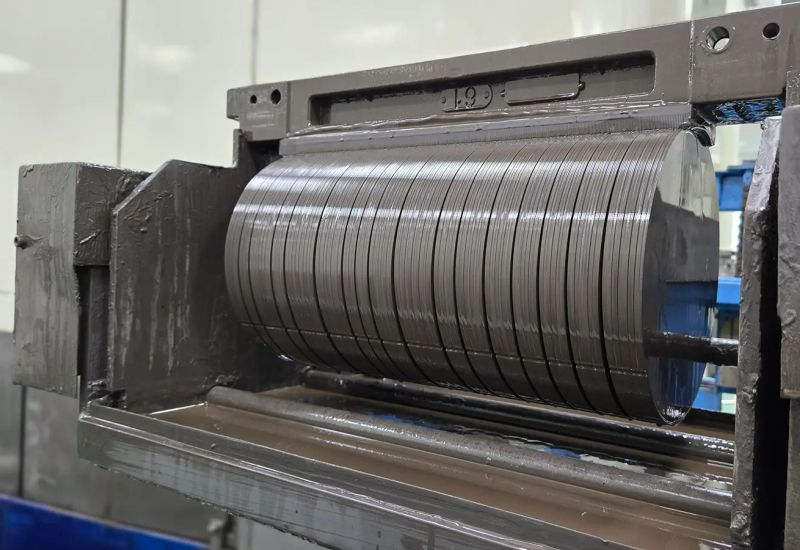
Image source: TSMC
These statistics are published by the resource TrendForce Just before the release of TSMC’s August report. The company dominated the contract chip manufacturing market in the second quarter, increasing its share from 72.3% to 72.5%. TSMC’s quarterly revenue increased 12.1% quarter-on-quarter to US$40.2 billion. Its 5nm, 4nm and 3nm production capacity has been fully reserved by customers. The company reported revenue from 2nm product sales for the first time, and Apple’s preparations for the launch of the iPhone 18 series yesterday should play a role in this regard. TSMC’s silicon wafer processing volume and product average selling price both increased in the second quarter.
The shortage of memory chips seems like it should reduce demand for chips for laptops and smartphones, but TrendForce experts point out that device makers are trying to buy components for future use in anticipation of further price increases. This has even led to higher prices for wafer production services using mature photolithography technology. Autumn is traditionally a time of new model launches for consumer devices, and in the area of artificial intelligence infrastructure, the start of deliveries of early-announced solutions will contribute to further revenue growth in the quarter.
Samsung’s revenue in contract chip manufacturing rose 1.8% quarterly to $3.26 billion, but under pressure from competitors, the company actually dropped its core services market share from 6.5% to 5.9%. Among them, China’s Semiconductor Manufacturing International Corp. deserves attention. The company’s revenue in the last quarter increased by 20% to US$3 billion, and its market position increased from 5.1% to 5.4%. In fact, from a monetary perspective, the Chinese manufacturer doesn’t have much time left to grow to Samsung’s level.

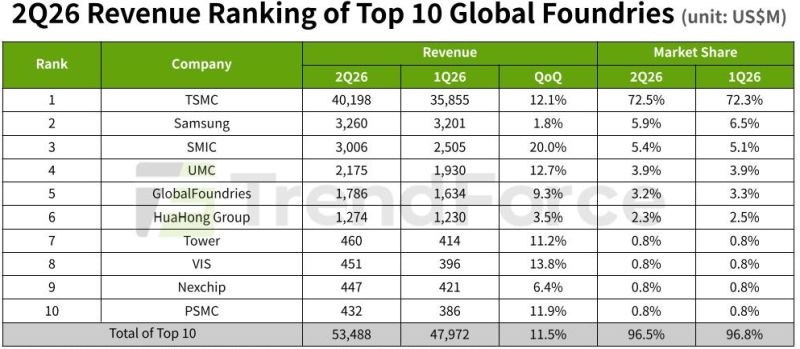
Image source: TrendForce
Taiwan’s UMC is still the island’s second-largest foundry in terms of revenue after TSMC. In this context, it has been firmly in fourth place with a 3.9% share for several consecutive quarters without declining, which is important. From a formal perspective, UMC’s second-quarter revenue increased by 12.7%, slightly stronger than TSMC, but in absolute terms, the amount was limited to US$2.2 billion.
American GlobalFoundries, ranked fifth, saw its share of the global contract services market drop from 3.3% to 3.2%, but at the same time, its revenue continued to grow by 9.3% to US$1.8 billion. Overall, the market situation is such that even “second-tier” foundry chip manufacturers can achieve sustained revenue growth of more than 10%. Ranked sixth is also a typical Chinese company (Huahong Group), although the company’s revenue only increased by 3.5% to US$1.27 billion, and its market share continued to decline from 2.5% to 2.3%.
Ranking seventh to tenth are Taiwanese chip manufacturers. Their second-quarter revenue is similar, and their global market share is also the same, which remains at around 0.8%. It turns out that all revenue is concentrated in the hands of six major players. Moreover, the top ten contract chip manufacturers account for 96.5% of global revenue. First, the number is slightly higher (96.8%), showing that players outside the top ten are capable of resisting this consolidation.
If you find an error, select it with your mouse and press CTRL+ENTER.