

NASA’s Curiosity Mars Rover Found Gale Crater’s Mount Sharp slope contains unusually wide and shallow depressions in the bedrock. Some of them are shaped like giant footprints, but they have nothing to do with hypothetical Martian life. At the same time, these structures are unlike anything Curiosity has previously discovered on the surface of Mars, which is very interesting to scientists.
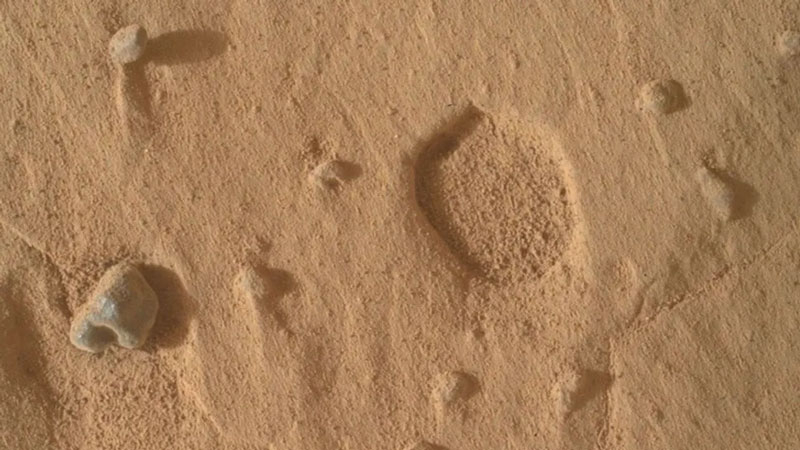
Image source: NASA
What is unusual about this discovery is precisely their appearance. Small craters and depressions are common on the Martian surface, but the new structures are wider and shallower, and nothing found near them that could leave such a mark and then disappear over time — fly rocks, weathered rocks or anything else. This rules out simple explanations for the form of weathering marks around a single boulder and forces us to look for another mechanism for its formation.
With the help of scientists, Curiosity used a variety of scientific instruments to conduct the most in-depth study of the anomalous area. The MAHLI camera provides detailed close-up images of the surface, the Mastcam provides an overall overview of the surrounding area, and the ChemCam and APXS alpha X-ray spectrometer provide insights into the chemical composition of the material. Preliminary data show that these depressions contain interesting layered structures that are chemically different from the surrounding bedrock.
So far, researchers have not determined the exact process by which these “imprints” are formed or how long they last. First, their origins are important for reconstructing Mars’ geological history: Differences between the material of the craters and the surrounding rocks may indicate processes of weathering, erosion, or chemical changes after the rocks were formed. Therefore, Curiosity will continue to study such structures to determine how they formed and to understand the conditions that existed in the Mount Sharp region in the past.
If you find an error, select it with your mouse and press CTRL+ENTER.