
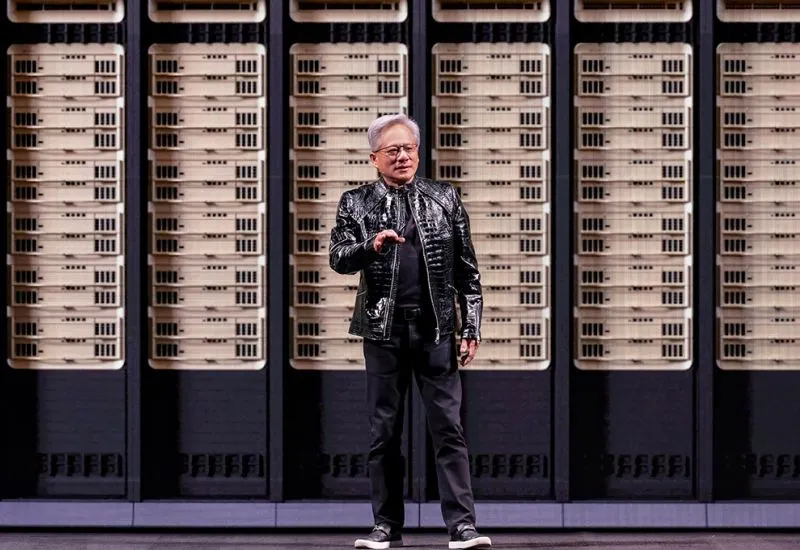
Since 2019, ASML ultraviolet (EUV) lithography equipment has been banned from shipping to China, and no such systems have been delivered to China through official channels. Nvidia founder Jensen Huang firmly believes that by 2030, the Chinese will have built the appropriate equipment themselves and be able to use it to produce chips using advanced technologies.
Image source: NVIDIA
“They’re going to get there by 2030. It’s actually just around the corner. One has to think that China is pretty good at mass production. It’s just a matter of time, so two or three years is actually a blink of an eye and can be ignored. As long as they care about that, they’re already in the right place.” – Nvidia CEO described China’s capabilities in developing advanced lithography technology on the All-In podcast, which was mentioned by Tom’s Hardware and several bloggers.
Huang also appreciates the potential of Chinese artificial intelligence modelers, but in the field of semiconductor manufacturing, he may have overestimated his peers. as explained Tom’s HardcoreChinese lithography system supplier SMEE can currently only provide dry lithography scanners equipped with 193 nm laser light sources, which can only be used for the production of 90 nm wafers. While SMEE is believed to have developed an immersion lithography scanner capable of producing 28nm wafers, there is no public evidence that the company has the ability to supply such equipment in high volumes.
Even if such equipment reaches Chinese chipmakers this year, mass production of components with its help will not be possible until 2028 or 2029. Overall, even in the field of immersion lithography with deep ultraviolet radiation sources (DUV), similar Chinese equipment is unlikely to be on par with modern ASML systems by 2030. In the field of advanced EUV lithography, Chinese equipment suppliers are further behind as they do not even have functional prototypes of outlines yet. scanner. However, if the rumors are true, Chinese experts have been able to develop a laser radiation source with a wavelength of 13.5 nm. But due to the lack of prospects for obtaining similar equipment from abroad, Chinese manufacturers can only rely on the success of import substitution. In this sense, narrowing the gap with Europe and the United States is actually only a matter of time.
If you find an error, select it with your mouse and press CTRL+ENTER.