
NVIDIA, Google and Emerald AI announce creation association Artificial Intelligence Energy Management Alliance (AEMA). Accelerate the development of artificial intelligence data centers and optimize and adjust energy consumption based on the current status of the power system. The AI data center will interact with the network and change the load if necessary. NVIDIA believes this will help quickly connect new capacity, improve power system reliability and more efficiently utilize available infrastructure.
NVIDIA said that traditional network solutions require fairly stable power consumption for facilities, but artificial intelligence data centers are not one of them. At the same time, their computing load can be changed arbitrarily, shifting calculations, using energy storage systems, responding to events in the power system, etc. This would allow more efficient use of the available grid, reduce energy consumption during peak load periods on the power system, and even postpone costly infrastructure upgrades. In addition, connecting large artificial intelligence data center networks becomes more secure and faster.
Meanwhile, The Register experts pay Please be aware of NVIDIA’s own limitations. Only if the data center gets enough power can the company sell more and more AI accelerators. Therefore, NVIDIA strives to make the most of every gigawatt of resources. For example, a typical 100 MW data center reserves up to 20% of capacity to compensate for equipment inefficiencies, energy conversion losses and demand surges.
Image source: NVIDIA
One solution is the DSX MaxLPS platform, which allows you to use more AI accelerators within a given “energy budget.” It coordinates the operations of computing and physical infrastructure, elements of which can exchange data on each other’s operations, thereby reducing energy consumption based on, for example, the actual load on the server, without having to continuously run at maximum power. The DSX Exchange API also allows you to use compatible third-party components, including . Vertiv and Schneider Electric Equipment.
DSX Flexible Directly ensures the interaction between the data center and the power system. NVIDIA, Emerald AI and Silicon Valley Power proved When load on the grid increases, some data center capacity can be temporarily freed up without stopping critical computing. Similar experiments carried out successfully National Grid, Emerald AI and Nebius. At the rack level, NVIDIA and Lambda have proven that this smart orchestration can accommodate more compute modules within a given power budget—19 instead of the usual 16—while increasing performance per watt by about a quarter.
Formally, there is nothing fundamentally new about the proposed technique. Google tested this system back in 2023 redistribute Data center load during peak hours. I did the same thing и Microsoftbut in both cases the problem is the processing of non-urgent background tasks over time or shifting between data centers. Google in 2026 modern Power management of its U.S. data centers adds the ability to regulate energy consumption more flexibly, supported by contracts with multiple energy companies.

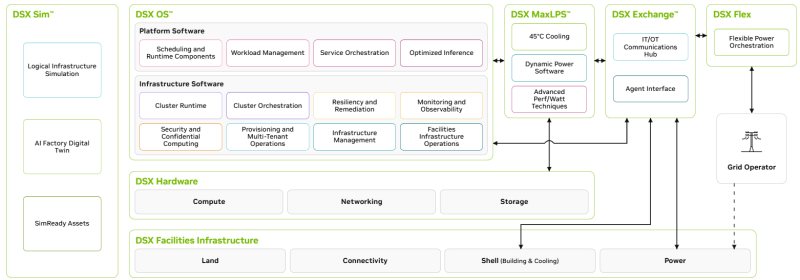
Image source: NVIDIA
NVIDIA intends to integrate this capability into data center AI infrastructure by default. For the company, the focus is not only on reducing the load on the energy grid, but also on optimizing connections with energy companies. It is assumed that if they knew they could quickly disconnect part of the load, they would be able to simplify the connection of new capacity. However, this does not completely shut down the data center, as critical tasks will be performed and non-essential loads will be suspended or moved to other data centers.
The AEMA Alliance should complement technology solutions by developing common rules for the interaction of AI data centers with power systems, including energy regulation and emergency response issues. It is also expected to standardize the exchange of technical requirements, performance indicators and operational data.
AEMA is positioned as a technology-neutral program because requirements will not be determined by the use of any particular hardware or software, but rather by the measured characteristics of the data center – from speed of response to emergencies to the predictability and duration of available load reductions. If a facility can demonstrate “flexibility,” simpler and faster procedures for connecting to the grid can be created for it, taking into account the actual risks and benefits of the grid.
Source: