
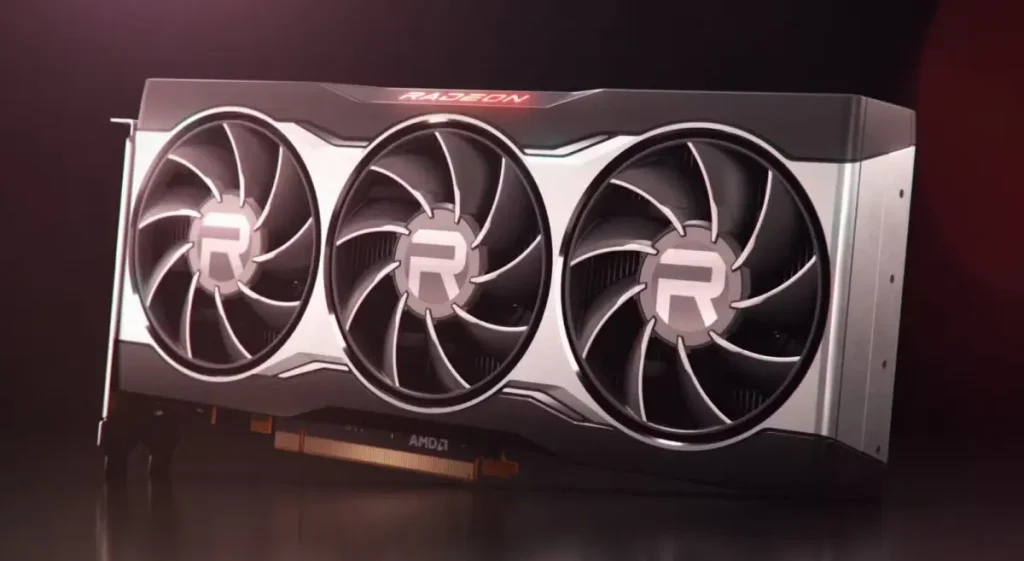
AMD Demonstrates a new ray tracing technology that has the potential to significantly reduce video memory requirements when processing extremely complex and dynamic scenes. The company demonstrated how a customized tetrahedral unit approach can process millions of animated triangles at a stable frame rate, with a huge difference in memory consumption compared to traditional approaches.
While AMD has yet to announce that this technology will be implemented in specific commercial games, this development could be particularly interesting for projects with lots of vegetation, distant objects, and characters using complex geometry. How actively developers will use the new system in practice remains unknown.

AMD remains one of the largest manufacturers of processors and graphics accelerators. The company’s chips aren’t just for PCs—AMD also provides the hardware platforms for modern computers. PlayStation 5 and Xbox Series X|S. At the same time, the main share of the computer independent graphics card market still belongs to NVIDIA. The flagship GeForce RTX 5090 is still an extremely expensive solution: at some third-party sellers, it costs more than $6,500. By comparison, the Radeon RX 9070 XT can be purchased from retailers for around $799.
AMD’s new advancements are related to further developments in how ray tracing geometry is handled. As company employee Holger Gruen explained in an interview with GPUOpen, the technology uses tetrahedral units, which allows you to efficiently handle animated objects while significantly reducing the amount of data that needs to be stored in video memory.
As a demo, AMD showed off a scene filled with vegetation and trees, consisting of a large number of triangles. On a Radeon RX 9070 XT with 16 GB of GDDR6 memory, the test was able to run at over 60 frames per second at 1920×1080 resolution. However, the main outcome of the experiment is not the frame rate itself, but the amount of memory used.
Using tetrahedral elements, only a demonstration scene is required Approx. 1.7 GB display. For comparison, a similar task using a clustering approach requires More than 80 GB. The difference therefore reaches tens of times, which is especially important for modern games, where VRAM capacity becomes one of the limiting factors when dealing with ray tracing and highly detailed geometry.

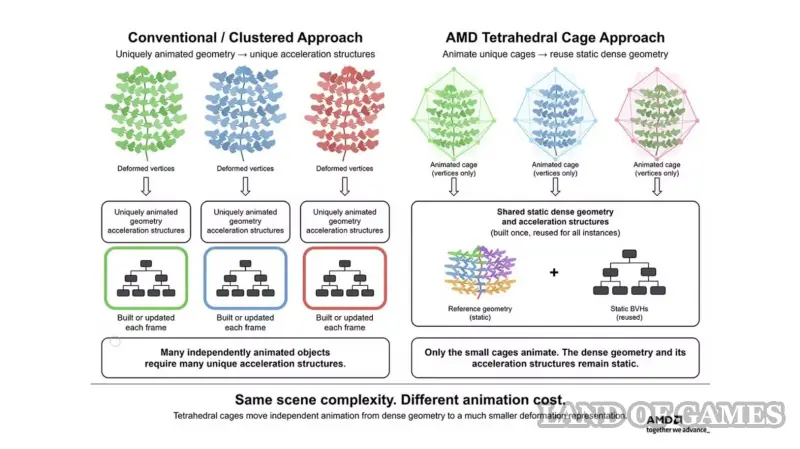
At the same time, AMD does not consider tetrahedral units to be a universal replacement for the cluster approach. Each method has its own advantages. Cluster systems give developers more precise control over vertex animation, and the new technology is particularly effective in situations where large numbers of dynamic elements need to be processed quickly. In particular, one of the potential uses is vegetation and features located at considerable distances.
Interestingly, this optimization is not only useful for owners of modern PCs. If the technology is integrated into game engines and becomes widely available among developers, it could also impact the console industry. Sony and Microsoft have confirmed further collaboration with AMD on their future gaming platforms. At the same time, AMD announced its own processors using Zen 6 architecture and RDNA 5 graphics cards in the next generation.
This development may become particularly important in the context of the ever-increasing memory demands of modern gaming. Reducing VRAM consumption will allow developers to create richer scenes without proportionally increasing the amount of video memory, which may make projects easier to run on slower and older graphics cards.
However, right now we’re specifically talking about a tech demo, not a feature that’s already in mainstream games. AMD has demonstrated the capabilities of its approach in controlled tests, but the real impact will depend on game engine support and developers’ desire to integrate the new system into their projects. If the technology does prove to be practical, the benefits could be seen when creating games for next-generation hardware.