


AMD has introduced a new ray tracing technology called tetrahedral cage method that can significantly reduce video memory requirements and process millions of animated triangles at stable frame rates.
AMD academician Holger Gruen published an article on the GPUOpen portal website saying that this method was demonstrated using dense grass and trees as examples, showing a performance of more than 60 frames per second at 1080p resolution on a Radeon RX 9070 XT graphics card.

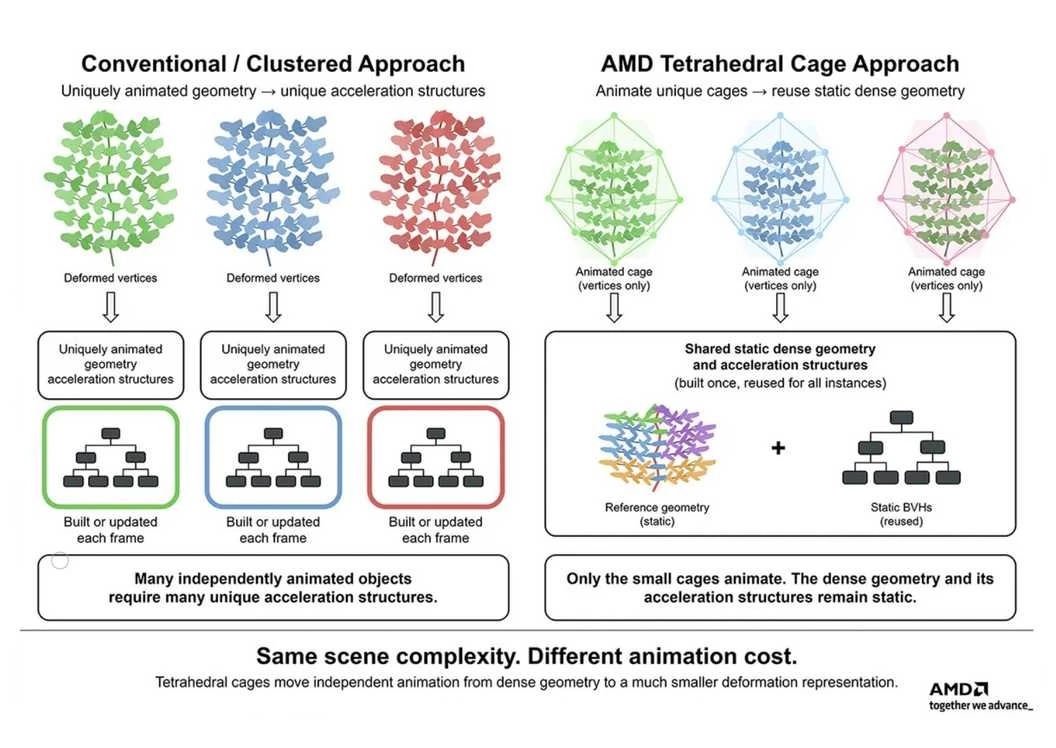
The main advantage of the new method is its incredible efficiency: if traditional clustering methods for similar scenes require more than 80 GB of video memory, tetrahedral cells reduce this number to 1.7 GB. Given the current crisis in the memory market and the high cost of components, such optimizations could have a huge impact on PC gaming and future consoles such as the PlayStation 6 and Microsoft devices based on the RDNA 5 architecture, although the timing of the technology’s implementation in actual games has yet to be determined.
How do you assess the prospects of AMD’s new technologies? In your opinion, does the modern gaming industry urgently need ways to optimize video memory consumption?