

Chinese company Xinao Group report Thermonuclear reactions were obtained using hydrogen boron fuel on the experimental spherical tokamak EXL-50U. According to the company, this is the first time that a private developer has been able to independently initiate such a response, with an intensity exceeding 100 million reactions per second. The experimental results were announced on September 28, 2026.
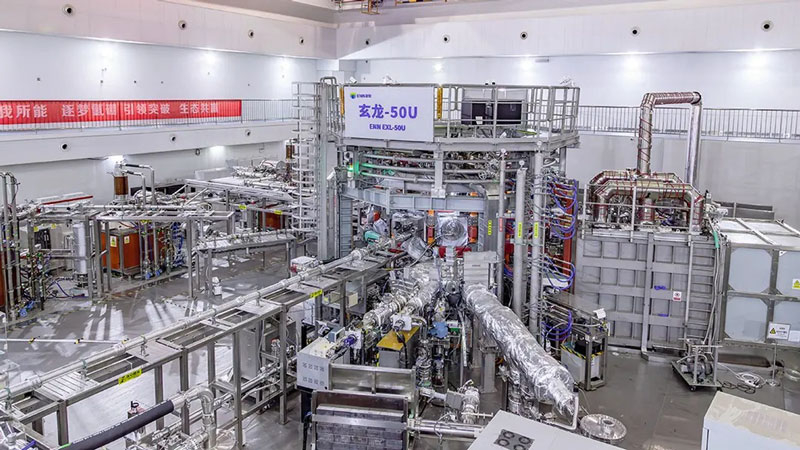
Image source: Xinao Group
In the hydrogen-boron cycle, protons of ordinary hydrogen collide with the nuclei of the isotope boron-11, resulting in the formation of three alpha particles (helium nuclei) and the release of energy. Unlike the most common deuterium-tritium reaction, this reaction does not produce a high-energy neutron stream, which can contaminate the reactor’s structural materials with radiation, making such a process truly environmentally friendly. In addition, hydrogen and boron are easier to obtain than tritium, which is radioactive and almost non-existent in nature.
The main problem with hydrogen-boron fusion is that the proton-boron-11 reaction requires more stringent plasma confinement than the deuterium-tritium reaction. Therefore, ENN experts did not try to heat the entire plasma in the reactor to extreme temperatures, although they will still use this method in the next stage of testing.
In the EXL-50U experimental device, they used high-energy neutral atom injection and radiofrequency heating simultaneously to generate a large number of fast protons in the plasma. Their energy falls in the first resonance peak region of the reaction with boron 11, which increases the probability of collision and increases the recorded reaction frequency to more than 100 million times per second. A reliable confirmation of a fusion reaction is the recording of those same alpha particles – free helium nuclei – produced during the reaction.
It should be remembered that sufficient time is still required before energy is received from such a reaction and even before the energy output exceeds the cost of initiating the reaction. First, the number of responses obtained per second is evidence that the process was successfully initiated in a particular experiment. The company plans to continue improving plasma parameters, and its next major project will be the Helong 2 installation, with construction starting in September. The company expects to complete installation, commissioning and trial operation by the end of 2027, and plans to obtain the first batch of hydrogen-boron synthesized electricity in 2030.
If you find an error, select it with your mouse and press CTRL+ENTER.