

astronomer first Compelling evidence has been obtained that mysterious bursts of rapid X-rays can occur during neutron star collisions. The latest European-Chinese X-ray telescope, the Einstein Detector, helps. The discovery links the nearly ten-minute X-ray burst EP250704a/GRB 250704B to a possible merger of two neutron stars.
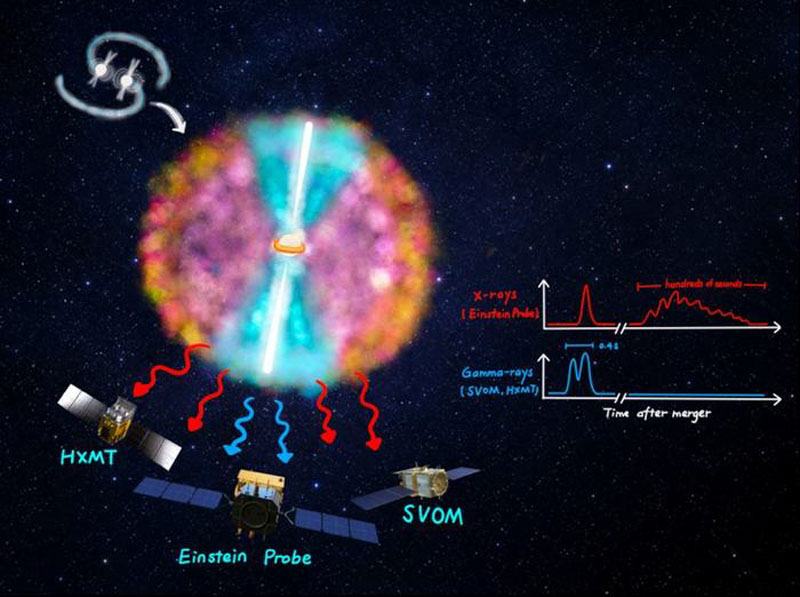
Image source: “Science Bulletin 2026”
Key to the solution are operational observations from ground-based telescopes. Within minutes of receiving the signal, the team began observations using the European Southern Observatory’s Very Large Telescope (VLT) in Chile and other observatories. The X-shooter spectrometer breaks down the flare radiation into wavelengths and detects the characteristic absorption lines of iron and magnesium. Their displacement makes it possible to determine the redshift of the light source z = 0.6610. This means that the radiation traveled more than 6 billion light-years before reaching Earth. As a result, astronomers were able to determine not only the characteristics of the flare, but also its cosmological distance, which provided all the necessary data to accurately model the event.
Just in case, scientists searched the area where the event occurred for signs of the supernova, which also produces flashes in the X-ray range, but found nothing. Combined with the nearly 10 minutes of X-ray emission duration and the measured distance, this suggests another scenario – the merger of two neutron stars. These objects are ultra-dense remnants of massive stars, and their collisions are accompanied by the release of powerful energy and gravity waves. The problem with observing them is that, under normal conditions, they are invisible to optical and other ranges. In effect, astronomers look at an empty patch of sky and make hypotheses about what is happening there based on indirect data.

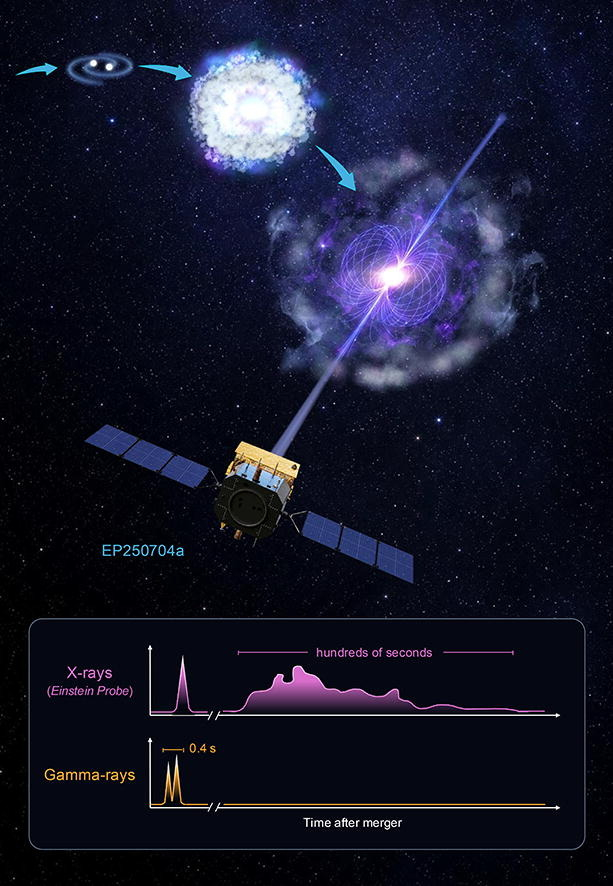
Researchers speculate that the collision may have produced a magnetar, a rapidly rotating neutron star with an unusually strong magnetic field. In this case, rotational energy and magnetic fields are able to fuel ambient radiation over long periods of time, explaining the unusually long X-ray flares. Previously, the main electromagnetic signature of neutron star mergers was thought to be short gamma-ray bursts lasting less than two seconds, but EP250704a shows that such events may produce longer-lasting X-ray emissions.
The development of gravitational wave astronomy will help obtain more convincing evidence of the occurrence of X-rays during neutron star mergers. The merger of neutron stars creates powerful disturbances in space and time, manifested as the propagation of gravitational waves. This will help in the future to link such observations to X-ray signals and pinpoint events. But it will be a different story.
If you find an error, select it with your mouse and press CTRL+ENTER.