

astronomer Found HD 156295 is a hot blue-white star of spectral class A that may contain signs of a planet. If the discovery is confirmed, it would be the first known discovery of a planet in the habitable zone of such a massive star. The star HD 156295 is about 140 light-years from Earth, has a temperature of about 7500–7800 °C, and is about nine times as bright as the Sun. But these are not all the eccentricities of this remarkable man.
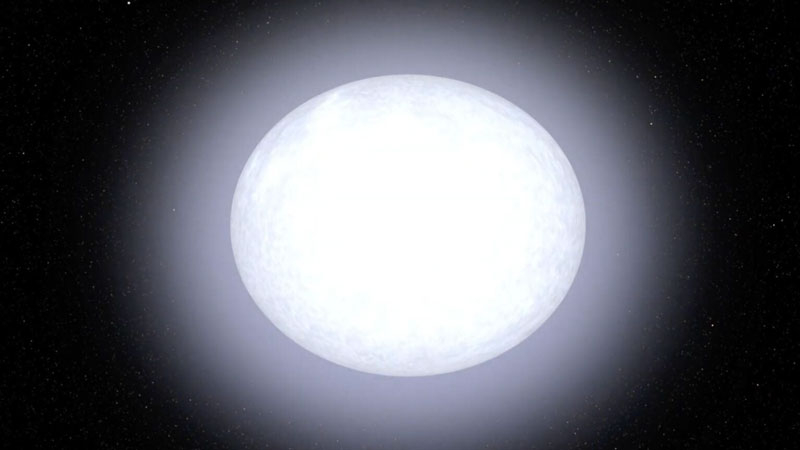
Artist’s impression of the variable star Delta Scuti. Image source: NASA
What’s unusual about this discovery has to do not just with the temperature of the star, but also with the method used to detect the planets. The researchers analyzed data from the TESS space telescope, which was originally designed to primarily look for transits, and studied nearly 16,500 pulsating (variable) stars, such as delta shield. The brightness of these stars changes regularly, so their pulsations can serve as a kind of cosmic clock. If there’s a massive object nearby, gravity forces the star to move slightly in its orbit, which is why the moment the pulsation reaches Earth varies periodically. This is exactly the periodic delay researchers found in HD 156295. In other words, the TESS instrument operates in an unusual way, which makes the discovery more interesting but also adds to the uncertainty.
Calculations show that the proposed exoplanet HD 156295 b takes about 2,200 days, or about six years, to complete one revolution and is about 3.9 astronomical units from the star. This is roughly equivalent to the distance between the Sun and the asteroid belt, but for the brighter star HD 156295, such an exoplanet orbits at the outer limit of the habitable zone.

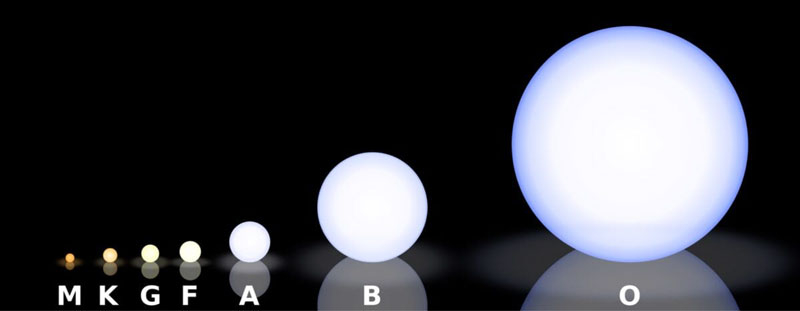
Size comparison of star types – The Sun is a star of spectral class G
Formally, there may be temperature conditions suitable for liquid water, but HD 156295 b itself is likely to be a gas giant several times more massive than Jupiter. So we’re not talking about a potential “Second Earth” but a planet that might have conditions suitable for life only on its moons, if at all. On the other hand, interesting organics might show up there, who knows.
For now, scientists are focused on the preliminary nature of the results: the chance that the detected signal is truly planet-related is estimated at just over 50%, and there are significant uncertainties in the object’s parameters. Additional observations should reveal whether the signal is caused by characteristics of the pulsating star itself or by other causes. However, this work demonstrates a new way to find massive planets around hot stars, where traditional methods of measuring radial velocity don’t work well enough for some reason.
If you find an error, select it with your mouse and press CTRL+ENTER.