

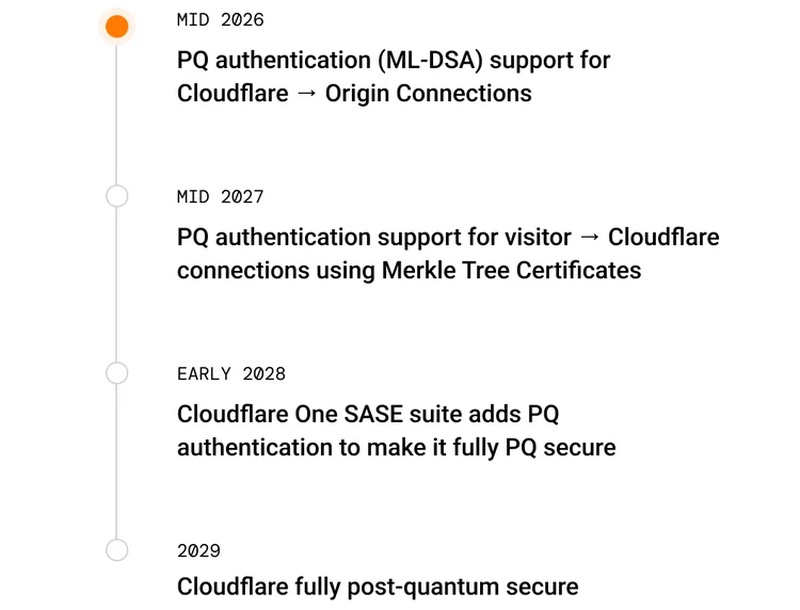
Cloudflare has announced plans to release TLS credentials that are resistant to quantum computer attacks. The company said it will use an open source platform that allows it to issue traditional TLS certificates and its successor quantum certificates, so-called Merkle Tree certificates. These hybrid certificates will be provided free of charge to all users.

Image source: Cloudflare
Cloudflare will use the already trusted root certificate from the GlobalSign CA. According to Cloudflare, the solution will allow millions of sites to start using post-quantum certificates almost immediately, without any impact on performance. Cloudflare’s plans are part of a major modernization of the Web Public Key Infrastructure (WebPKI) to ensure secure encryption and website authentication in the coming post-quantum era.
One of the main challenges is the use of quantum-resistant digital signatures that can be easily transmitted on demand and recorded in a transparent log. The modernization process will take several years as it requires the joint efforts of developers of numerous operating systems, browsers, certification authority software and infrastructure elements.

Securing WebPKI from quantum attacks is a difficult task that requires fundamental architectural changes, not just algorithmic changes. Using the post-quantum version of modern classic X.509 certificates will increase the amount of data transferred during the TLS handshake (the connection establishment process) at the beginning of a new session with the server by about 40 times. The additional computational cost and network bandwidth load required to implement such a system will cause traditional networks to collapse.
In February 2026, Google proposed using Merkle trees, hierarchical data structures that use cryptographic hashes and other mathematical methods, to use only a small part of them to verify the content of large amounts of information. Google and Cloudflare have tested this technology in limited pilot projects, which can reduce the amount of data transferred during connection establishment to about 40 KB, which is comparable to the size of the data currently being processed.

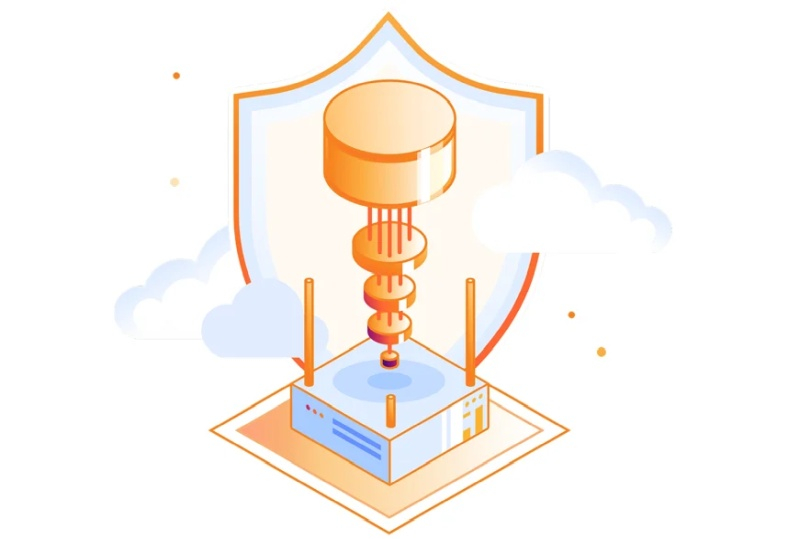
The current WebPKI system relies on multi-link signature chains for credential authentication and is vulnerable to quantum computer attacks. Since replacing these signatures with quantum-resistant signatures required excessive resources, these chains were replaced by compact proofs based on Merkle trees. To form such a certificate, the certification authority only needs to sign a “tree root”, which can represent millions of certificates. In most cases, browsers handle so-called “landmarks” – lightweight proofs that prove the certificate is somewhere within the tree.
Industry-wide regulations require that TLS credentials be published in a decentralized registry with the ability to add but not edit or delete entries (called a public transparency ledger). Website owners monitor these logs in real time to ensure that no unauthorized certificates have been issued for the domains they use. The transparency program was launched in response to a 2011 hack by Dutch company DigiNotar, which allowed attackers to issue 500 fake certificates for Google and other high-profile websites.

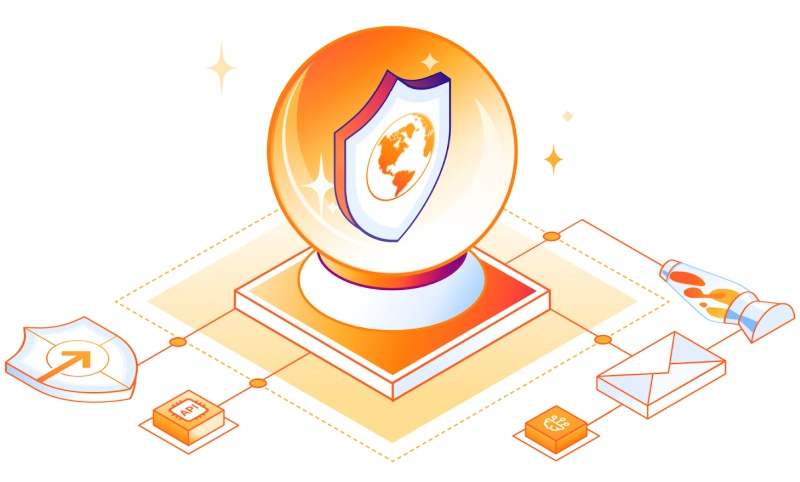
Under the current PKI system, updates are performed by adding new links to the signature chain. Merkle trees allow you to confirm the integrity of a signature chain without explicitly listing each individual link. This approach has another important advantage. In today’s systems, transparency logging is a separate process from issuing credentials. For certificates based on Merkle trees, registration in the log becomes an integral part of the issuance process.
Cloudflare’s plans include many other solutions. One of them is ACME (Automated Credential Management Environment), an open source mechanism for issuing credentials and automatically renewing them before expiration. In addition, quantum-resistant certificates will provide the ability to transmit digital signatures through alternative channels (such as browser updates).

“We haven’t issued the certificate yet, it will take some time, — Cloudflare rep explains. — However, we are open about our work, communicating milestones and detailing what we are building, while collaborating with Root Credential Project members and others in the WebPKI community. ” Cloudflare plans to begin issuing certificates in the first quarter of 2027.
If you find an error, select it with your mouse and press CTRL+ENTER.