
There has been a reallocation of the photographic equipment market. China’s DJI and Insta360 currently produce more than 90% of the world’s handheld cameras. Traditional photography equipment makers saw smaller sales declines, but they made more money on mirrorless cameras. This is a significant change in the market, but there is a significant gap in the data related to professional photography and it’s important to understand what it is, writes movie D.
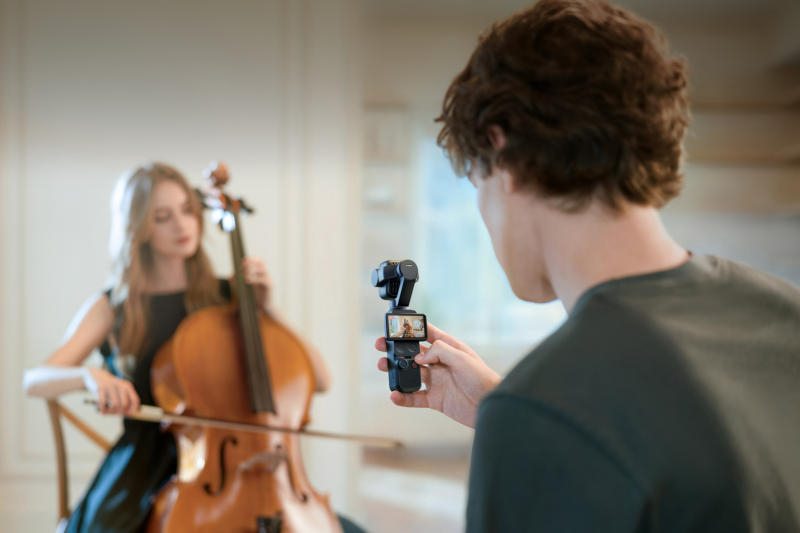
Image source: DJI Innovations
CineD Resources analyzed the report released on September 23 international information centerSpecifically for portable smart cameras, as well as the report of CIPA, the Japanese Photographic Equipment Manufacturers Association, including Canon, Sony, Nikon, etc., for the first half of this year. IDC defines portable smart cameras as three categories of devices: action cameras, 360° cameras, and gimbal cameras. Smartphones and cameras with interchangeable lenses do not fall into this category.
As of the end of the second quarter of 2026, the portable camera market has grown more than one and a half times compared with the same period last year, with sales reaching nearly 5.9 million units. DJI accounts for about three-quarters of such devices, and Insta360 accounts for a fifth. Therefore, the remaining manufacturers, including GoPro, only gained less than one-tenth of the market share. Its largest segment now consists of cameras on stabilizers – they are ahead of classic action cameras. GoPro suffered the most from the reshuffle: its shipments fell by about half compared with last year. A report from GoPro itself confirms this trend – camera sales to end consumers are down 38% and revenue is down 31%.

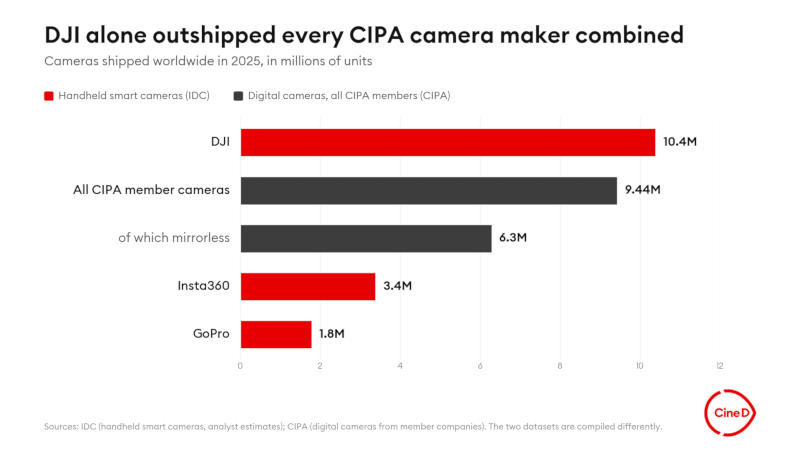
Image source here and below: cined.com
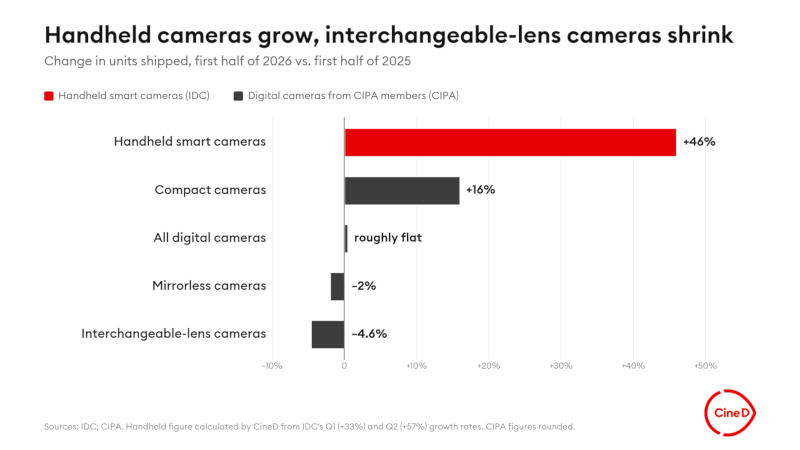
According to IDC calculations, DJI will ship more than 10 million portable cameras throughout 2025, a record number for the manufacturer. By comparison, total supply from all CIPA member companies is approximately 9.4 million units. In other words, DJI’s camera shipments last year exceeded those of all CIPA members combined. Mirrorless cameras accounted for approximately 6.3 million units of CIPA’s total sales, which means that DJI and Insta360 combined shipped more than twice as many cameras as all mirrorless camera manufacturers. The gap continues to widen this year. In the first half of 2026, the portable smart camera segment grew by 50% year-on-year; according to CIPA, shipments of interchangeable lens cameras fell by about 5%, while shipments of mirrorless cameras remained almost unchanged, falling by about 2%.
It’s also important to consider the price factor. The average cost of gimbal cameras and action cameras decreased year-on-year in the first and second quarters. As a listed company, Insta360 releases financial data in the public domain – it is worth noting that as of the end of the first half, its revenue increased by about 50%, and profits almost disappeared, plummeting 94%. The company itself cited four reasons for this: high memory chip prices, hoarding of chips to ensure uninterrupted supply, massive investment in the development of new drones with 360-degree views, and increased competition.
In the world of mirrorless cameras, the opposite is true. According to CIPA, manufacturers are shipping slightly fewer “bodies” (cameras without lenses), but their financial results are improving: fewer cameras are being sold, but revenue per device is growing. In the first half of this year, the compact camera market grew by about 16%.
Logically speaking, the photographic equipment market is divided into two directions. The first is the mass consumer segment, where Chinese companies compete on features and price; these products compete with smartphones rather than mirrorless cameras. The second is the narrow high-end market for interchangeable lens cameras, whose manufacturers are more interested in profits than sales. The popularity of lightweight cameras is also growing, which means there is widespread demand for small, dedicated devices, and it would be incorrect to say that DJI and Insta360 are simply taking market share from mirrorless cameras.
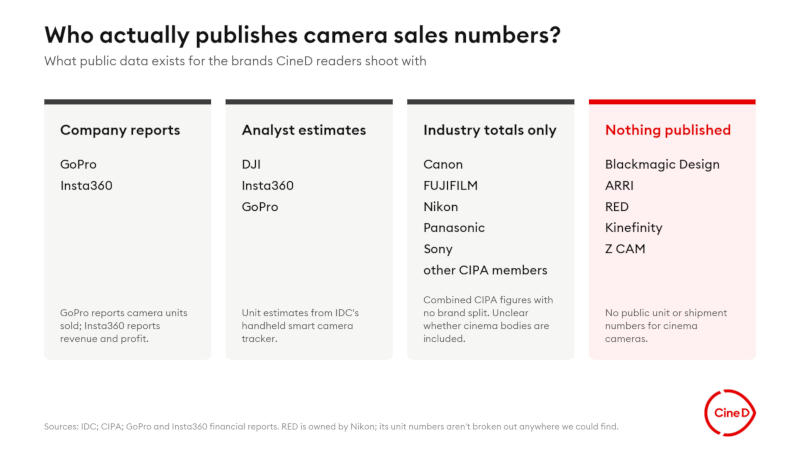
The statistics provided do not include data for the professional video and film equipment market. Blackmagic Design is a private company and doesn’t release sales numbers, and neither does ARRI. Nikon absorbed RED and stopped publishing sales figures. Small film camera manufacturers such as Kinefinity and Z CAM do not disclose statistics. There are no separate sections for Canon Cinema EOS and Sony Cinema in the CIPA statistics – the association simply doesn’t report whether dedicated cameras are taken into account in its overall metrics. Therefore, it is impossible to say exactly what dynamics are emerging in the film camera market and who is dominating it.
IDC and CIPA data are generated in different ways. In the first case, an expert assessment by an analyst is provided, in the second, a report by an association member. DJI is a private company and cannot compare IDC information with official manufacturer information. IDC and CIPA consider products as they are introduced to the market rather than end-consumer purchases; these reports primarily cover different manufacturers. Essentially, we have to compare two incomplete pictures. Cameras are very different. Gimbal and mirrorless cameras, which cost hundreds of dollars, are completely different devices, and comparing them by unit volume makes the handheld camera category seem to make more business sense than it actually does. Finally, both reports ignore the largest camera category: smartphones.
As a result, prices in the handheld camera category have fallen for two consecutive quarters while sales have grown, and for Insta360, one of the reasons for declining profits is increased competition. Competition will only intensify. According to unofficial data, Vivo and Oppo are developing their own stabilized cameras, with the latter aiming to release its first model before the end of the year. And if smartphone manufacturers with their own supply chains and retail networks really start to develop this market segment, this will affect the pricing policies therein. The cameras on the stabilizer are now equipped with an inch matrix and support recording 10-bit video in Log format. The category’s huge sales have funded development; these cameras are increasingly used as secondary cameras for professional photography and are replacing mirrorless cameras among bloggers.
If you find an error, select it with your mouse and press CTRL+ENTER.