
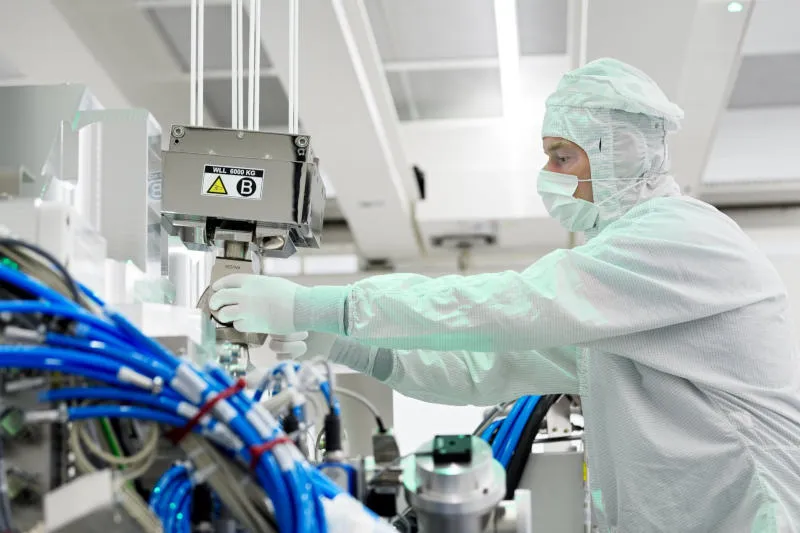
Chinese chipmakers have stockpiled hundreds of ASML deep ultraviolet (DUV) immersion lithography machines. Although they are not as advanced as advanced EUV systems, such equipment can be used to produce 7-nanometer logic wafers and memory for AI accelerators. Some equipment purchased for mature technology processes can be repurposed for more advanced production – supporting China’s semiconductor ambitions even in the face of export restrictions.
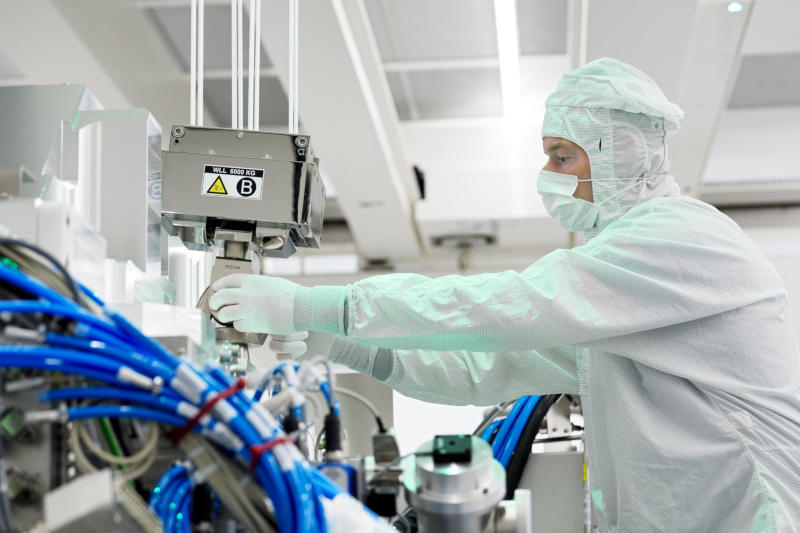
Image source: asml.com
As of the beginning of 2026, Chinese-funded enterprises have purchased approximately 343 sets of DUV immersion systems. Report Center for Technology & Government (CTS), Washington. About 270 of them are ASML Twinscan NXT:1980i. The author stated that in 2024 and 2025 alone, Chinese companies purchased about 90 and 89 such machines respectively, spending more than $13 billion.
Chinese manufacturers are unable to purchase ASML EUV lithography machines, but supply of some DUV immersion models continues. The Netherlands introduced export licenses for NXT:2000i and higher systems in September 2023, extending the requirements to NXT:1970i and NXT:1980i a year later. However, in individual cases, the latter supply may still be approved.
The report’s authors believe this is a major flaw. These devices can not only be used in the enterprise where they are purchased, but can also be transferred to other production lines or reused for more sophisticated technical processes. In particular, NXT:1980i is capable of producing the 7nm logic chips and HBM2e memory required for Huawei’s Ascend AI accelerator. However, the mere presence of photolithographers is not enough: other technical operations, equipment and an acceptable yield of suitable products are also required.
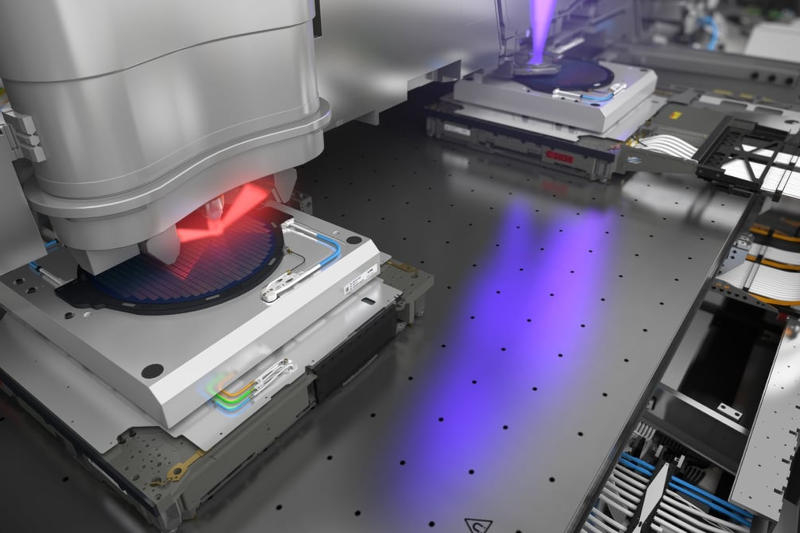
The scale of procurement was also noted in ASML’s report. China will account for 41% of the company’s system net sales in 2024 and 33% in 2025. In the first quarter of 2026, this share fell to 19% and to 14% in the second quarter.
Under the most optimistic theoretical CTS scenario, continued imports will provide capacity for the annual production of AI chips, and by 2035, the total production capacity will reach 434 million H100 equivalents. Starting from 2027, imports will be stopped and this limit will be reduced to 153 million pieces. This is not a prediction of the number of ready accelerators: the calculations assume that remaining production constraints are removed, and H100 equivalents serve as the unit of comparison for computational power.
The report’s authors, former U.S. officials Nicholas Brown and Saif Khan, called for a ban on all further shipments of deep UV immersion systems to China and restrictions on maintenance of advanced manufacturing equipment. The proposal does not apply to all DUV lithography: it is recommended that older “dry” units be retained for mature processes. The new ban has not yet been passed, and the equipment that has been accumulated continues to provide China with opportunities to develop chip production.
If you find an error, select it with your mouse and press CTRL+ENTER.