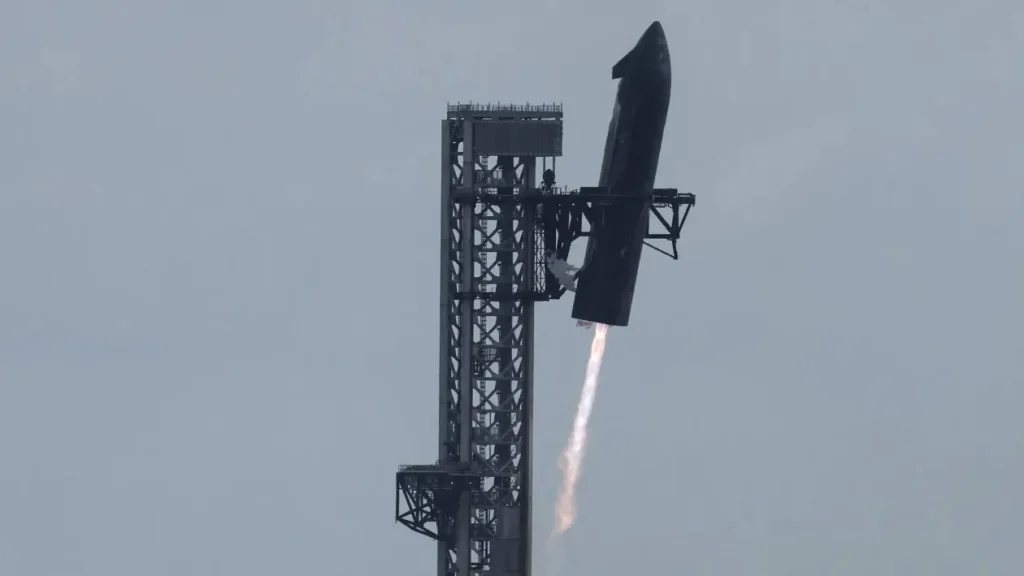
SpaceX returned Starship from orbit for the first time to Starbase in Texas, where it was picked up in the air by the mechanical “arms” of the launch tower. Thus ended the 15th test flight of Starship – the longest in the history of the program. In 22 and a half hours, the ship completed 14 orbits around the Earth and launched 26 Starlink V3 communications satellites into orbit.
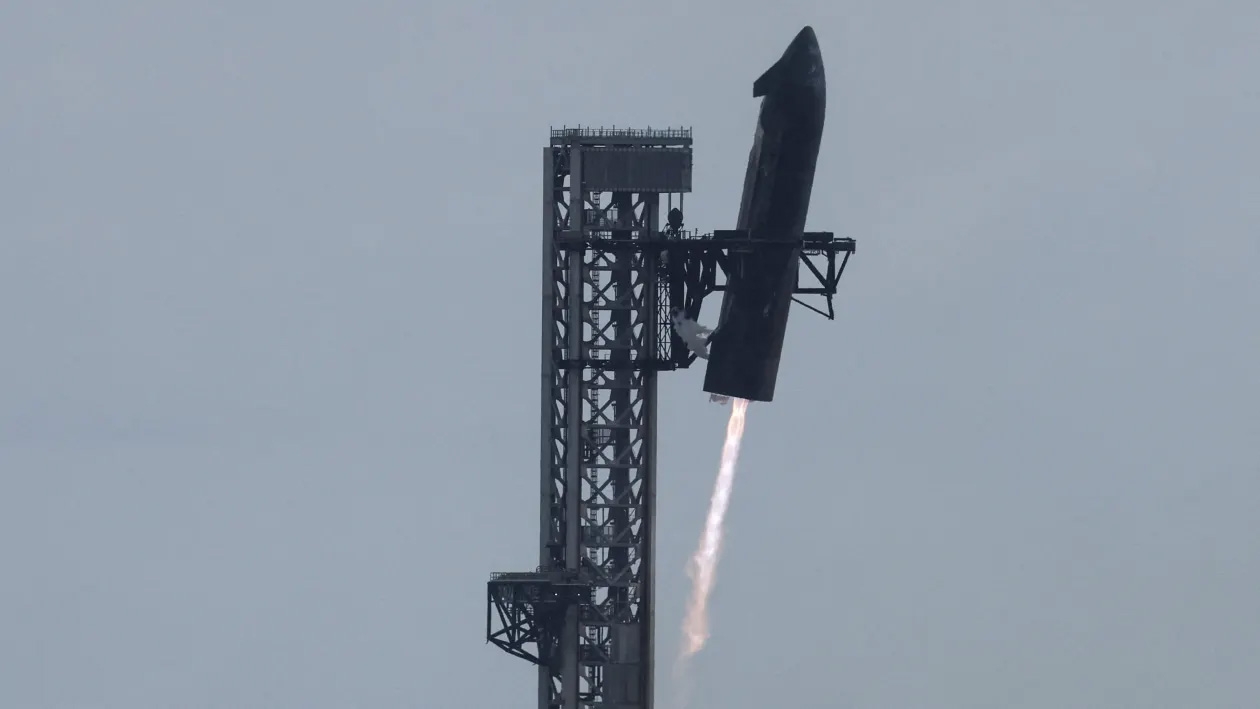
Image source: CNBC
The capture took place on November 14 at about 15:20 local time, when it was 00:20 on November 15 in Moscow. The broadcast footage shows Ship 42 emerging from the clouds, turning to a vertical position and descending between the grips of the Mechazilla tower. Until now, SpaceX has only been able to catch Super Heavy boosters in this way, which return to the launch site a few minutes after launch. The ship itself traveled a much longer path – it entered orbit, and almost a day later it entered the atmosphere and returned to the same tower.
Three of the 26 Starlink V3 satellites the craft released into orbit helped prepare it for its return. They installed cameras to inspect Starship’s heat shield after launch. Engineers studied images from satellites and ground cameras and gave the go-ahead to return to Texas. The flight plan also included backup options with splashdown off the coast of Chile or Hawaii.
According to the original plan, the tower was supposed to catch both steps in turn. However, during the return of the Super Heavy accelerator, the on-board automation discovered that it was outside the calculated position for capture. As SpaceX representative Dan Huot clarified, the control system worked normally – it canceled the approach to the tower and sent the stage to a backup area over the Gulf of Mexico. About six and a half minutes after launch, the abort system activated and the booster exploded over the water. SpaceX is still investigating the reason for the deviation.
The return of Ship 42 brings SpaceX closer to the goal for which the company is developing Starship: reusing both stages of the rocket. For the Falcon 9, the company regularly returns the booster, but for each launch it has to build a new second stage. If Super Heavy and Starship itself can be quickly prepared for the next flight, SpaceX expects to significantly reduce the cost of launching cargo into orbit.
SpaceX’s own satellite business may be the first to benefit from this. In the third quarter of 2026, the communications division, which includes Starlink, generated $2.4 billion in operating profit, compared to $2.8 billion for the company as a whole. The current flight was the second in which Starship delivered operational Starlink satellites into orbit. SpaceX estimates that one batch of 26 V3s will add about as much data capacity to the network as ten Falcon 9 launches with previous-generation satellites.
For NASA’s Artemis lunar program, the company is developing a separate landing version of the spacecraft – Starship HLS. It should deliver astronauts and cargo from lunar orbit to the lunar surface, and after the expedition, return the crew to orbit for docking with Orion. Elon Musk also has a longer-term goal for Starship – to use reusable ships to deliver people and cargo to Mars.
If you notice an error, select it with the mouse and press CTRL+ENTER.