

Security researchers from Wiz Research, Ikotas Labs, Metnir, Rapid7 and Xint independently discovered two critical vulnerabilities in the popular open source web server Nginx that allow hackers to remotely execute arbitrary code without authorization. Both bugs are related to HTTP/2 handling and received a CVSS 4.0 score of 9.2. Servers serving websites, web applications and APIs were at risk.

Image source: AI
Nginx is a popular open source software that works as a web server and reverse proxy. The vulnerabilities found were identified as CVE-2026-123633 and CVE-2026-123007. The first is related to a use-after-free memory management error, in which the server frees up memory that is still being used when processing a request. The second occurs due to an integer overflow in HTTP/2 flow control, leading to incorrect memory operations.
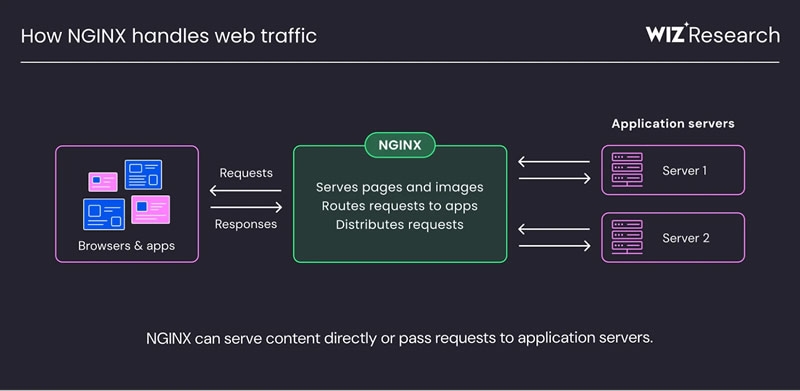
Image source: wiz.io
Particularly dangerous is the fact that the vulnerabilities are located directly in Nginx, so an attack does not require errors in the code of the site or application itself. Researchers have confirmed the possibility of executing code even on a server that simply distributes static files, without additional modules and the server side of the application. Having gained access, an attacker can steal confidential data, change the content of sites, or disrupt the operation of services.
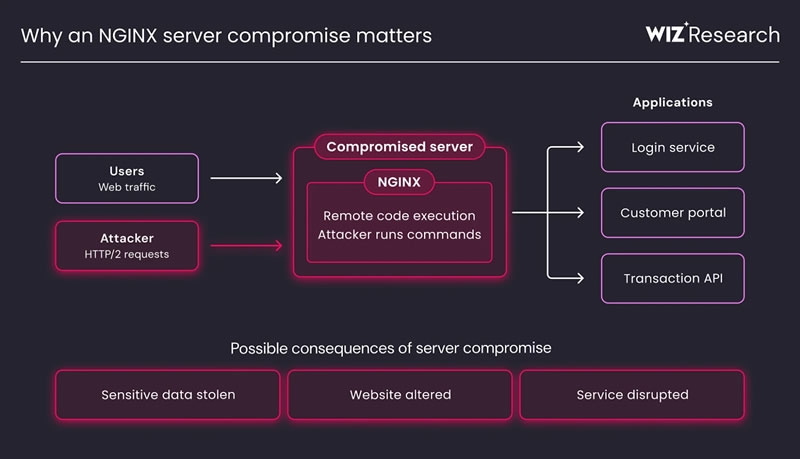
Image source: wiz.io
CVE-2026-123007 has been present in Nginx code since version 1.9.5, released in 2015. Thus, she remained undetected for more than ten years. Wiz Research used its own Wiz Atlas platform to detect vulnerabilities, as well as Gemini 4 Carbon and ChatGPT 5.6 Sol to test the impact of exploitation. Researchers have confirmed the possibility of remote code execution and prepared test exploits, which they do not yet plan to publish.
F5, the company responsible for Nginx development, has already prepared fixes. For Nginx Open Source, both vulnerabilities are fixed in versions 1.30.7 and 1.31.9. Fixed versions have also been released for Nginx Plus: 37.0.7.1 and 37.2.0.1 for CVE-2026-123633, as well as 37.0.8.1 and 37.3.0.1 for CVE-2026-123007.
If you notice an error, select it with the mouse and press CTRL+ENTER.