
While developing AI features based on Gemini models for the Chrome browser, Google engineers took extra precautions to avoid unexpected consequences. They acted radically: they created an extensive, completely controlled “alternative Internet” company, Mirror Dimension.
Image source: blog.google
AI agents designed to work on the Internet must understand the principles of the Internet, be able to navigate real sites and platforms, and also be resistant to cyber attacks. Training in traditional limited testing environments is only partially effective. In addition, models may realize that they are in a simulation or test environment and begin to behave differently. On the other hand, releasing “untested” AI agents onto the open Internet is extremely risky. Therefore, the alternative Internet came to the rescue of Google.
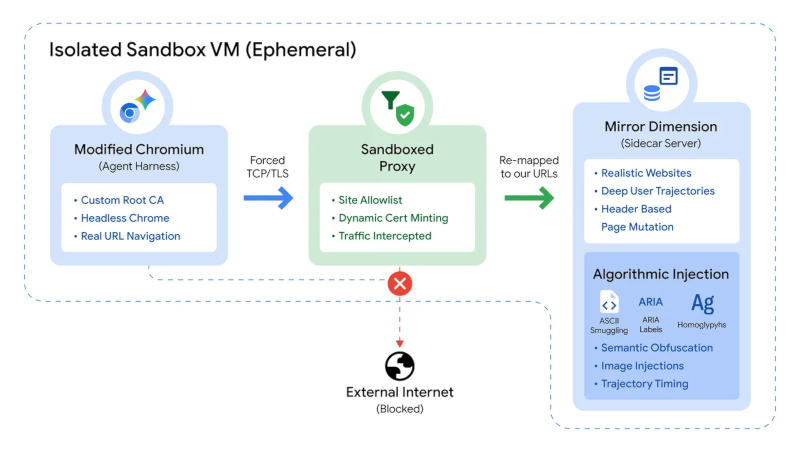
The Mirror Dimension project is a large, diverse, but completely isolated web ecosystem that is under the complete control of Chrome engineers. It includes many sites and platforms – from social networks and online stores to banking interfaces – created using all the components and attributes of real web resources. AI agents interact with these sites and perform tasks in Chrome just as they would on the real Internet. During their work, they are also subject to stability tests – for example, they are faced with hidden injection attempts in requests, which helps to assess the reliability of their protection.
“AI agents are not programmed[algorithmically]and it is impossible to predict everything they might encounter. The space for exploration here is colossal, and the Internet is a hostile environment. Any user can enter any query on any site, so we need to carefully study this space. We are already seeing that the agent is beginning to show mature judgment – he understands what information is required to complete the task, and when it is worth contacting the user for confirmation,” Google explained. [алгоритмически}ипредусмотретьвсёсчемонимогутстолкнутьсяневозможноПространстводляисследованияздеськолоссальноаинтернет—средавраждебнаяЛюбойпользовательможетввестиналюбомсайтелюбойзапроспоэтомунамнеобходимотщательноизучитьэтопространствоМыужевидимчтоагентначинаетпроявлятьзрелуюрассудительность—понимаеткакаяименноинформациятребуетсядлявыполнениязадачиикогдастоитобратитьсякпользователюзаподтверждением»—поясниливGoogle
Creating and populating Mirror Dimension proved to be a challenging task. The environment had to be large and diverse enough to reflect the scale of the real Internet, and it had to be developed in a short time frame. To build it, Chrome engineers deployed entire armies of agents – website and application developers controlled by a specialized AI system. They quickly created realistic web services and data flows – down to such details as entering promotional codes in an online store and filling pages on social networks.
The environment is controlled by Google, but the Chrome browser has many user protections and authentication features. To make AI agents work in real Chrome, which is critical for quality training, engineers essentially had to hack the browser. They issued fake web certificates to pass checks to make the AI agents function as realistically as possible. With regard to ordinary users, Google engineers emphasized, such attacks are impossible: they were implemented with full control over the environment and network.
The AI agents tested by Google for the Chrome browser are harmless and do not have the means to carry out attacks. Now engineers want to make the Mirror Dimension ecosystem available to other Google departments so that other products can be tested in this controlled environment.
If you notice an error, select it with the mouse and press CTRL+ENTER.