The project “Strategy for the Development of the Communications Industry”, prepared by the Ministry of Digital Development, provides for accelerating the growth rate of tariffs for communication services in Russia. This probability is noted in both the base and target scenarios. The reason given is the growing imbalance between the growing load on infrastructure and declining industry revenues over the past ten years. According to experts, increasing tariffs is necessary for the development and modernization of communication networks.
Image source: unsplash.com
According to the project developers, “for more than 10 years, the imbalance between the exponentially growing load on the telecommunications infrastructure (Internet traffic) and the stagnant or even falling economic indicators of the industry has been increasing.” The authors explain this imbalance by the long-term lag in the growth of the cost of communication services from the increase in real consumption volumes and load on networks, as well as from the general increase in prices in the economy.
According to the document, over the past five years, Internet traffic in Russia has grown by an average of 21.6% per year, while revenues from mobile communications and fixed broadband access have grown by only 8%, which is lower than the annual estimated growth in prices for services in the economy, equal to an average of 10.5%.
“Thus, for a long time, there has been a growing gap between the infrastructure needs to serve growing traffic and the revenue base of operators, which finances its expansion and modernization,” the document says. According to the authors of the project, it is impossible to maintain even the current volume of capital investments at current tariffs without further increasing debt.
“The load on the infrastructure is growing: over the past 10 years, Internet traffic in Russia has increased almost ninefold. Operator revenues grew much more slowly. Networks need to upgrade equipment and expand coverage, including in sparsely populated and hard-to-reach areas. When estimating costs, regulatory requirements are also taken into account,” said a representative of the Ministry of Digital Development.
According to Rosstat, over the past five years, communication tariffs have grown slower than the general price level in the country. The Ministry of Digital Development refers to data from the International Telecommunication Union, according to which in Russia the cost of fixed broadband access is five times, and mobile communications two times lower than the world average. In fact, the average tariff for these services is now about 600–800 rubles per month. At the same time, the median cost of communication services around the world is $7.68, according to Exacaster.
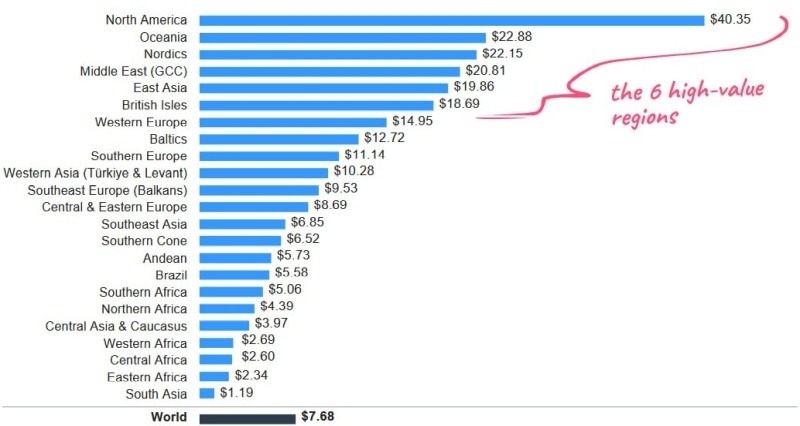
Image source: exacaster.com
Analysts’ opinions on this issue differed, they report:News” Some are inclined to believe that a noticeable increase will occur as early as next year, since the increase currently lags behind inflation, the increase in the cost of housing and communal services, fuel, electricity and other usual services. According to a number of experts, the lower limit of the equilibrium price is the median tariff at the level of 2.3–2.5 thousand rubles. Such figures are justified primarily by the complexity of logistics, the increase in the tax burden, and the increase in costs for the system of operational investigative measures (SORM).
Analysts also refer to the need to comply with regulatory requirements for CII and FSTEC, the rise in prices data center services and increased contributions to the universal service reserve. An increase in the number of devices per user, an increase in access speeds, and the development of cloud solutions and the Internet of Things increase the load on networks and require constant investment and increased investment.
According to TelecomDaily CEO Denis Kuskov, tariffs are now growing annually by 8–10%, but in the coming years the rate of increase may accelerate to 15–20%. In his opinion, state support measures, such as tax breaks, assistance in connecting communication facilities to energy supply networks and other measures, could curb price increases.
ComNews Research partner Leonid Konik claims that the cellular business in Russia remains highly profitable. At the end of 2025, OIBDA margin (an indicator reflecting the share of operating profit before depreciation and amortization in the company’s total revenue) was 34.5% for MTS, 42.3% for MegaFon, 42.7% for VimpelCom and 46.1% for T2. At the end of last year, MTS paid shareholders 69.32 billion rubles, and MegaFon – 24.36 billion rubles, Konik noted.
“The claim that Russia has the cheapest mobile communications in the world has long been untrue. The analytical service of the global association GSMA Intelligence has calculated that by the end of 2025, the median ARPU (average payment per subscriber) per SIM card in the world has decreased to $9.7 per month – just over 800 rubles. Russian Big Four operators do not have at least some modest package tariff for this amount in every region,” he claims.
The Ministry of Digital Development clarified that work on the project continues, the preliminary scenarios presented in it do not imply an automatic increase in tariffs for subscribers, and the increase in the cost of services must be justified by specific costs for the development and modernization of networks and controlled by the FAS.
If you notice an error, select it with the mouse and press CTRL+ENTER.