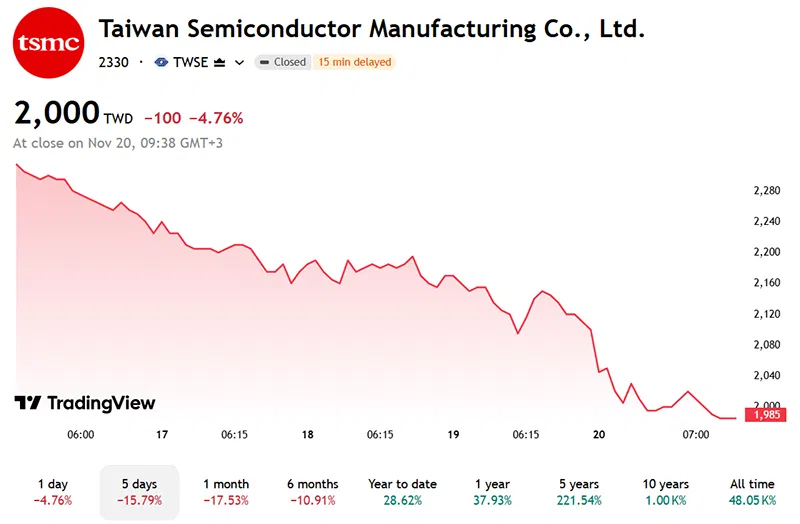
TSMC shares on the Taiwan Stock Exchange on Friday, November 20, fell 4.8% to NT$2,000 per share, a seven-month low. Over the week, the world’s largest contract chip manufacturer lost 15.8% of its stock market value. This is the company’s worst result since October 1997. The sell-off in semiconductor stocks intensified amid new U.S. export restrictions, and Taiwan’s TAIEX index lost 17.5% for the week, the most in any week since 1990.
New rules from the Bureau of Industry and Security of the US Department of Commerce came into force on November 19. Washington has tightened controls on the supply of cutting-edge accelerators to overseas data centers that provide significant AI computing power to Chinese companies. The restrictions now also include a scheme in which the chips themselves remain outside of China, and the Chinese customer uses them remotely.
Other provisions of the rules directly affect contract manufacturing. For a number of orders from Chinese developers, a simplified procedure was excluded from the list of acceptable ones, which allowed the manufacturer to confirm that the number of transistors in the finished chip is below the established threshold, and thereby remove it from more strict control. As a result, TSMC suspended Chinese orders for the production of chips using 16 nm and thinner process technology until it receives American export licenses. For such customers, 28nm and 40nm process technologies remain largely the same, provided the chips do not require HBM memory and advanced packaging.
TSMC was under attack from two sides. The restrictions have already affected some of its orders from China, and tightening rules for foreign data centers call into question some of the future demand for accelerators that the company produces for Nvidia and other developers. The scale of direct losses is still unknown. But the stakes are high for TSMC: 7nm and thinner processes accounted for 79% of its wafer revenue in the third quarter.
Washington’s orders came at a time when investors were already exiting AI stocks due to high valuations, rising debt and doubts about the return on investment in data centers. On Friday, MediaTek and UMC lost about 10% and 9%, respectively, and the US SOX semiconductor index ended the week down 17.1%. Even Nvidia’s strong earnings didn’t stop the sell-off.
TSMC’s latest reporting showed revenue growth of 50.9% and net profit of 68.7% year-on-year in Taiwanese dollars. The company then expected that demand for advanced technological processes would remain high, and was going to quickly increase the production of 2nm chips. Friday’s plunge reflects market anxiety about future sales: Regulations are already changing the conditions for access to cutting-edge chips, and investors are increasingly doubtful that the current pace of AI spending can be maintained.
If you notice an error, select it with the mouse and press CTRL+ENTER.