In recent days, investors have begun dumping shares of companies that were previously the main beneficiaries of the AI boom. Nasdaq 100 Indexwhich is dominated by technology companies, fell 3.4% in early trading, extending a decline that began on Tuesday. Semiconductor stocks were hit particularly hard. The S&P 500 index, which includes the largest US companies, fell 2.1%.

Image source: unsplash.com
Nvidia shares, which surged Monday on Jensen Huang’s surprise return as CEO, fell 7%. Broadcom and Intel fell more than 5%, while Micron shares lost over 8%.
According to Van Luu, director of global solutions strategy at Russell Investments, “the mood is extremely worrying,” and the euphoria caused by Huang’s return to the leadership of Nvidia has been replaced by a growing awareness that “attention to the artificial intelligence ecosystem will only intensify.”
Investors are increasingly asking: will the unprecedented costs associated with the development of AI pay off, and how will they be financed in an environment of rising interest rates? A sign of declining interest in risky investments was the increased demand for reliable US government bonds. The 10-year Treasury yield is currently 4.84%.
The VIX volatility index, which Wall Street calls a “fear gauge,” remained high above 30, roughly double its September lows. Investors’ desire to avoid risk has intensified amid news of the introduction of new customs duties – today US President Donald Trump announced the introduction of a series of new duties on key trading partners, including the EU, China, Japan and South Korea.
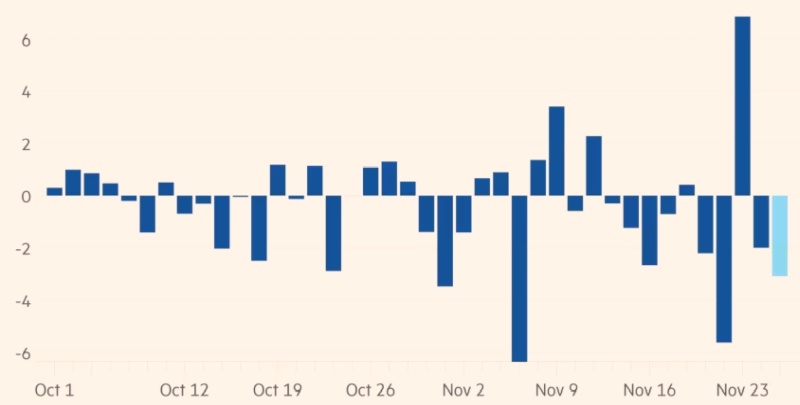
Nasdaq 100 Index Changes / Image Source: LSEG
The instability in the AI sector was reflected in Asian stock markets, with shares of local semiconductor manufacturers also falling sharply. South Korea’s Kospi index fell 6%. Shares of SK Hynix and Samsung Electronics, two of the biggest chip makers, which account for about half the market capitalization of the Kospi index, fell 11% and 10%, respectively. Japan’s Nikkei 225 index, which is heavily weighted by technology companies, fell 2.8%.
European stock markets, less exposed to the technology sector, remained relatively stable in early trading, with the benchmark Stoxx Europe 600 index down 0.2%. The European technology sector index is down 2% and down nearly 12% since early November, making this the sector’s worst month since 2022.
Analysts caution investors against trying to “buy the dip.” According to experts, macroeconomic risks are now too high, and the imbalance in AI-related investments is global in nature and primarily affects shares of companies developing infrastructure for AI.
If you notice an error, select it with the mouse and press CTRL+ENTER.