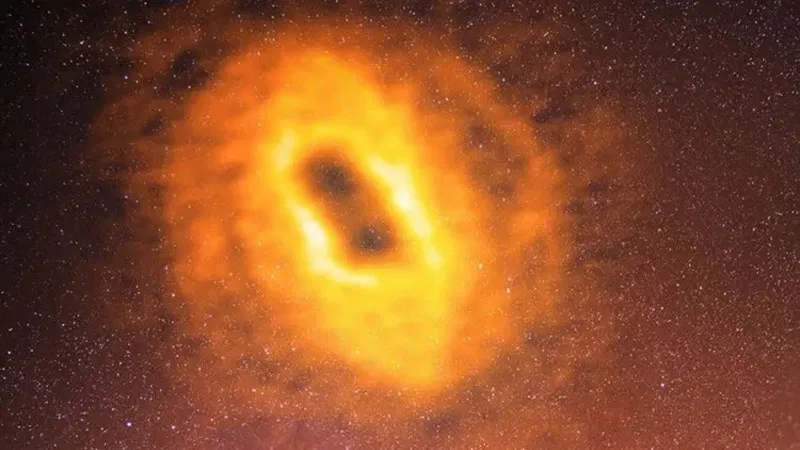
Astronomers have for the first time directly observed evidence of the final thermonuclear flare of a dying star similar in mass to the Sun. It is like the last beat of the heart, after which life leaves the body. Previously, this was only seen on models. Reality was a surprise.
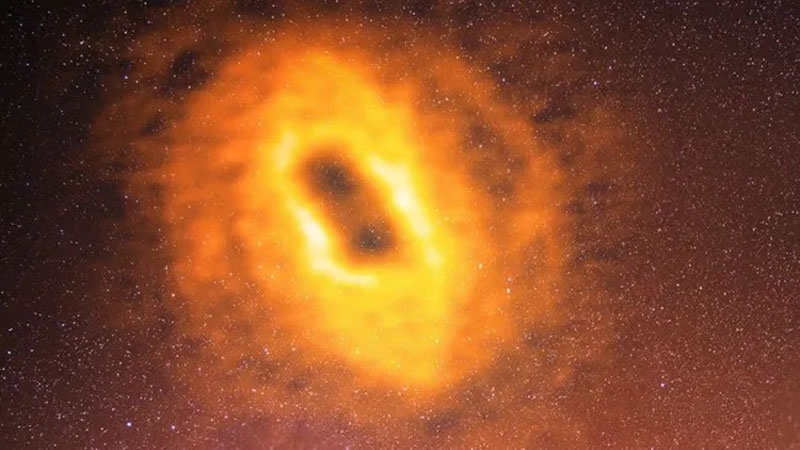
Image source: ALMA/ESO
A dying star or object IRAS 06530-0213, located approximately 12 thousand light years from Earth in the constellation Monoceros, scientists studied using the ALMA radio telescope. The observations revealed a large shell of molecular gas surrounding a nascent bipolar nebula with a characteristic two-lobe structure. The appearance of the shell of the gas, according to the authors of the study, retained a trace of the so-called thermal impulse – a short-term increase in thermonuclear reactions in the shell of the star, accompanied by the ejection of matter into interstellar space.
Researchers poetically called this trail the “last heartbeat” of the star. These “impacts” occur after the star turns into a red giant. Then, in the outer shell of the star in the layers of hydrogen and helium, thermonuclear reactions periodically occur with the subsequent ejection of matter outward – those same thermal pulses.
After the last of them, there is not enough matter left around the star for such reactions, and most of the outer shell is scattered into space. At the same time, around the remains of the star in the form of a white dwarf, a planetary nebula begins to form from its last outer layers. It was this moment that the ALMA radio telescope captured – the shock wave from the last thermonuclear pulse and the beginning of the formation of a planetary nebula around the star’s core.
Such processes have long been predicted by theoretical models, but the discovered structure represents the first direct evidence of the last such impulse in a star already moving into the final stage of evolution. The discovered gas shell has a diameter of about half a light year. Based on the measured rate of expansion, astronomers estimate that the material was ejected approximately 6,500 years ago.
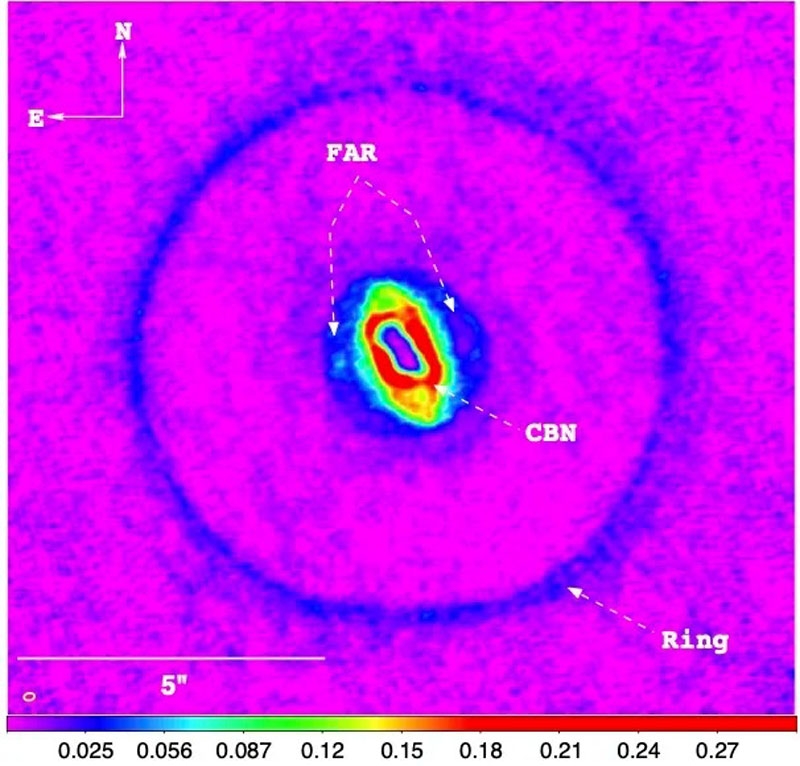
The observations also made it possible to reconstruct subsequent changes. Approximately 2000 years after the outburst, the rate of mass loss from the star remained relatively low, then over the next thousand years the emission of material increased sharply. As a result, arc-shaped gas structures were formed surrounding the central nebula, hinting at the likely presence of a companion in the system, which “muddies the waters” with its orbital motion around the dying star.
The age of the nascent bipolar nebula and the gaseous matter surrounding it is estimated to be less than 700 years, which by the standards of the life of a star is less than one instant. However, ALMA did not detect a compact dust disk near the central star, which is usually associated with the interaction of the components of the binary system. The authors admit that such a disk could exist temporarily and disappear after the formation of directed jets of matter – jets – from a dying star, when it ate up its partner.
Another surprise is related to the chemical composition of the released gas: researchers found increased levels of rare isotopes carbon-13, oxygen-17 and nitrogen-15. Their ratio does not correspond to standard models of stellar nucleosynthesis, so this mechanism still requires clarification. In general, observational data allows us to compare theoretical models of the last stages of stellar evolution with how it looks in real life. At least in the example of one dying star very similar to the Sun.
If you notice an error, select it with the mouse and press CTRL+ENTER.