
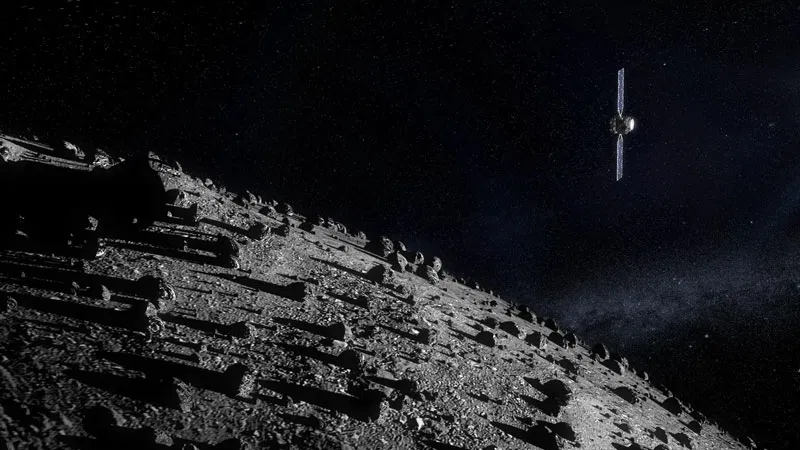
For the first time, the European Space Agency (ESA) has captured detailed images of the aftermath of NASA’s DART spacecraft colliding with asteroid Dimorphos, revealing a stadium-sized crater. The European Hera probe began approaching the asteroid to collect detailed information about the collision.
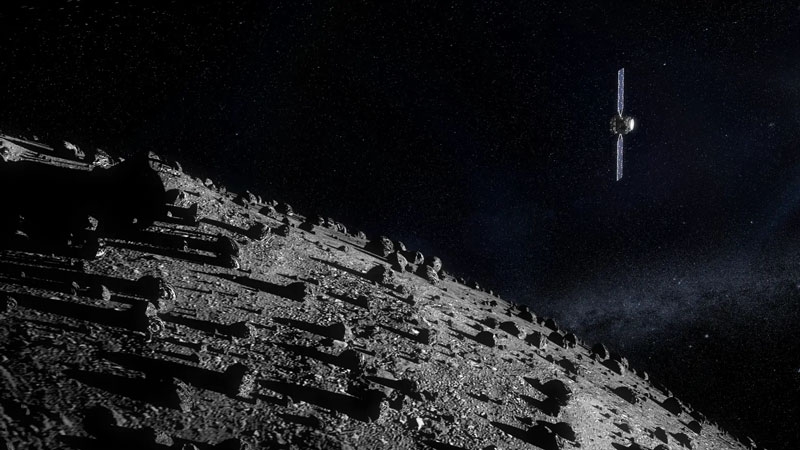
An artistic representation of the Hera station near the asteroid. Image source: ESA
According to first picturesthe impact not only left a large crater in the surface of the asteroid: the side of the asteroid facing the collision site was flattened, and almost its entire width. At the same time, it turned out that after the collision, Dimorph continues to rotate chaotically, and many boulders of different sizes from small to huge fly around it.
As we remember, a controlled collision occurred on September 26, 2022 as part of a NASA experiment to change the orbit of an asteroid. The DART spacecraft, weighing approximately 500 kg, crashed into the 151 m diameter Dimorph at a speed of approximately 6.1 km/s. As a result, the asteroid’s orbital period around the larger Didymos, a double asteroid system with a diameter of about 730 m, was shortened by 33 minutes.
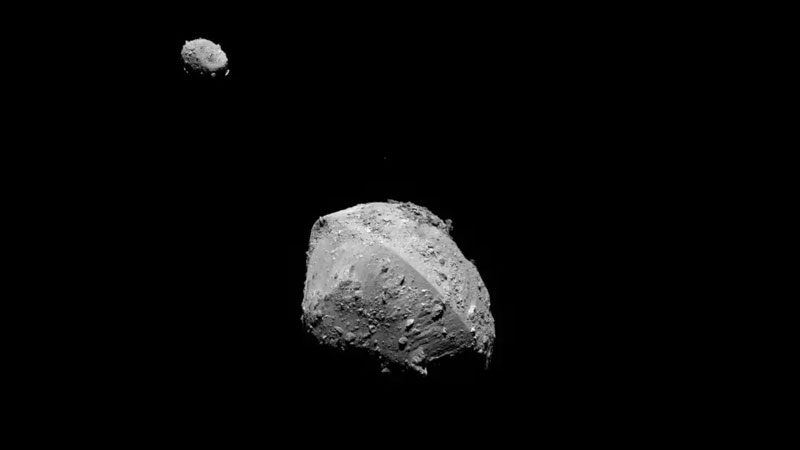
Photo of asteroids from a distance of 30 km
Ground-based observations did not make it possible to establish exactly how the impact changed the shape and internal structure of the celestial body, which is important for creating accurate models for the impact deflection of asteroids dangerous to the Earth. The ESA Hera interplanetary station was supposed to fill this gap, which in early November 2026 approached Dimorph at a distance sufficient to obtain the first images of its surface.
Three Hera instruments will be used to study the asteroid: the monochrome Asteroid Framing Camera (AFC), the multispectral Hyperscout H camera, which simultaneously records images in 25 spectral ranges, and the Thermal Infrared Imager (TIRI), which measures surface temperature. Now the device is at a distance of 25–30 km from a pair of asteroids and moves in elongated orbits, maintaining an average speed of about 12 cm/s using low-thrust engines. Another surprise was the discovery of hundreds of previously unknown rock fragments several meters in size orbiting the asteroid pair.
The study will continue with a gradual approach: in December 2026, Hera should approach to approximately 13 km to obtain more detailed images, and in January 2027, the separation of two small satellites, the Juventas and Milani cubesats, is planned.
Juventas, developed under the guidance of engineers from Luxembourg, is equipped with a low-frequency radar to study the internal structure of the asteroid and should subsequently attempt to land. Italian Milani will study the composition of asteroid matter and surrounding dust. These measurements should help determine exactly how the DART impact changed Dimorph and how effectively the impact transferred momentum to it.
If you notice an error, select it with the mouse and press CTRL+ENTER.