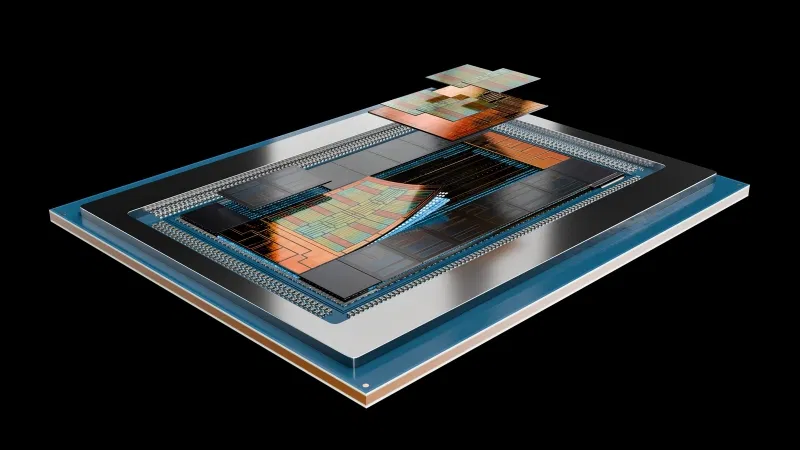
AMD reported additional details about GPU Instinct MI430Xdesigned for HPC and scientific tasks using AI, and also presented the results of performance testing in inference problems of accelerators Instinct MI455X as part of a rack solution AMD Helios. In addition, the company announced GPU Instinct MI450Xproviding AMD Helios users with another option for selecting the amount of memory in accordance with the requirements of their AI workloads and the specifics of system deployment.
The company noted that scientific modeling, advanced AI systems and interactive inference have different infrastructure requirements, and the MI400 series accelerators help meet them with support for double-precision (FP64) computing at the hardware level, large amounts of memory for resource-intensive AI models and advanced configuration options. Thus, the Instinct MI430X is designed for tasks that combine high-precision modeling and AI. Hardware support for FP64 computing allows you to perform complex scientific calculations, and the presence of 432 GB HBM4 (bandwidth up to 23.3 TB/s) allows you to work with larger models and data sets.
AMD still gives credit the role of hardware support for FP64 computing in scientific research. Her new study examines 47 workload configurations across 11 applications and benchmarks. It analyzes in what cases it may be emulation is useful double-precision calculations, and in which scientific codes require native FP64 support. Research results confirm the correctness chosen course: The Instinct MI430X is designed to meet the diverse computing needs of HPC and AI for scientific research.
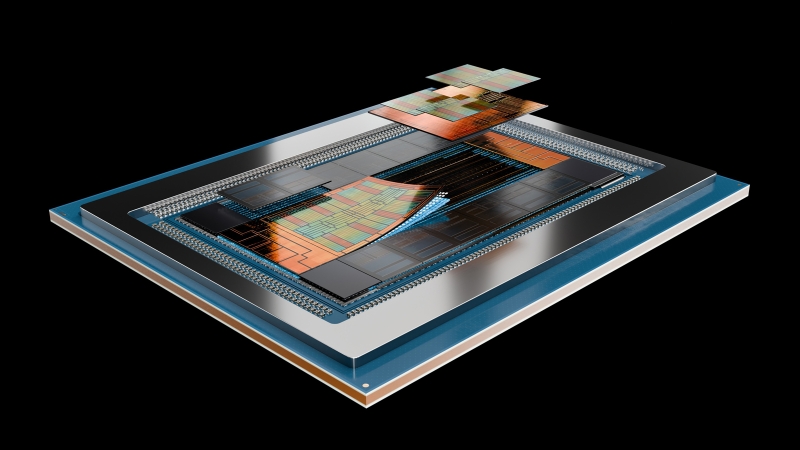
Image Source: AMD
New AMD testing demonstrates the capabilities of the MI455X in the AMD Helios system in inference tasks: the figure reached 21,333 tokens per second per GPU when working with the DeepSeek-R1 model (according to the MLPerf Inference Offline methodology). This provides 30% higher throughput, which NVIDIA Vera Rubin in the same MLPerf test (according to the latest published results). The AMD Helios system has 20% higher HBM memory bandwidth and higher on-node scale-up bandwidth than NVIDIA Vera Rubin, which is what the results reflect.
The announced AMD Instinct MI450X GPU gives AMD Helios users more flexibility in selecting the hardware that suits their AI workloads and deployment requirements. The chip is equipped with 288 GB of HBM4 memory, which is the main difference from the MI455X. It has the same compute capabilities, memory bandwidth, and scalability (both intra-node and inter-node) as the MI455X.
For workloads that fit within the MI450X, the new MI450X delivers another powerful solution: it allows you to achieve throughput and response time targets while optimizing operating costs. Both options are supported by the same open rack-level architecture and AMD ROCm software platform, but the MI455X has additional memory headroom – important for working with larger models, longer contexts, or when you need to process more requests at once.
If you notice an error, select it with the mouse and press CTRL+ENTER. | Can you write better? We always welcome new authors.
Source: