
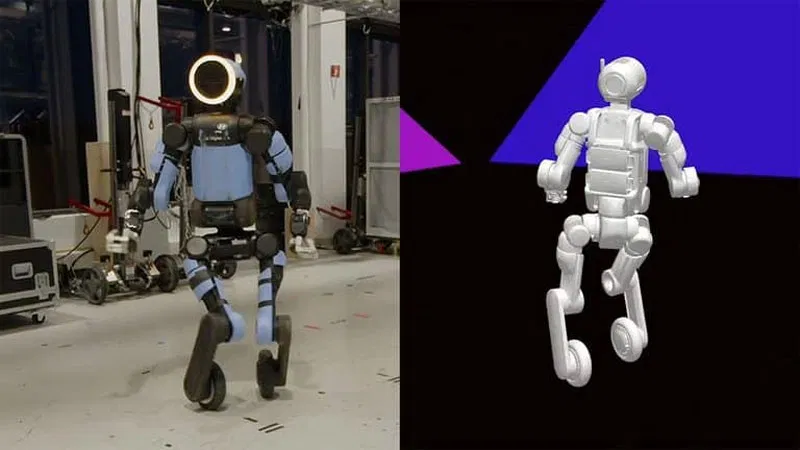
Boston Dynamics originally solved the problem of maximizing the load on all electric drives of the Atlas humanoid robot – it replaced both feet on its legs with wheels. If you’ve ever tried roller skating for the first time, you’ll understand what kind of trouble he got himself into.
Image source: Boston Dynamics
The all-electric humanoid robot Atlas was unveiled on April 17, 2024. Previously, the version of the robot worked on hydraulics. Hydraulics are powerful, but not suitable for mass use. By replacing all the drives in Atlas with electric ones, the company opened a new chapter in the life of robots. But what is the best way to test all the drives together and under maximum load at the same time? The solution was found in replacing the feet with wheels with connecting standard engines in the ankles to them through a special adapter.
The company emphasizes that it has no plans to introduce a wheeled version of the robot – this is purely a research platform to test how effectively the robot’s trained full-body control system interacts with real electric drives when operating at the limit of their performance. We are talking not only about the motors in the ankles, but also about all the moving parts of the machine.
In the software model of the robot, each wheel was represented as an ankle joint with unlimited rotation. To adapt the reinforcement control system, it was necessary to change the structure of rewards during training, the range of control commands, and the algorithm for maintaining body position. As a result, the robot learned to independently use wheels for movement, turns and lateral movements.
Training was carried out in the physical simulator MuJoCo with subsequent transfer of the control model to a real device. Engineers compared low-level control parameters, tested the actuators, and adjusted their mathematical model in the simulation to match how the real equipment behaved.
At the same time, some movements were formed on the basis of a library of human motion capture recordings (Motion Capture). For example, during lateral movements with a jump, the system learned to use wheels instead of the typical human sliding of the feet. In a similar way, the robot performed a 360-degree jump: it performed it by tracking the trajectory recorded during a similar human movement. According to the developers, the robot repeated this trick on the first try.
Let us repeat: the main goal of the experiment was the long-term operation of electric drives with high torque and rotation speed at full load with the robot’s mass. Each acceleration, turn and braking forced the engines to work in all possible combinations of torque and speed, which made it possible to study their behavior, including in the most intense modes.
The results obtained during the tests are already being used to improve the standard version of the robot with legs. In particular, the team’s next project is dedicated to improving the robustness of the robot’s control system to failures of individual drives and its ability to compensate for such failures using reinforcement learning.
If you notice an error, select it with the mouse and press CTRL+ENTER.