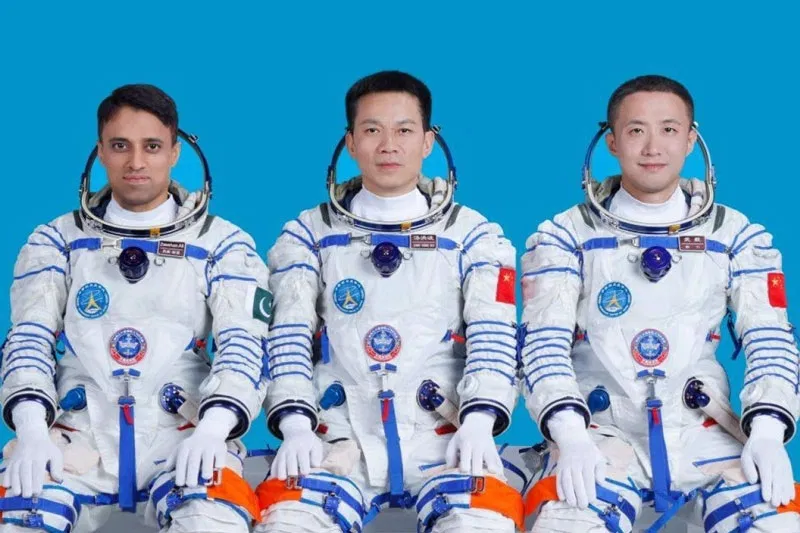
On November 25, 2026, at 03:18 Moscow time (08:18 Beijing time), the Long March 2F launch vehicle launched from the Jiuquan Cosmodrome with the Shenzhou-24 manned spacecraft. The crew included two Chinese taikonauts and an astronaut from Pakistan – this is the first foreign specialist to visit and work at the Chinese Tiangong orbital station.
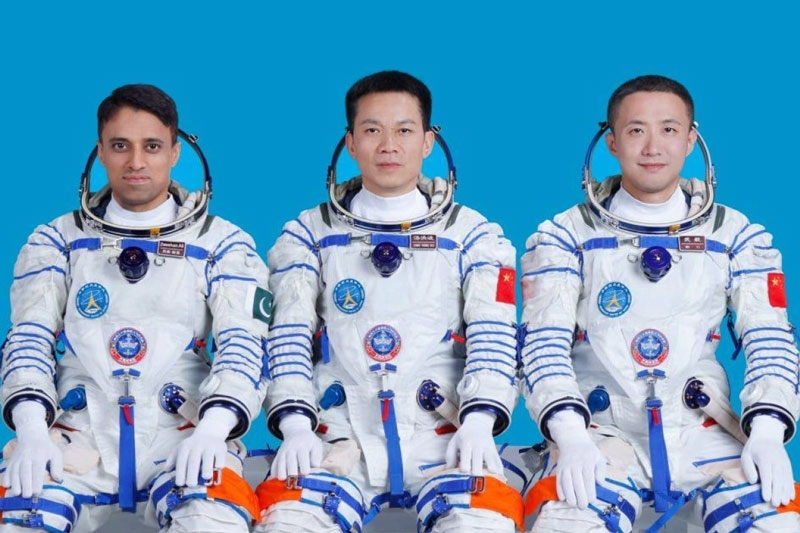
Image source: SCMP
40-year-old Pakistani military pilot Muhammad Zeeshan Ali was chosen for the joint flight. Chinese cosmonauts Tang Hongbo and Wu Yi went on the ship with him. Tang Hongbo, who previously participated in the Shenzhou-12 and Shenzhou-17 missions, was appointed crew commander. This will be his third and record-breaking visit to the Tiangong station for Chinese cosmonautics. For flight engineer Wu Yi, this will be the first flight into space, as well as for his Pakistani colleague.
Ali went to the station as a payload specialist. He will spend about a week in space. After completing the program, the Pakistani will return to Earth on the Shenzhou-23 ship, along with two participants from the previous expedition – Zhang Zhiyuan and Lai Ka-ying. At the same time, Chinese astronaut Zhu Yangzhu will remain at the station for another year: this will be the first year-long experiment in the history of the Chinese manned program for a person to stay in orbit.
For docking of Shenzhou-24 with the forward docking port of the Tianhe base module, an accelerated automatic rendezvous scheme lasting about 3.5 hours is provided.
Ali’s main task will be four joint Chinese-Pakistani scientific experiments in the field of biotechnology and materials science. Two projects are devoted to biological research, and two more to new materials. In particular, the Pakistani astronaut will install experimental equipment to study cyanobacteria – photosynthetic microorganisms that can absorb carbon dioxide and release oxygen. The research should provide data for the development of biological systems for oxygen regeneration and the production of biological resources in long-term space flights.
Another experiment involves sending 32 samples of quinoa seeds into orbit to study the plant’s resistance to space conditions. The remaining two projects will test the protective properties of graphene-based composites and the ability of self-healing carbon fiber reinforced plastics to repair damage.
The training of the first Pakistani participant in China’s manned program took place within the framework of an agreement between the space departments of the two countries, signed in February 2025. The selection of candidates included medical, psychological and technical tests, and training in China included mastering the ship and station systems, training in emergency situations and learning the Chinese language necessary to understand commands and operate equipment.
For Pakistan, this mission will be the first experience of a citizen of the country participating in orbital space flight. The Chinese side, in turn, views it as the beginning of expanding international cooperation on board its orbital station. Lai Jiaying, by the way, is a citizen of Hong Kong. She became its first representative in space and successfully passed all tests. China is gradually expanding the geography of space partners on its territory, counting on attracting new participants in future space programs.
If you notice an error, select it with the mouse and press CTRL+ENTER.