The European Space Telescope Euclid has discovered the most distant quasar known to date. Object J1504+6252, called Dún Aonghasa, existed only 630 million years after the Big Bang, which is difficult to explain by modern models of the evolution of the Universe.
Image source: AI generation ChatGPT/3DNews
A quasar was discovered by analyzing data from approximately 18 months of Euclid observations among millions of recorded objects. Its nature was subsequently confirmed by observations using the Keck Observatory, the Large Binocular Telescope (LBT), the Hubble Space Telescope and, finally, the James Webb Space Telescope. The latter made it possible to determine the mass of the central black hole of the object – about 360 million solar masses. Quasars are extremely bright galactic nuclei that glow when gas falls into a supermassive black hole.
The peculiarity of Dún Aonghasa is that, despite the huge mass of the black hole, at the moment of recording light from the quasar, it absorbs the surrounding matter relatively slowly. Therefore, the observed accretion rate does not explain how the object managed to gain such mass in the first 630 million years of the existence of the Universe. Obviously, the object has experienced stages of exceptionally rapid growth in the past. In any case, the data obtained are of interest for testing theoretical models of the formation of the first supermassive black holes, since the specific mechanism of their appearance still remains a subject of research.
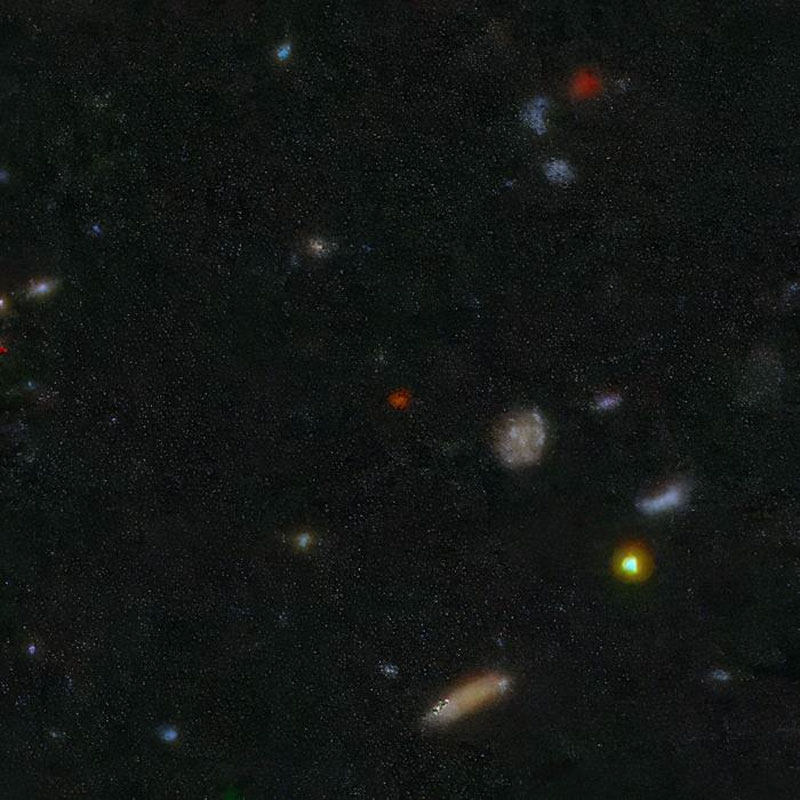
The quasar you’re looking for is the red dot in the center of the image. Image source: ESA
The discovery itself was made possible through a combination of sensitive infrared imaging and wide sky coverage by the Euclid telescope, launched in 2023. During the first year and a half of scientific work, the mission identified 31 ancient quasars, including 12 objects with a redshift greater than seven. By comparison, previous surveys took about 15 years to detect a comparable number of quasars at these distances.
However, objects with a redshift above eight are so rare that only a few dozen such sources are expected to be found in the entire planned Euclid survey area. Quasar J1504+6252 was the first among them – it was discovered at redshift 8.13. This is the first quasar with an offset greater than eight. The new find pushes back the previous observation limit by about 40 million years. By the way, the previous record was also set by Euclid.
If you notice an error, select it with the mouse and press CTRL+ENTER.