Google has released the Gemini Decisions API, designed for tasks in which artificial intelligence needs to quickly evaluate data, select courses of action, and test given conditions. The new interface is based on the Gemini Decision 1 model, capable of analyzing several types of information at once and processing up to 1000 questions in one request.

Image source: Google
The main difference between the new product and conventional generative models is the way queries are processed. Instead of sequentially creating text Gemini Decision 1 evaluates the proposed options in one pass, resulting in a median computation time of 50–100 ms. Taking into account the complete processing of the request, the delay increases to 150–250 ms.
The model works with text, images, audio recordings, videos and PDF documents. Different types of data can be combined in one context, such as matching a phone call record with account information or checking a scan of an insurance claim along with photos of damage to a vehicle in an accident. The maximum amount of shared context reaches 256,000 tokens.
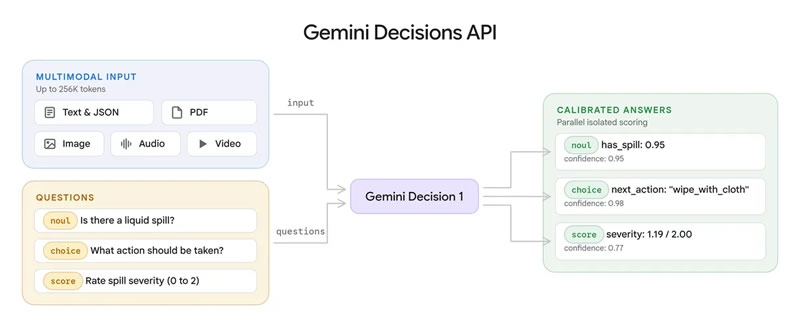
The developers have provided three assessment modes. In the first, the model determines the probability of the truth of the statement, in the second, it selects the most suitable option from the list, and in the third, it assigns a rating on a predetermined scale. For each result, a confidence score between 0 and 1 is returned, so the application can automatically forward doubtful cases to a human for review.
Google expects to use the new API as an intermediate control layer for AI systems. For example, Gemini Notebook uses it to select the appropriate model and level of reasoning depending on the complexity of the query. This reduces latency for common queries by up to 40%, leaving deep analysis models to solve complex problems. Stitch (formerly known as Galileo AI) uses the technology to help prototype interfaces, and Google Search uses it to identify malicious behavior when interacting with MCP tools.
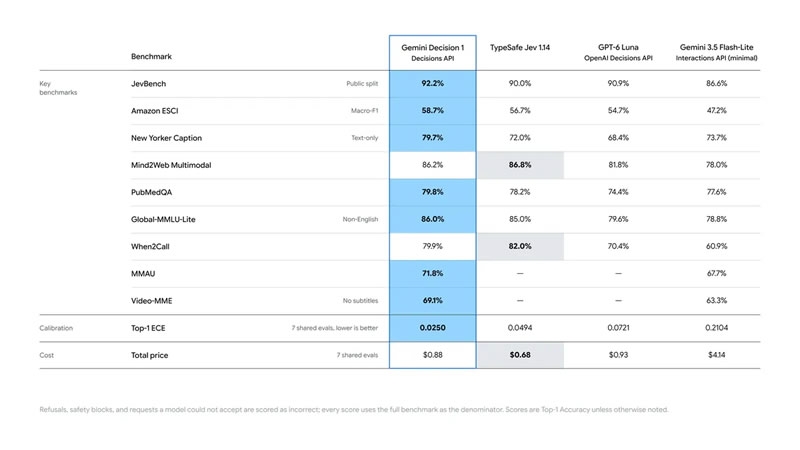
Google also provides benchmark results covering query routing, reasoning, ranking, and multimodal understanding. According to the developer, Gemini Decision 1 showed the best results in this set of tests and minimal calibration error. In addition, under the same test conditions, the model turned out to be almost five times more economical than Gemini 3.5 Flash-Lite with API.
The usage cost is $0.10 per million input tokens, while output tokens are not charged. General input is paid once, regardless of the number of questions being tested, and the additional cost is generated only by the instructions and criteria of each test.
Developers can already get an API key in Google AI Studio and use the free tier to create prototypes. Integrations with OpenRouter, LangChain, Vercel, LiteLLM, Pydantic AI and other tools are gradually appearing, and the company promises to add support for Gemini in Google Cloud later.
If you notice an error, select it with the mouse and press CTRL+ENTER.