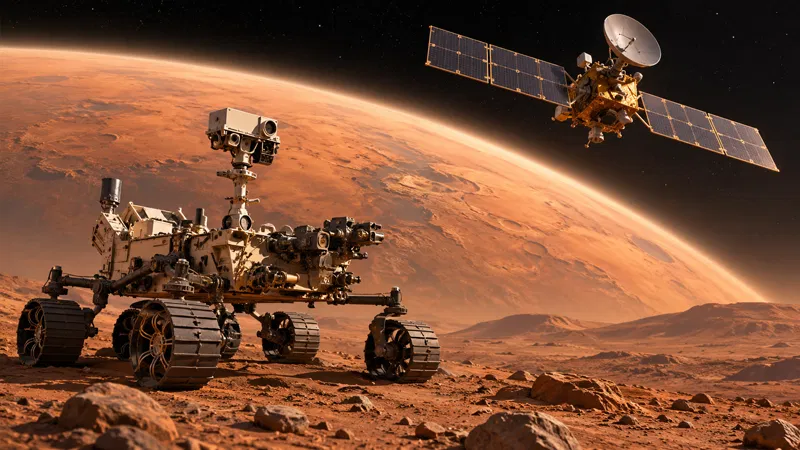
NASA reported unrelated technical problems on two vehicles operating near Mars: the Perseverance rover and the Mars Odyssey orbiter. Due to malfunctions, the scientific work of both missions was temporarily suspended. The chances of saving the devices are quite high.
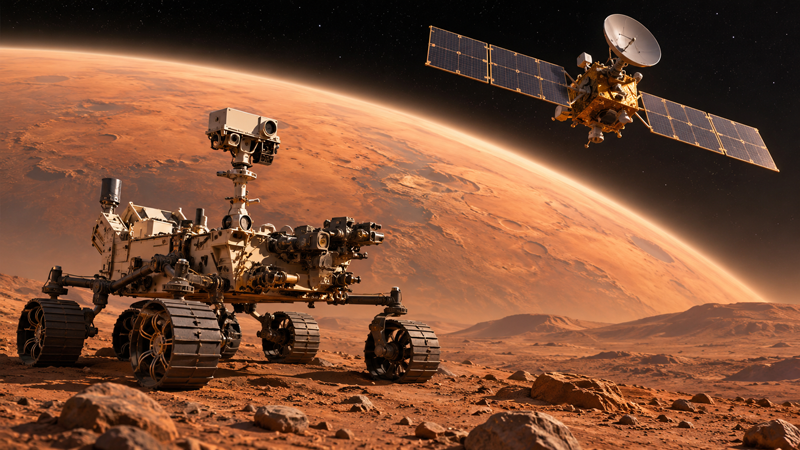
Image source: AI generation ChatGPT/3DNews
The news is unpleasant, but the incidents are not fatal: Perseverance remains operational and maintains contact with Earth, and Odyssey has already exited safe mode. Engineers at NASA’s Jet Propulsion Laboratory (JPL) are investigating the causes of malfunctions and testing the possibility of restoring normal operation of the devices.
Perseverance’s problems stem from both its primary and backup UHF radios, which are designed to transmit large amounts of data to Mars orbiters, which then relay the information back to Earth. On October 30, 2026, when turned on, the main radio station did not transmit control signals to the rover’s computer – the so-called “heartbeat”, or electronic impulses confirming the functionality of the radio station.
After 25 missed signals, corresponding to approximately 100 seconds of lack of communication with the radio unit, the standard protection system turned off the faulty transmitter, switched to the backup one and switched the device to safe mode. Subsequent diagnostics revealed another problem: the backup radio system was transmitting at approximately half the expected power. Therefore, engineers temporarily abandoned the use of both UHF transmitters.
Perseverance now communicates directly with Earth via a highly directional X-band antenna using NASA’s Deep Space Network (DSN). However, the channel’s capacity is significantly lower, so scientific operations and new image acquisition are suspended to free up the channel for telemetry transmission.
The Mars Odyssey orbiter has detected a problem with one of its four flywheels, the reaction wheels used to control attitude. From November 4 to November 6, the device was in safe mode, after which engineers determined that one of the wheels had stopped rotating. Another such mechanism failed in 2013, so the Odyssey has only two working flywheels, while standard attitude control requires at least three.
In such conditions, the device is forced to rely exclusively on low-thrust hydrazine engines, which consume fuel when correcting the position. According to preliminary estimates by experts, after 25 years of work in Martian orbit, the supply of hydrazine may be enough for only one to two months of attitude control without the help of flywheels. Meanwhile, the orientation system is necessary primarily to hold the station’s solar panels in the desired position, without which the Odyssey’s onboard system will forever lose power.
In the process of trying to restore the rotation of the failed flywheel, the faulty wheel responded to the command once and began to move. Engineers are now carrying out further tests to determine whether it can be returned to service.
NASA expects Perseverance to resume science operations by the end of November, while Mars Odyssey is targeting the last week of November. The reasons for the failures of both vehicles have not yet been established: NASA has not reported any confirmed mechanical damage to the rover’s radio systems, nor the specific reason for the stoppage of the orbiter’s flywheel. Mars Odyssey was launched in April 2001 and entered Mars orbit in October of that year. The mission was originally planned to last approximately two and a half years, but the device continues to operate and remains a critical element of the Martian relay network.
If you notice an error, select it with the mouse and press CTRL+ENTER.