In the fourth quarter of 2026, supply chain participants began to revise their production and sales plans for 2027-2028, which somewhat slowed the pace of DRAM procurement. The cautious approach is due to a number of factors: the outcome of the US midterm elections, possible changes in Nvidia’s funding policy for neo-cloud providers and geopolitical restrictions that have affected the supply of advanced chips and access to leased computing resources.
Given the uncertainty regarding how these processes will affect demand, TrendForce analysts have developed a base and pessimistic scenario for the dynamics of contract prices for DRAM. According to the base scenario, during 2027 the growth rate of contract prices will gradually decrease, in the second half of the year they may stabilize, and in 2028 they will begin to fall.
The base case scenario takes into account a number of demand-side factors. Manufacturers of consumer electronics have difficulties with sales, but they also have limited ability to accept further price increases. Chinese cloud providers began to reduce purchases of server DRAM at the beginning of the fourth quarter, although the released volumes were largely absorbed by their North American colleagues.
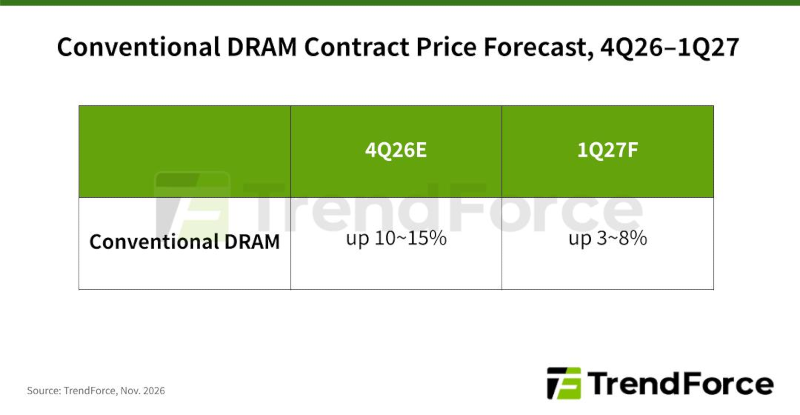
Image source: trendforce.com
Following the midterm elections in the United States, market participants expect a more cautious approach to domestic data center development. Combined with power supply constraints, this could change demand for data center construction in 2028. In addition, Nvidia may reduce financial support for non-cloud providers. Additional uncertainty is created by new regulations introduced by the US Department of Commerce – they limit access to advanced accelerators for those data centers that serve Chinese customers. Permission will also be required for the production of advanced components for Chinese chip designers. All this may further curb the growth of demand for DRAM in Asia.
The volume of DRAM supplies in the period from 2026 to 2028, analysts expect, will show strong growth: manufacturers intend to commission new capacities and switch to more advanced technical processes. If server shipment growth slows in 2028, the DRAM shortage could ease, and contract prices for all product categories will begin to decline as early as Q1 2028.
In its worst-case scenario, TrendForce assumes that server manufacturers will continue to cut purchases as demand forecasts are revised downward, leading to massive inventory drawdowns across the supply chain. Additional risks include reduced investment and possible consolidation among non-cloud providers, as well as the introduction of further restrictions by the US Department of Commerce. Under such conditions, the growth of server deliveries will begin to slow down as early as 2027. As a result, the dynamics of contract prices for standard DRAM modules will change: in the fourth quarter of 2027 they will begin to decline, and in 2028 the pace of this decline will accelerate.
If you notice an error, select it with the mouse and press CTRL+ENTER.