Phison Electronics Company announced the release of Pascari Space, a new category of purpose-built SSDs designed for commercial use in space.
Lower launch costs amid the challenges associated with deploying ground-based processing infrastructure, including high power consumption, cooling requirements, limited physical space and risks associated with natural disasters, are driving the development of on-orbit infrastructure and satellite technology, the company says.
The company’s new line of storage devices draws on its experience in the space industry: its technology is used in Mars rovers, as well as in the first data processing equipment deployed by the company on the Moon Lonestar in 2025. True, it only worked for a short time, but, according to the company, the reliability of the Pascari SSD has been confirmed in real space conditions, which allowed them to receive TRL-9 status (technological readiness level 9).
The Pascari Space line of highly configurable SSDs is designed to meet data integrity, durability, and resiliency requirements in environments where troubleshooting is not possible. It includes three specialized series of solutions:
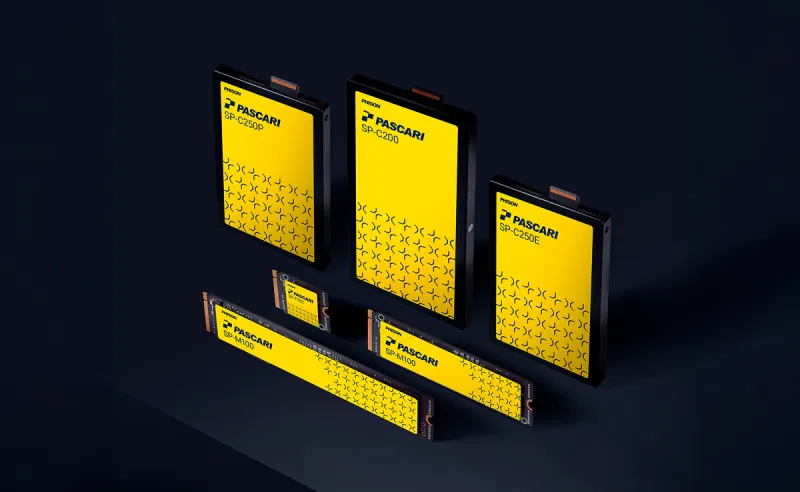
Flight Critical: Wide-temperature, DRAM-free drives designed for spacecraft applications where maximum reliability is more important than high performance. The series includes SSD SP-F100 in BGA 1620 and BGA on M.2 2230 form factors with capacities from 40 GB to 1 TB with PCIe 4.0 x4 interface, designed for operation at temperatures ranging from −40 to +105 °C. Main Storage: High-performance storage solutions for common spacecraft systems and on-board computing systems, providing the optimal balance between durability and functionality. The series includes the SP-M100 model in M.2 2280 and M.2 22110 form factors with a PCIe 4.0 x4 interface with capacities from 480 GB to 4 TB, designed to operate at temperatures ranging from −40 to +85 °C. Orbital Data Center: high-capacity storage devices designed for orbital data centers and storing significant amounts of information in orbit. The series includes models SP-C200 (form factor E3.S, E3.L), SP-C250P (E3.S) and SP-C250E (E3.S) with PCIe 5.0 x4 interface, designed to operate at temperatures of 0 – 70 °C. The capacity of the SP-C200 model is 32 – 128 TB, SP-C250P – from 2 to 32 TB, SP-C250E – from 1.6 to 25.6 TB.
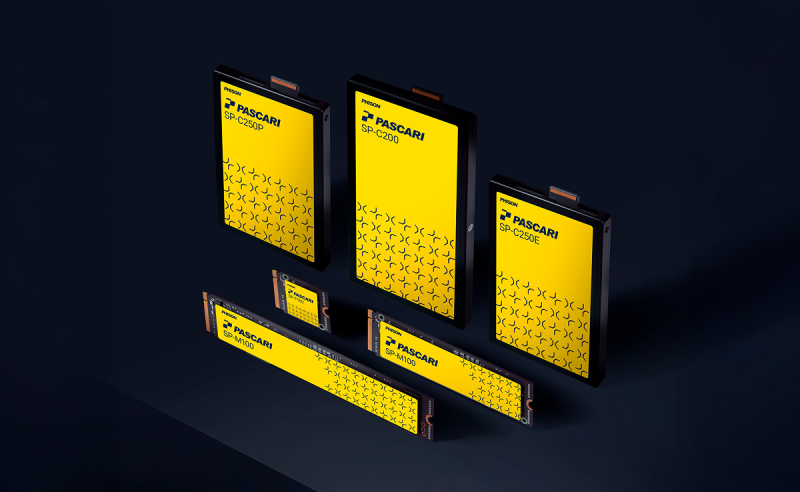
Image Source: Phison Electronics
Pascari Space offers SSDs tailored to specific mission requirements. This is achieved through our own development of controllers and firmware. In particular, using the IMAGIN+ platform, it is possible to customize parameters such as wear resistance, data retention period, error handling algorithms, performance indicators, testing and verification procedures, as well as radiation resistance for specific tasks – all this is implemented through the selection of components and adjustment of firmware in accordance with mission requirements.
Pascari Space also provides multi-level data protection using LDPC, SmartECC, SmartRefresh and SRAM data interleaving technologies. Radiation resistance assessment services (including heavy ion testing and post-production lot testing) are available to ensure mission-specific reliability and resilience.
As part of its ongoing collaboration with Lonestar Data Holding, Phison will support the creation of the first commercial orbital data center node, StarVault-001 (SV-001), part of the StarVault network. The launch of the mission is scheduled for the first half of 2027. A 488 TB Phison Pascari Space will be delivered into orbit, providing approximately 370 TB of usable capacity in low Earth orbit.
Image Source: Phison Electronics
“Through Project StarVault, Lonestar is creating a secure, sovereign infrastructure for storing data off-Earth. It does not depend on terrestrial risks and lays the foundation for future services in the field of AI and computing power in space,” said the founder of Lonestar Data Holdings. In turn, the CEO and President of Phison US noted that the requirements for storage devices in space flight conditions are significantly higher than the standards adopted on Earth.
If you notice an error, select it with the mouse and press CTRL+ENTER. | Can you write better? We always welcome new authors.
Source: