
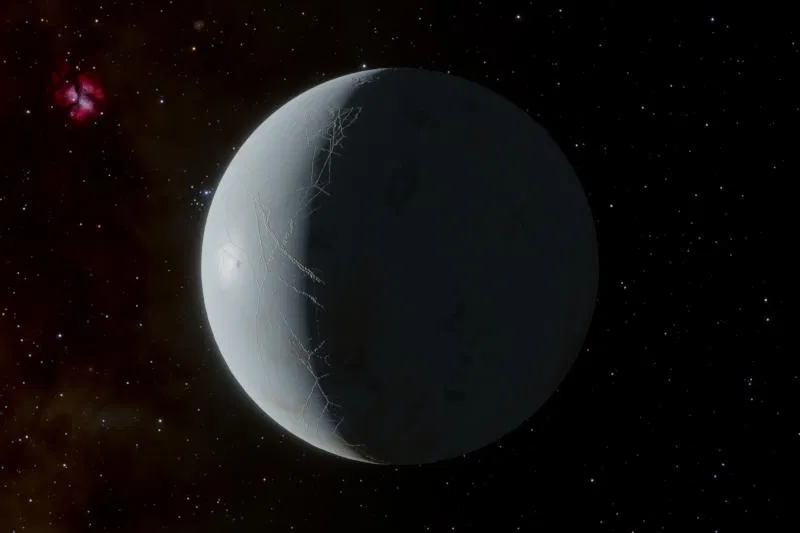
A team of researchers simulated the evolution of the Solar System over 4.5 billion years. The goal of the project was to find out whether the strange arrangement of icy bodies beyond the orbit of Neptune could be explained by the presence of another, as yet undiscovered planet.
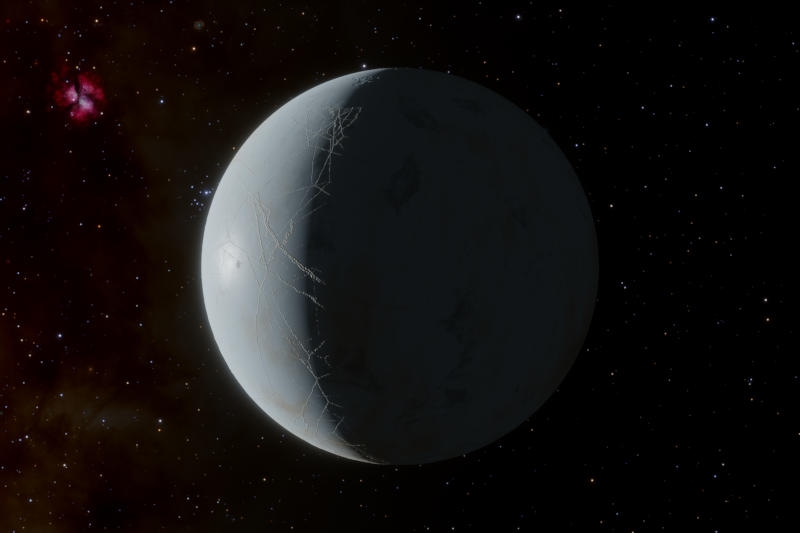
Image source: ras.ac.uk
The researchers named the hypothetical object “Planet X2” – a reference to long-standing discussions about “Planet X”, although the new hypothesis differs from previous ones. Most known Kuiper belt objects move in orbits located in the wide disk beyond Neptune, but beyond that the order is somewhat lost.
Some icy bodies move in orbits inclined more than 45° to the plane in which the other planets rotate. Other objects are isolated: even at the point of their orbit closest to the Sun, they remain so far from Neptune that they practically do not experience its gravitational influence. For example, the dwarf planet Sedna never comes closer to the Sun than 76 times the Earth-Sun distance, called an astronomical unit (AU)—well beyond the orbit of Neptune, which is about 30 AU.
According to the simulation results, the structure of the solar system beyond the orbit of Neptune is best explained by the presence of a planet whose mass exceeds that of Earth. It should move along an elongated orbit, not approaching the Sun closer than 200 AU. Over billions of years, the gravity of such an object could cause some orbits to become highly tilted, while others would remain isolated and relatively flat.
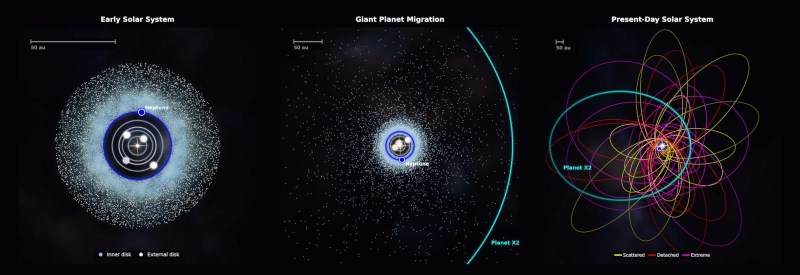
Another series of simulations showed that a planet the size of Mars or Earth could also wreak havoc early in the system’s formation. But, as calculations show, such relatively small planets would be thrown out of the solar system before they could leave a noticeable mark on its structure. This led scientists to hypothesize the existence of a massive object – a “super-Earth” somewhere on the periphery of the solar system.
The hypothetical “Planet X2” is a more modestly sized object than “Planet Nine”, whose existence has been proposed to explain why the orbits of some of the more distant celestial bodies are oriented in similar directions. Last year, astronomers working with the Subaru Telescope in Hawaii reported the discovery of an object similar to Sedna – dubbed “Ammonite” – and its orbit appears to be deviated from the orbits of other objects in the region. Another study showed that when the sun was young, a passing star could have sent celestial bodies into orbits similar to Sedna.
There are many ways to disrupt the ordered structure of the disk, and the results of computer modeling are not yet the discovery of new planets. And if the chaotic state of the outskirts of the Solar system is consistent with the hypothetical influence of some invisible object, the question cannot yet be considered closed. By running simulations based on data from the Dark Energy Survey, the researchers found that the most likely models do a good job of explaining orbital inclinations and the minimum distances of objects to the Sun; however, during the simulation, too few objects with the most extended orbits were identified. Finding “Planet X2” would require capturing the outermost world by the faint sunlight it reflected, and then tracking its movements through a series of images.
If you notice an error, select it with the mouse and press CTRL+ENTER.