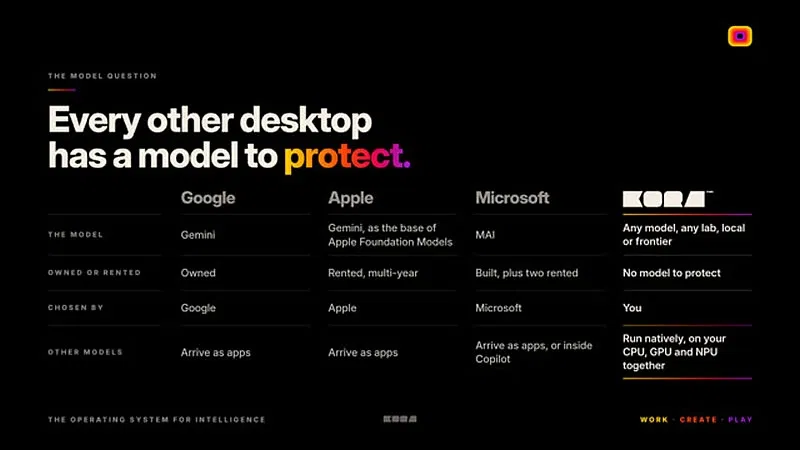
Startup Kora Systems introduced the Linux-based desktop operating system Kora, aimed at developers, content creators and users actively working with artificial intelligence. The platform will integrate various AI models and autonomous agents at the system level.
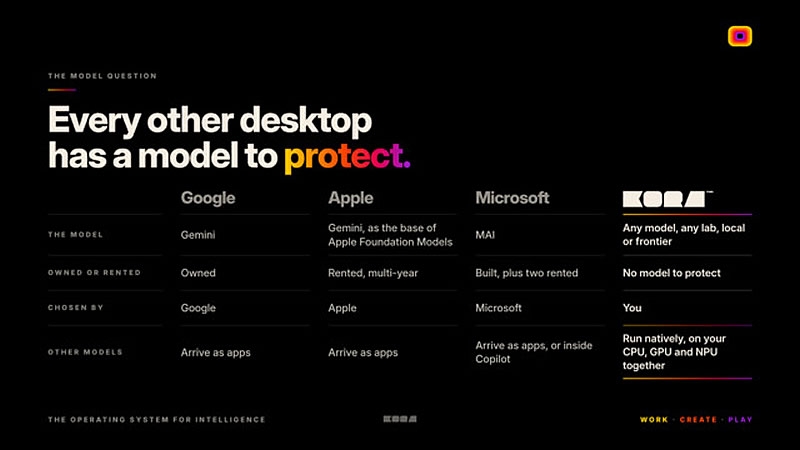
Image source: Kora
The main feature of the OS is the ability to maintain a common context for working with different AI tools. For example, a user can start a project using OpenAI models, then move to Anthropic tools to deploy code, and then use local AI for the rest of the work to reduce cloud query costs. In this case, information about projects, documents and previous interactions will be stored directly on the computer.
To work with files, a file system based on a neural network is provided. It indexes the contents of documents by topic, so the user can find the desired document by describing its contents in the search bar, even if he does not remember the name or location. The system also uses separate workspaces to delimit projects and control which files, devices and online services AI agents can access.
Kora is built on the Linux kernel and will support computers with Qualcomm Snapdragon processors, as well as x86-64 systems from Intel and AMD. Compatibility with Windows applications will be ensured by special software layers. The company also develops its own applications for email, calendar and contacts, and is preparing an SDK for third-party developers.
Gaming capabilities will be retained by GameFrame technology, created on the basis of the previous development of GameOS. At the same time, Kora is focused on powerful computers with at least 64 GB of RAM, which are necessary to run demanding local AI models.
The project is led by Kirt McMaster, who previously co-founded Cyanogen, an alternative version of Android that was widely used before the company folded about a decade ago. Together with him, Kora is being developed by Franck De Girolami, who participated in the creation of GameOS, and John Lagerling, who previously worked on Android at Google. The operating system is expected to appear in 2027.
If you notice an error, select it with the mouse and press CTRL+ENTER.