A series of powerful flares on the Sun on the tenth day of May 2024 led to an unprecedented phenomenon – two stable radiation belts around the Earth split into four for a couple of months. This came as a surprise to satellite operators and could have resulted in a massive loss of spacecraft in orbit.
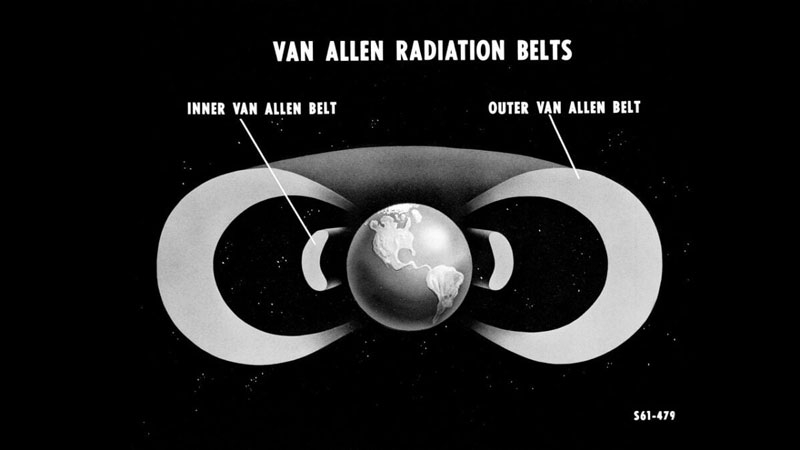
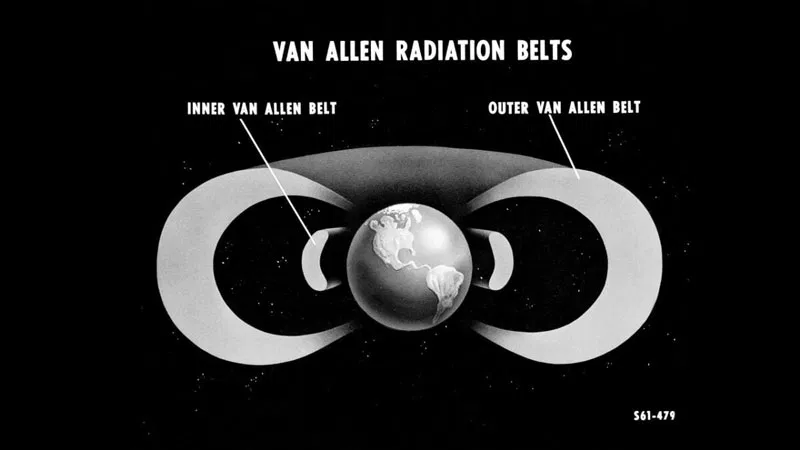
Historical idea of the Earth’s two radiation belts. Image source: NASA
The presence of two radiation belts near the Earth was discovered in 1958 by the first American satellite, Explorer 1. They were named after physicist James Van Allen. One belt is located at an altitude of approximately 1000–12,000 km, and the second at 13,000–60,000 km. The inner belt consists primarily of high-energy protons, while the outer belt consists of high-energy electrons.
One such particle may be enough to disable the on-board electronics of a satellite or cause irreversible changes in human cells. Long-term splitting of the belts and the emergence of new zones with increased radiation can take them by surprise and lead to the loss of equipment and damage to the health of space crews.
Scientists talk about the splitting of the Van Alen belts into three and then four regions found out thanks to observations from the European PROBA-V satellite, which is in a sun-synchronous polar orbit at an altitude of 820 km. The changes arose after a powerful geomagnetic storm on May 10–11, 2024, called the Mother’s Day Event. The magnetic field disturbance index during the storm was −412 nT, making it the strongest geomagnetic storm in two decades. Polar lights were seen these days even in the Stavropol Territory.
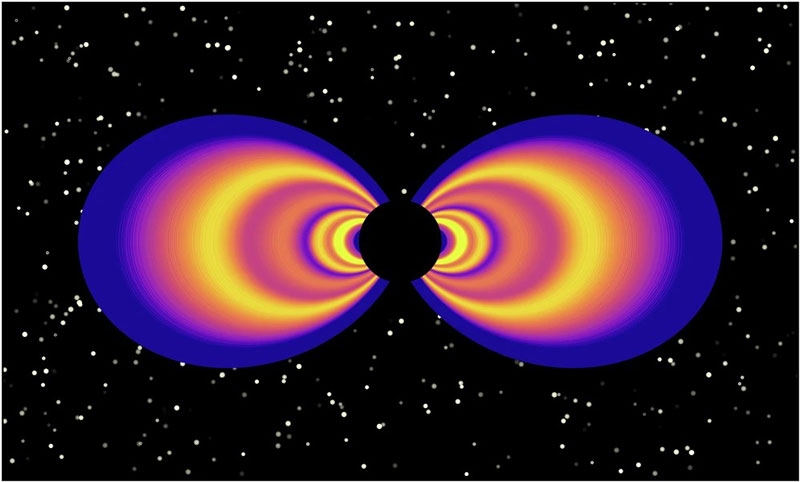
The formation of four radiation belts near the Earth (marked in yellow-orange). Image source: npj Space Explor 2026
The observations were made using the EPT (Energetic Particle Telescope) installed on the satellite. The device is capable of detecting electrons with energies from 0.5 to 8 MeV in six energy channels, as well as protons with energies from 9.5 to 248 MeV. The analysis showed that during the May storm the flow of charged particles increased, and the region with a reduced electron concentration (the so-called gap) that existed between the inner and outer belts was partially filled with them.
What happened was what scientists called the displacement of electrons – under the influence of many factors, including human activity (radars, communications, etc.), high-energy electrons displaced by the solar wind and plasma began to concentrate in other areas of near-Earth space. The overall electromagnetic situation around the planet formed three, and then four, temporarily stable areas of high concentration of field lines, where displaced electrons gathered and two extra radiation belts formed near the Earth.
By August 2024, everything had returned to the previous configuration of the Van Alen belts. Then, during another period of solar activity in late autumn, a third belt appeared for a while. In principle, three radiation belts near the Earth have been observed before, but four belts and for a period of more than a month – this was the first time. Obviously, such things need to be studied and learned to predict. The human presence in space is growing and no one needs surprises in the form of the unexpected appearance of radiation belts in previously unknown orbits.
If you notice an error, select it with the mouse and press CTRL+ENTER.