
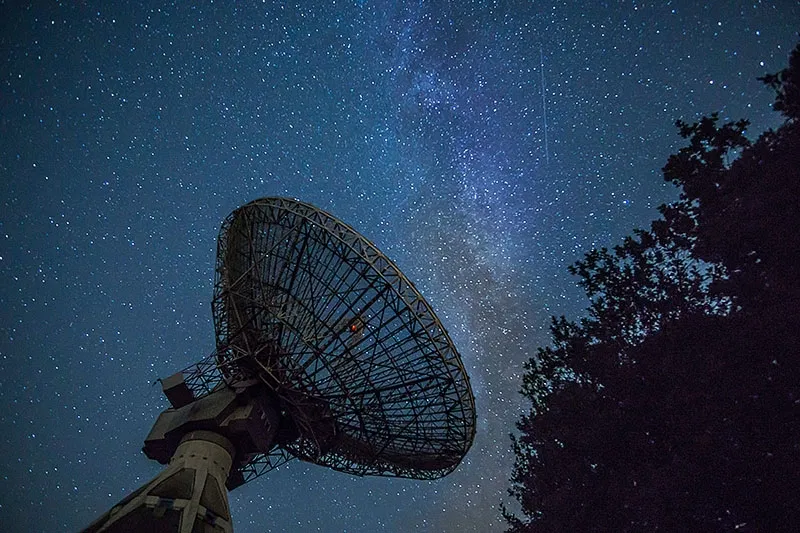
Satellite launches have increased significantly over the past decade. The implementation of large-scale projects, such as the Starlink satellite Internet service, has led to more and more spacecraft in orbit. Already, there are often more of them above a typical city in mid-latitudes than there are stars visible to the naked eye.
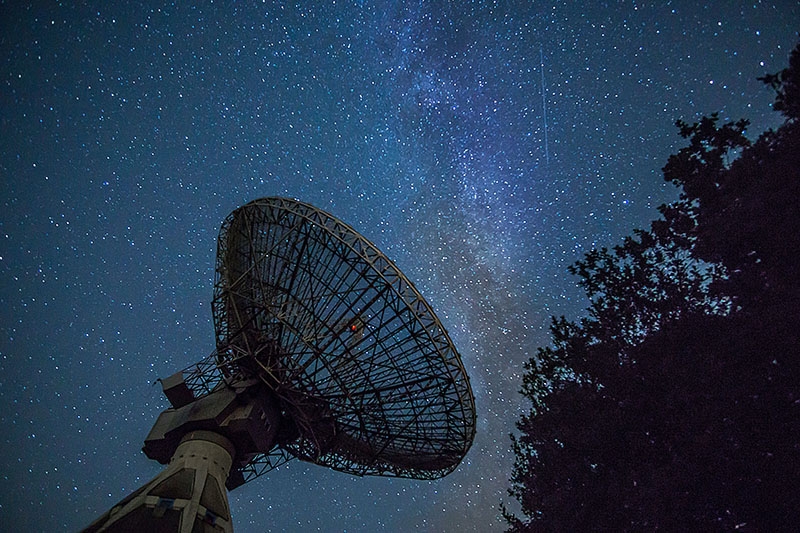
Image source: Stephan Widua/unsplash.com
This conclusion was made by Accu Components researchers after analyzing the trajectories of 15,833 operational satellites that currently orbit the planet in low Earth orbit – an altitude of less than 2,000 kilometers. Looking at data for October 12 and 18 this year, provided by the US Space Force through the public website CelesTrak, the researchers estimated that with a completely open horizon, there were 710 satellites in the sky over a typical UK city at any given moment of the night.
They noted that such a high density of satellites is typical for much of Europe, the United States and other regions in mid-latitudes – especially in the band between 40 and 50 degrees north or south latitude.
“Most Starlink satellites orbit at an inclination of about 53 degrees to the equator, causing them to cluster in mid-latitudes. The given global indicators are approximate and are based on calculations on a grid covering the entire planet for one day, Accu Components reported to the portal Space.com. “The fewest satellites are observed near the equator—there are about 490 of them.”
Not all of these satellites can be seen with the naked eye, since they become noticeable when illuminated by the rays of the Sun at a time when darkness has already fallen on the Earth’s surface. Thus, in the first hour after sunset, about 300 “luminous” satellites are visible over the British city; by midnight, the number of visible spacecraft drops to 20, and before dawn rises again to 300. According to the study, on average, 105 of the 710 satellites flying over the Earth reflected sunlight.
For comparison: according to the OwnStarMap project, in the dead of night over large cities such as London or New York, due to severe light pollution, only a few dozen stars can be seen with the naked eye. In small towns their number increases to several hundred. And only far from civilization, in remote rural areas or mountainous areas, you can observe thousands of celestial bodies.
With satellite companies planning to put hundreds of thousands, and possibly millions, of spacecraft into orbit in the coming decades, the number of satellites flying by could significantly exceed the number of visible stars over any city on Earth. This, astronomers fear, may affect the ability to observe celestial bodies and study the Universe.
If you notice an error, select it with the mouse and press CTRL+ENTER.