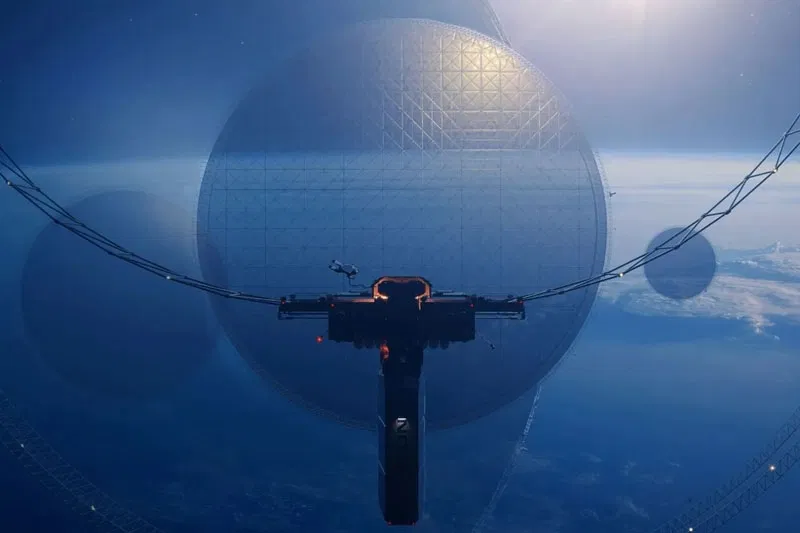
Living in outer space is not about cramped sections of small stations. It will be possible to truly live and work in orbit only in structures of a cyclopean scale, which will have to be assembled in space, since they are too large to be delivered there by rockets. And then you can’t do without robotic installers, because vacuum and radiation are not for humans.
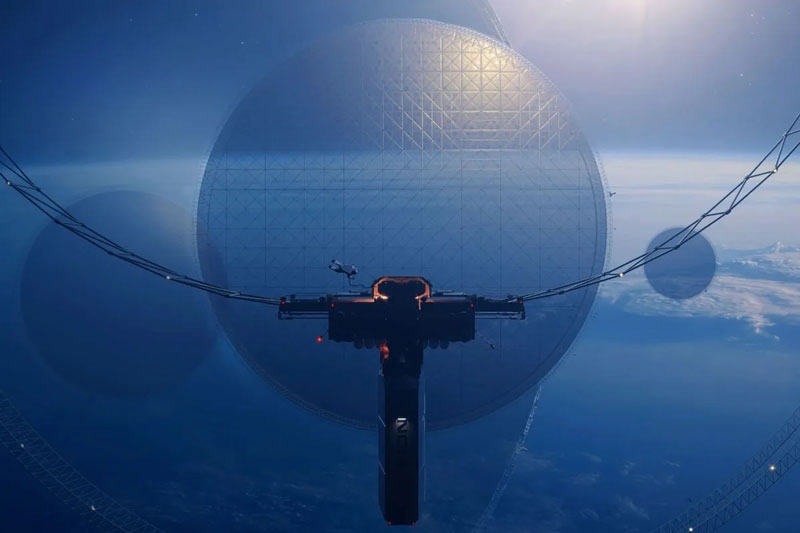
Conceptual images. Image source: DARPA
A group of engineers from the California Institute of Technology (Caltech), with funding from the US Defense Advanced Research Projects Agency (DARPA), for the first time demonstrated automated assembly of the structure directly in Earth orbit. The experiment was carried out as part of the NOM4D program (Novel Orbital and Moon Manufacturing, Materials and Mass-efficient Design), and the developed robotic system was called ASTRA (Autonomous In-Space Tensioned Reflector Assembly). Its task was to create the frame of a parabolic antenna with a diameter of 1.4 m from individual elements delivered into space.
The basis of the installation was a relatively simple robotic manipulator with mobility along three axes of space. He removed composite tubular elements and aluminum connecting units from the cassettes, oriented them in space and connected them into repeating sections (truss compartments). After assembling the next section, the robot attached a thin perforated reflective film to the structure, which in the assembled structure should play the role of an antenna mirror. This solution is convenient for automated assembly and allows reducing the weight of the reflector.
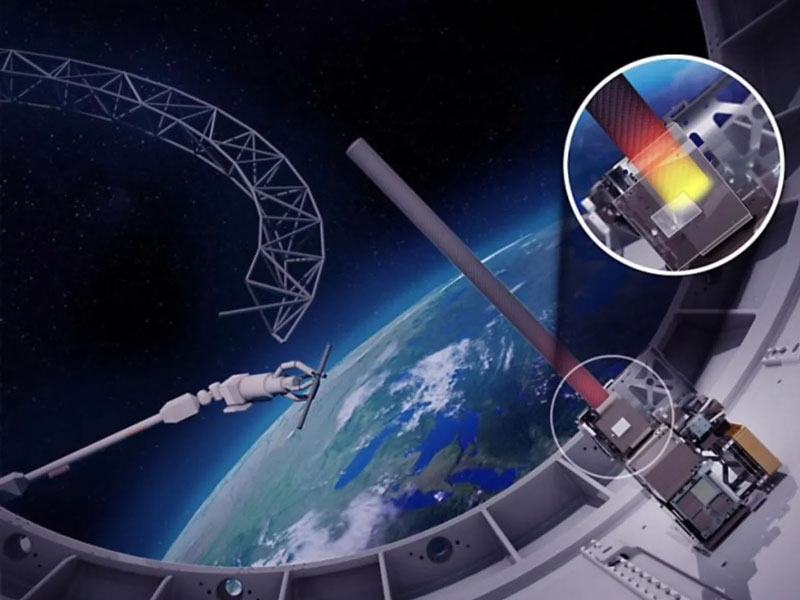
An experimental installation with a volume of about one cubic meter was sent into orbit on March 30, 2026 as part of the SpaceX Transporter-16 mission. The equipment was placed on Momentus’ Vigoride 7 orbital platform, which provided it with power, communications and surveillance cameras.
It is important to clarify that the robot worked according to commands from Earth: engineers sent it commands through the platform’s on-board computer, and the results of the operations were checked using the photographs received. Communication was available in approximately seven to eight short sessions of about 15 minutes per day. To test the commands, the team used a ground-based copy of the setup, on which they tested solutions and reproduced faults.
As a result, the robot independently assembled the third section of the farm, while the other two were delivered already assembled. It was not possible to completely complete the 11-section antenna design due to technical difficulties and limited time for the experiment. However, DARPA views the demonstration as proof-of-principle that robotic assembly of large structures in space is possible.
In the future, the technology can be used to create large radio antennas, space telescopes, solar power plants and other orbital structures. The NOM4D program is considering the possibility of building structures hundreds of meters and even kilometers in size, but this will not happen anytime soon.
If you notice an error, select it with the mouse and press CTRL+ENTER.