
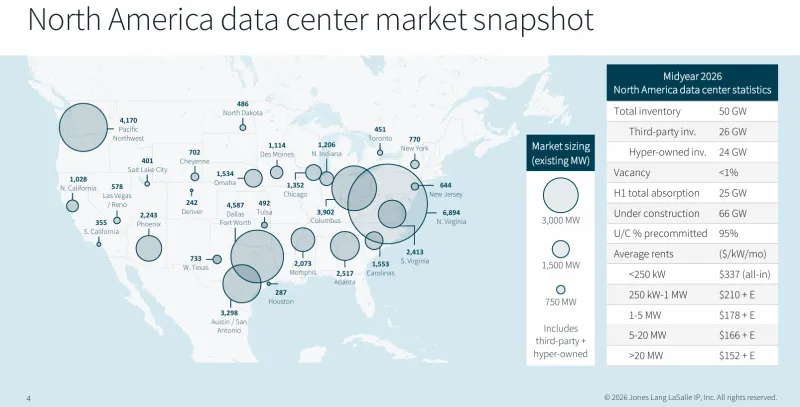
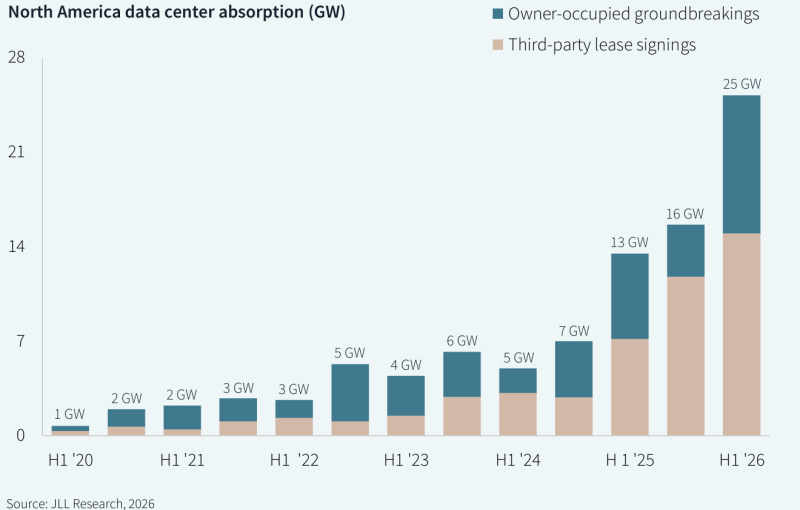
According to statistics from commercial real estate expert Jones Lang LaSalle, demand for data center capacity exceeded experts’ expectations in the first half of 2026, driven by hyperscale enterprises. During this period, a record 25 GW of capacity was developed, Report Data center updates. Reporting North American Data Center Mid-Year Report 2026 Analysts said North American data center demand will double year-over-year in the first half of 2026 as companies compete for data center capacity.
Analysts say demand for data centers is now five times what it was two years ago, and despite the unprecedented scale of construction, available capacity in the region has remained around 1% for the third year in a row. Since 2020, rents have increased by approximately 70%, with average rental costs increasing by 9% annually. Experts expect this trend to continue until 2030.
In North America, 66 GW of data center capacity is currently being built, 95% of which has been secured through preliminary contracts. According to JLL, the demand driver driving the 25 GW “absorption” is hyperscalers, new cloud and artificial intelligence companies actively competing for available computing power. At the same time, local community rejection of new data centers plays an important role today and has become a major obstacle to growth.
Image source: Jones Lang LaSalle
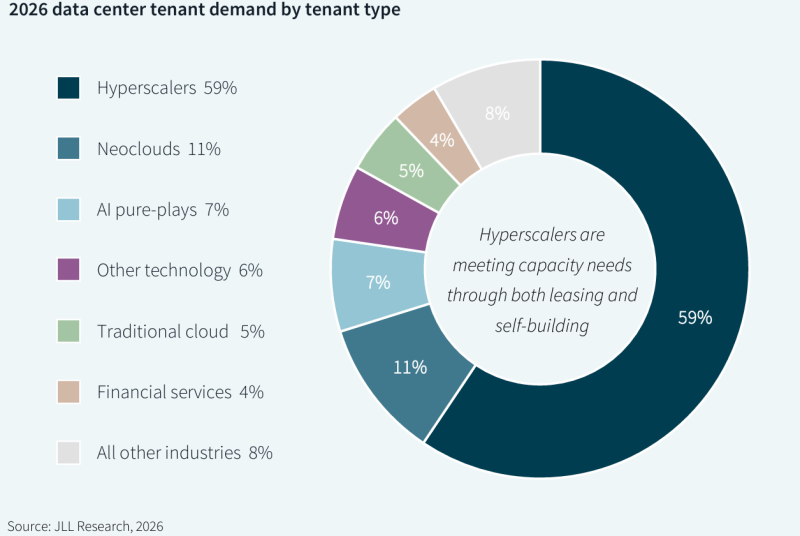
Hyperscalers are driving the industry and will account for 59% of data center rental demand by 2026. Additionally, to gain access to any infrastructure capacity, various types of companies form alliances. As a result, AI companies rent capacity from hyperscalers, while new cloud companies provide facilities to the latter.

The huge demands of hyperscale enterprises also affect enterprise users, who find it increasingly difficult to obtain “personal” business development capabilities. Enterprise customers typically require relatively small amounts of power, ranging from 500 kW to 3 MW, while hyperscalers require gigawatts, but they are the ones who “throw the blanket over themselves.”

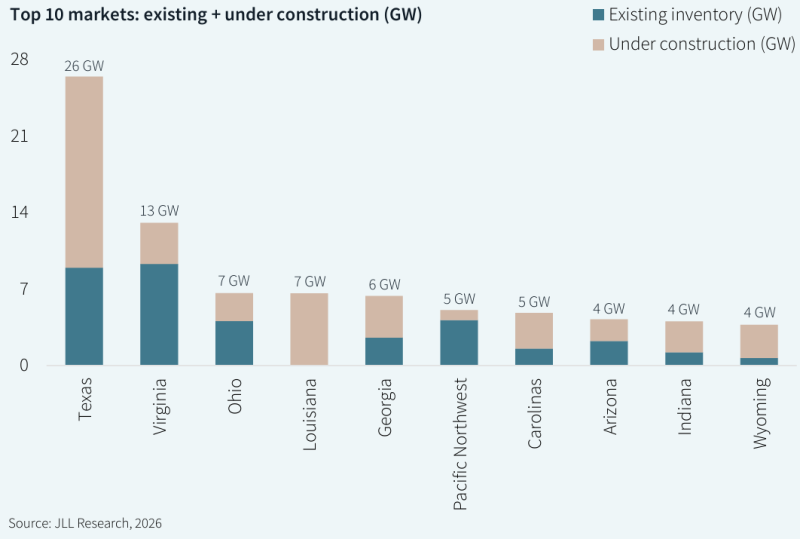
According to JLL, 79% of Americans support U.S. leadership in artificial intelligence, but only 14% are willing to provide land for their communities to achieve this goal. Experts say this stance could hinder further development of the infrastructure the U.S. needs to remain competitive in artificial intelligence. According to statistics, 77% of data center construction projects in the region are currently located in “frontier markets”, whereas previously there were almost no data center construction in the region.

Recently, huge investments have been made in resource-rich and construction-friendly markets, such as the West. Texas, Ohio, Louisianaas well as north and south carolina. As construction accelerates, developers are trying to connect with local communities to create jobs, generate tax revenue and invest in local infrastructure for long-term economic growth.

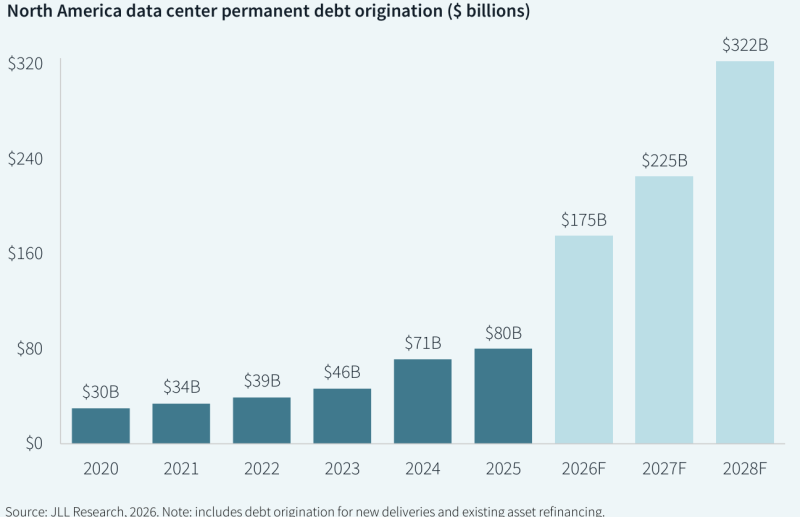
Meanwhile, JLL noted the high level of investor confidence in the sector. Financing of data center projects is expected to continue until 2028, with US$250 billion in artificial intelligence-related bonds issued in the first half of 2026 alone. Funding liquidity remains high, with more than $700 billion in new long-term debt financing coming to the construction industry over the next two and a half years. However, McKinsey assertionBuilding too little energy capacity is far more dangerous than building too much energy capacity – even if not all planned data centers come to fruition.
source: