
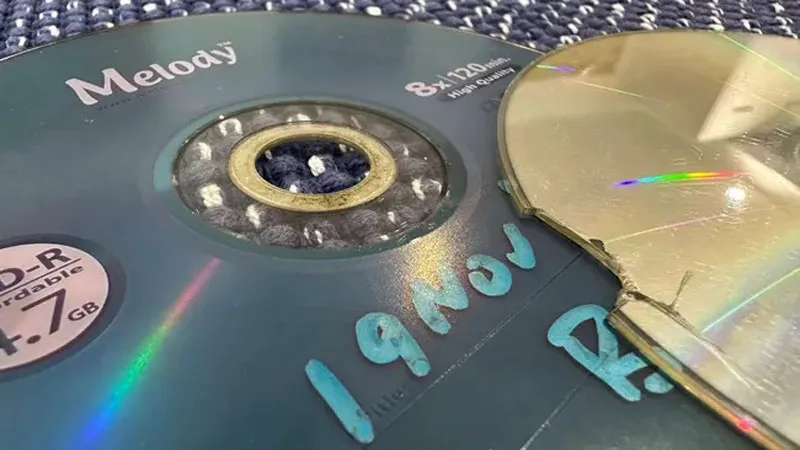
Old disc owner Collide Colleagues at the popular website Tom’s Hardware report that due to an unusual phenomenon of media degradation: some CDs, after years of storage, begin to spontaneously become riddled with deep cracks and even break into pieces. This happens in addition to common misfortune Ancient optical media – oxidation of the working layer and destruction by ultraviolet radiation.
Image Credit: Tom’s Hardware
Sources say that several new cases of spontaneous disc destruction have attracted the attention of Japanese collectors, resulting in a number of similar messages appearing on social networks. The cause is not believed to be related to normal aging of the recording layer. According to some indications, we can talk about chemical damage to the polycarbonate base of the disc.
In one case, the destruction of the polycarbonate substrate was associated with repeated cleaning and polishing of the disc – excessive care of its surface; in another case – long-term storage in a sealed box on a foam bed. The source emphasized that this is actually the conclusion of “armchair experts” and does not claim to be the final truth. But there is a common sense element to these conclusions.
Although polycarbonate has high mechanical strength, some chemicals may cause polycarbonate to crack under the influence of the environment. First, cloudy microscopic areas and a network of microcracks appear, after which the material loses impact strength and collapses under the influence of internal mechanical stresses. It is strictly prohibited to use strong solvents to clean discs, such as acetone and benzene, which can dissolve polycarbonate. When cleaning, you can use the less corrosive isopropyl alcohol or methanol, but over-cleaning, even with safe products, can cause damage.
Another potential source of danger is the aged polyurethane foam lining some protective electronic equipment and media cases. Users have noticed that the material releases volatile compounds over time, and in sealed boxes, gases can accumulate near the surface of the disk.
Ammonia compounds, in particular, can cause damage to polycarbonate and form microcracks that are expected to have a negative impact on polycarbonate. Experts are aware of the release of volatile chemicals from polyurethane foam, although the composition of the emissions depends greatly on the composition and age of the material, so it’s impossible to say that ammonia destroyed a specific disc without conducting a chemical analysis.
This kind of mechanical damage to the base is particularly dangerous for CDs: classic CDs are actually based on a single polycarbonate base, while DVDs consist of two thinner polycarbonate halves glued together, so the nature of their damage is somewhat different. At the same time, chemical cracking complements known problems in long-term storage of optical media – oxidation of reflective metal layers, damage to the dyes of recorded CDs/DVDs, exposure to UV radiation, and delamination of DVDs.
If you find an error, select it with your mouse and press CTRL+ENTER.