


Optical communication lines have long been used as sensors for seismic activity. For this purpose, standard equipment is sufficient; the physics and algorithms of light propagation in optical fibers do the rest. turn out to beIf you change the shape of the fiber, the sensitivity of this sensor can be increased by a factor of 1,000. This opens the way for glass nerves in batteries, planes, devices and buildings to sense the world and themselves in it.
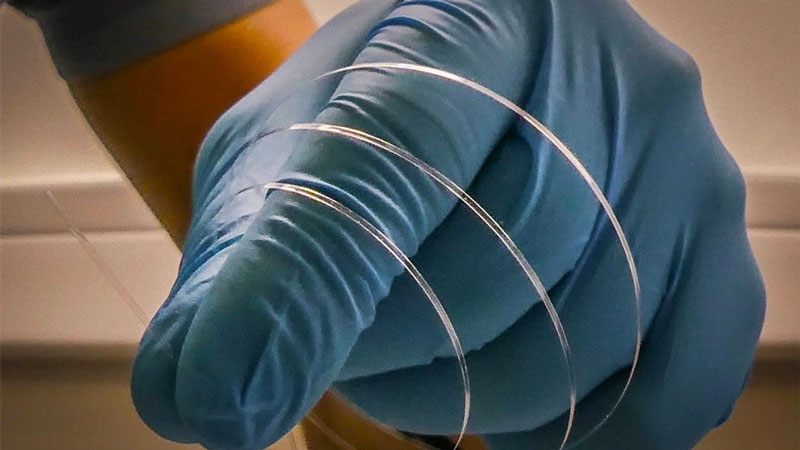
Image source: KTH Royal Institute of Technology
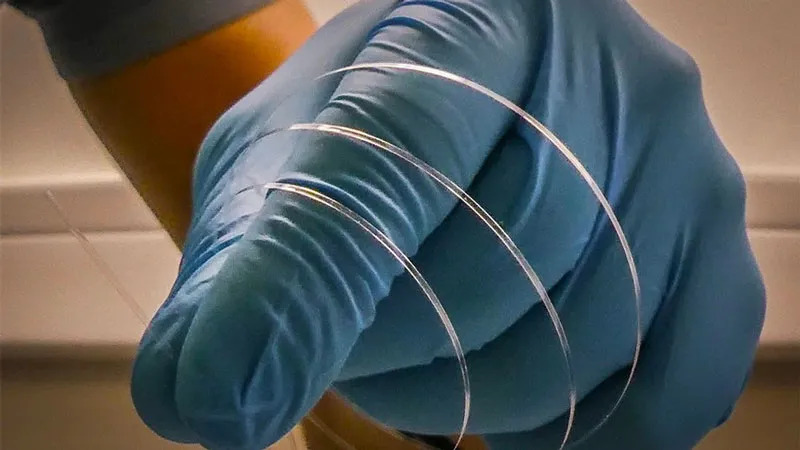
Researchers at the Royal Institute of Technology in Sweden and two British universities, the University of Southampton and the University of Bristol, report the development. They came up with an unusual flat optical fiber that itself became an ultra-sensitive pressure and temperature sensor. The new platform is called HARFF – High Aspect Ratio Flat Fiber, which is a flat fiber with a large aspect ratio.
Unlike traditional round optical fibers, it has an elongated, quadrilateral, almost ribbon-like cross-section and can contain air channels, multiple light guides, or inserts made of other materials. This geometry significantly changes the mechanical response of quartz glass to lateral loading: the experimental pressure sensor created is three orders of magnitude more sensitive than similar devices based on conventional round quartz fibers.
For experimental flat fibers, the width-to-thickness ratio is approximately 20:1, and the microstructured sample can have multiple parallel fibers. In this case, the flat optical fiber can be soldered with regular optical fiber and connected to existing optical equipment. In other words, no new hardware is needed to take advantage of the fantastic new capabilities of flat fiber optics.
To enable the optical fiber to detect temperature and pressure, microcavities are created in it and additives in the form of various metals and alloys, such as tin alloys, are added. Particularly impressive results were obtained when measuring pressure. Microstructured fibers with a thickness of 80 μm and a width of 655 μm and two internal air channels were used in the experiments. The resolution of this sensor reaches the level of several kPa.
The researchers turned the same platform into a highly sensitive thermometer by filling one of the channels with a tin-based alloy with a melting point of about 220°C. When heated, the metal expands and creates mechanical stress in the glass, changing its refractive index, which can be easily measured using traditional telecommunications equipment.
Developers believe the flat fibers could be embedded directly into composite materials in aircraft, drones, bridges and other structures, as well as inside batteries, to record the expansion of electrodes, the formation of gases and dangerous temperature increases. In addition to industry, the technology can also be applied to medical monitoring systems.
If you find an error, select it with your mouse and press CTRL+ENTER.