
Initially, the boom in artificial intelligence systems mainly drove the increase in DRAM prices, but gradually NAND memory also joined the ranks of continued price increases. At the end of last quarter, the five largest NAND suppliers’ revenue increased 77% sequentially to $68.87 billion, indicating high price dynamics in this area.
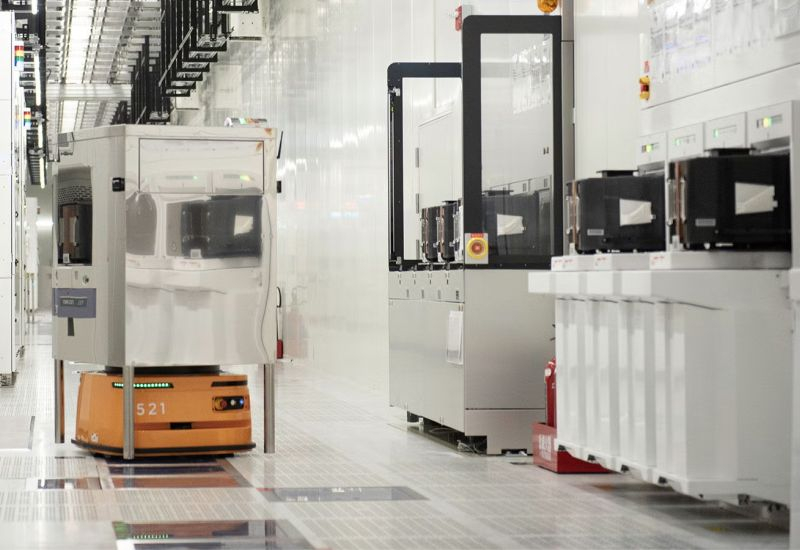
Image source: Micron Technology
represent TrendForceThose who cite these statistics do not hide the fact that this revenue growth is mainly due to the persistence of NAND shortages and rising average selling prices. The author of the TrendForce report said that demand for flash memory in the PC and smartphone fields will be suppressed by high prices in the third quarter, but the server field is much less elastic, so prices are likely to continue to rise. In addition, manufacturers give priority to the production of DRAM and HBM, and use the remainder to finance NAND. This limits the supply of solid-state memory on the market and drives up prices.

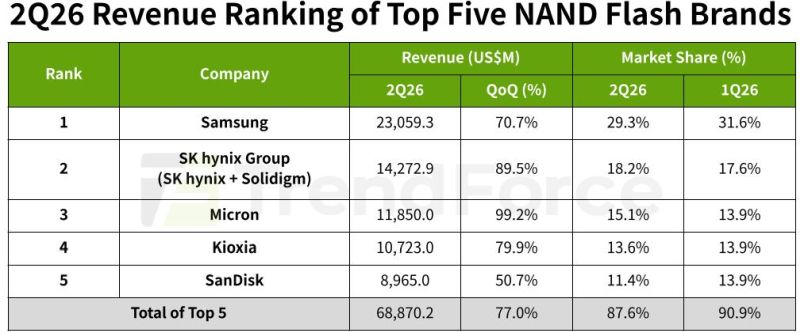
Image source: TrendForce
Last quarter, Samsung Electronics led the NAND field with a 29.3% share, and revenue increased by 70.7% quarter-on-quarter to US$23 billion. Under pressure from competitors, its market share fell slightly, accounting for 31.6% of the market in the first quarter. Ranking second is the alliance between SK Hynix and Solidigm. Its sales revenue increased by 89.5% to US$14.3 billion, and its market share increased from 17.6% to 18.2%. The leader in revenue growth is Micron Technology, which almost doubled, while its position also increased from 13.9% to 15.1%. Although Kioxia’s revenue surged 79.9% to $10.7 billion, its share fell from 13.9% to 13.6%. Additionally, the company slipped to fourth place, losing third place to US-based Micron. Sandisk’s decline was even more obvious, with its revenue growing only 50.7% to $8.97 billion, and its market share falling from 13.9% to 11.4%. In the second quarter, the top five NAND manufacturers collectively controlled 87.6% of the global market. In the first quarter of this year, its share reached 90.9%.
Incidentally, representatives of Counterpoint Research painted a slightly different picture of the balance of power in the NAND market in the second quarter, with Chinese company YMTC in third place. The authors of this report rely on the physical volume of memory supply rather than its sales revenue. Of course, Yangtze Storage, which supplies cheaper NAND, may not be included in TrendForce’s statistics, especially since it has not yet entered the stock exchange, so its specific revenue amount cannot be known.
If you find an error, select it with your mouse and press CTRL+ENTER.