


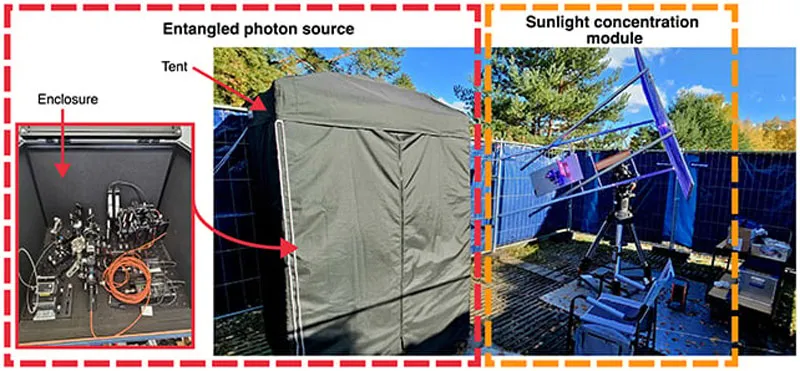
the scientist first Quantum entanglement was obtained directly from sunlight, showing that there is no need to use expensive lasers to create entangled photons. The experiment was conducted by researchers at the University of Ottawa and the Max Planck Institute for Light Science in Germany. The work holds promise for more energy-efficient photonic quantum technologies, as traditional systems for creating entangled states require high-power lasers.
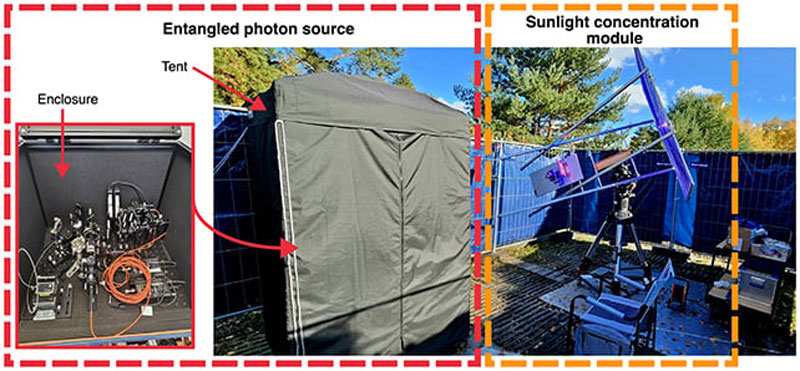
Image source: Optica 2026
The experiment is based on the spontaneous parametric light scattering (SPDC) process, in which pump photons in a nonlinear crystal are converted into a pair of photons with interconnected quantum states (entangled). Traditionally, coherent lasers have been used as pump sources because high spatial and temporal coherence is believed to be necessary and mandatory for the formation of entanglement. Ordinary sunlight is incoherent; its photons are jumbled up in direction and wavelength. Most physicists believe that searching for entangled pairs from this perspective is a futile exercise.
The physicists who conducted the new experiment partially agree, but they believe that even photons of incoherent light find something in common, and that’s polarization – the oscillations of an electric field that maintain a certain order in a chosen direction. They succeeded.
The key engineering solution is a device that concentrates scattered solar radiation to an intensity strong enough to work with microscopic nonlinear crystals. To do this, the team created a tapered glass solar concentrator. The system collects light over an area of approximately 1.4 m2 It is passed through a large Fresnel lens, which is then directed into an optical fiber about the thickness of a human hair and focused onto a crystal. An experiment was conducted in the backyard of one of the campuses, using a sun-tracking system that ensured a steady flow of light into the light path.
The researchers obtained a photon state that approximates about 94% of the ideal entangled state, and the measured correlation violates Bell’s inequalitywhich confirms their quantum nature and the possibility that classical physics cannot explain the phenomenon. In the future, this technology may have applications in quantum communications, such as satellite encryption key distribution systems, where sunlight can already be used in space and reduce the weight and energy consumption of equipment by eliminating pump lasers.
It also opens up the possibility of conducting quantum experiments outside the laboratory using expensive equipment, which would expand participation in the science by experts and even amateurs. The first desktop computers appeared in garages. Why won’t the first quantum desktop be there?
If you find an error, select it with your mouse and press CTRL+ENTER.