
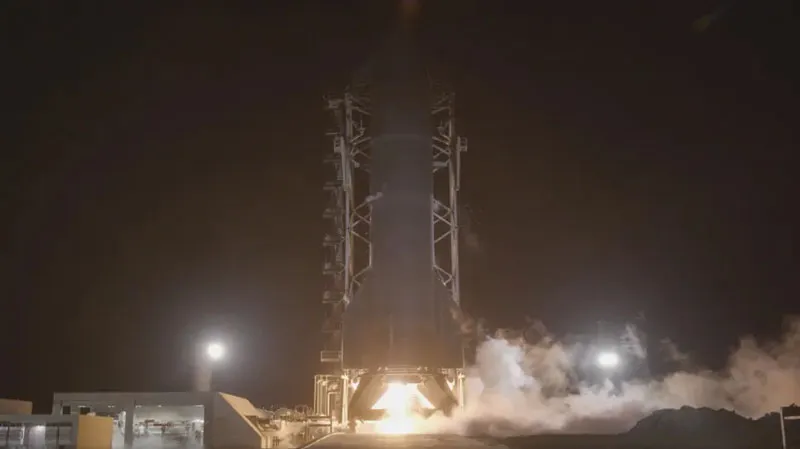
Space Exploration Technologies Corporation spend A static fire test of the engines of Starship (Ship 41), which is preparing for its historic 14th flight, its first attempt to enter Earth orbit. Testing was conducted at a location near the Starbase complex in South Texas. First, engineers ignited one of Raptor 3’s six engines to simulate its operation during a deorbiting maneuver, and then ignited all six engines on the spacecraft for 60 seconds.
Image source: SpaceX
The Ship 41 prototype represents the upper stage of the Starship V3 rocket system and is the most advanced version of the system. The vessel is equipped with three atmospheric and three vacuum Raptor 3 engines, optimized for operation outside of dense atmospheres. The test not only checks the starting of the engines, but also the stability of the fuel system, the operation of the control automation and the ship’s ability to generate the required thrust in all parts of the flight path. Such inspections are a mandatory pre-flight step that confirm the availability and readiness of the power plants to solve the tasks assigned to them.
The Starship V3 platform has already demonstrated significant progress in previous flight tests, with the system approaching orbital altitude, performing complex maneuvers, including restarting Raptor engines in space, and the upper stage successfully performing a controlled descent and splashdown. The third version of the complex was approximately 124 meters tall and was designed with a significantly larger payload than earlier versions of the starship. In the future, as part of the Artemis program and subsequent interstellar missions, SpaceX is expected to use this rocket to launch large satellite constellations to deliver cargo to the moon.
Starship’s first orbital flight, planned for late August or early September, will be a key test of the fully reusable Super Heavy rocket structure. To achieve practical operation, SpaceX still needs to prove reliability for orbital operations, on-orbit refueling, and superheavy and ship-grade reuse. But this is ahead of schedule. In the next few days, the company will conduct static ignition tests of the 33 Raptor 3 engines of the Super Heavy booster, after which the final assembly of the rocket can be carried out before launching the rocket’s 14th test flight. It won’t be what Musk previously promised, but it will still go down in history as the first time a fully reusable complex has entered Earth orbit.
If you find an error, select it with your mouse and press CTRL+ENTER.