

Scientists from Pohang University of Science and Technology (POSTECH) in South Korea report About progress in creating metalenses, ultra-thin optical elements that can replace bulky lens systems in augmented reality and virtual reality devices. They have made progress in two areas that have hindered mainstream technology: eliminating color distortion from full-color imagery and developing scalable production methods.

Image source: AI Generation ChatGPT/3DNews
Metal lenses work differently than regular glass lenses: Instead of using curved surfaces to refract light, they use flat metasurfaces made up of millions of nanostructures, usually in the form of columns. These elements, which are smaller than the wavelength of light, can change the phase, amplitude and direction of propagation of photons to form images in extremely thin layers of material. This transforms the magnifying glass from a thick lens set to a flat, lightweight plate of glass. However, one of the main problems with such super lenses remains that Color difference: Red, green and blue light are focused at different distances due to the properties of the material and nanostructure.
This is important for mass production. The entire metalens array should be made of the same material to make it cheap and simple. Traditionally, this has been solved by individually selecting the width of the nanopillars for each color (red, green and blue). But this also means that each color is focused at a different distance from the lens, and users see streaks of color rather than a clear, full-color image. Scientists at Pohang University of Science and Technology proposed increasing the height of each column, which solved the focusing problem. But another problem arises – this complicates the production phase of the metalens.

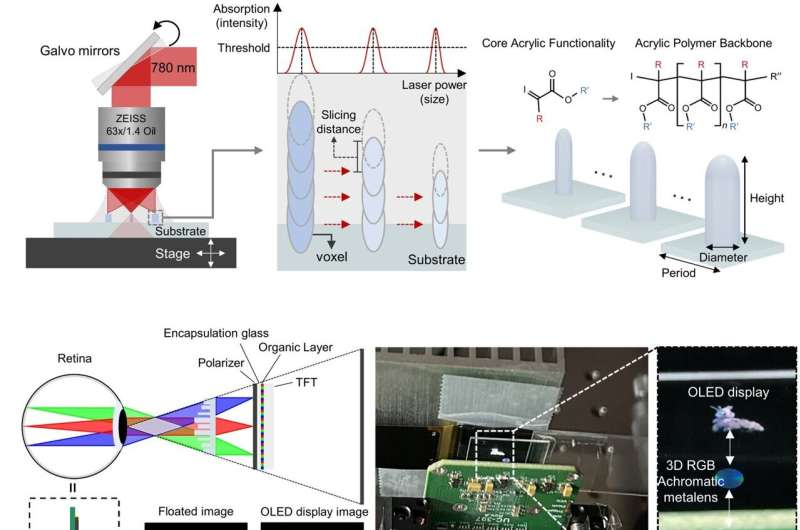
Image source: Nature Communications 2026
In this regard, the team conducted another study and found that traditional nanoprinting lithography (where the product is actually stamped under the press) can be adapted to the height of the print. Typically, the height of elements on a stamp is always the same. The combination of electron beam lithography and nanoprinting creates the conditions for stamping complex metal lens reliefs suitable for mass production.
“We expect these technologies to be widely used not only in lighter and thinner augmented reality glasses and next-generation displays, but also in various optical industries such as imaging systems and optical sensors.” ——scientist said. Anyone who has used an AR and VR headset is well aware of how convenient and lightweight they would be if the head had a thin piece of glass housed in a small frame instead of a giant half-helmet. We need this kind of progress.
If you find an error, select it with your mouse and press CTRL+ENTER.