
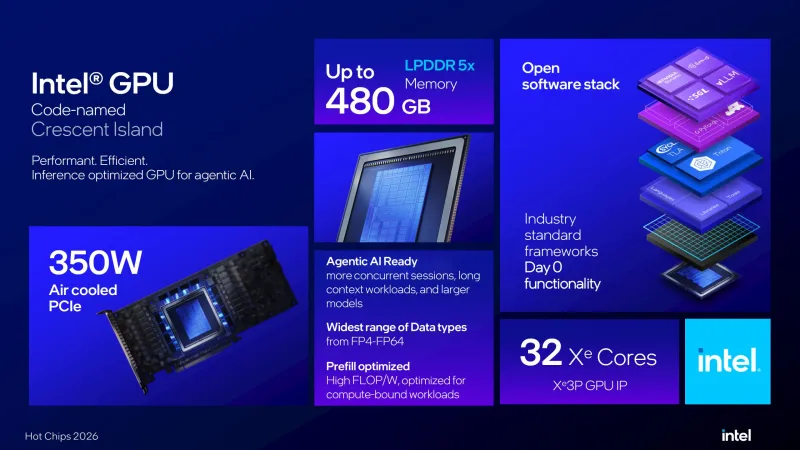
As part of its Hot Chips 2026 conference, Intel revealed new details about its Crescent Island accelerator device, which is designed to perform AI inference tasks in data centers. For the first time, the company talked in detail about the compute part of the GPU: it will receive 32 Xe3P cores and 256 XMX matrix engines. Intel previously announced that the Crescent Island will be available as an air-cooled PCIe card and will come with up to 480 GB of LPDDR5X memory.
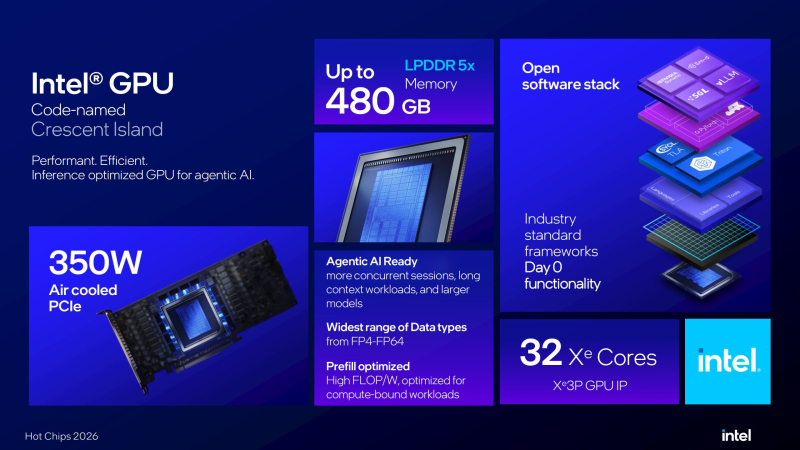
The computing part of Crescent Island is divided into four Compute Slice blocks, each block contains 8 Xe cores. The GPU has a total of 32 Xe3P cores, 256 vector engines and the same number of XMX matrix engines, responsible for accelerating operations used by neural networks. Each Xe core has 512 KB of combined L1 cache and local SLM memory, bringing their total size to 16 MB. In addition, the GPU provides 32 MB of shared L2 cache.
The Xe3P architecture is a specialized evolution of Xe3 focused on performance and energy efficiency for computing workloads. At Crescent Island, Intel eliminated the modules required to process traditional 3D graphics, freeing up transistor budget for computing resources. The accelerator supports multiple data formats, from FP4 for AI inference to FP64 for high-precision computing.
One of the most unusual features of Crescent Island is the memory subsystem. Intel chose LPDDR5X instead of the expensive HBM used by modern Nvidia and AMD accelerators. Intel’s own reference card will come with 160 GB of memory, while partners will be able to create accelerators with up to 480 GB of memory. This approach provides lower bandwidth than HBM but can significantly increase memory capacity at moderate cost and power consumption. Large amounts of memory should allow large language models to be placed on a single accelerator, serve longer contexts, and execute requests from large numbers of AI agents simultaneously.
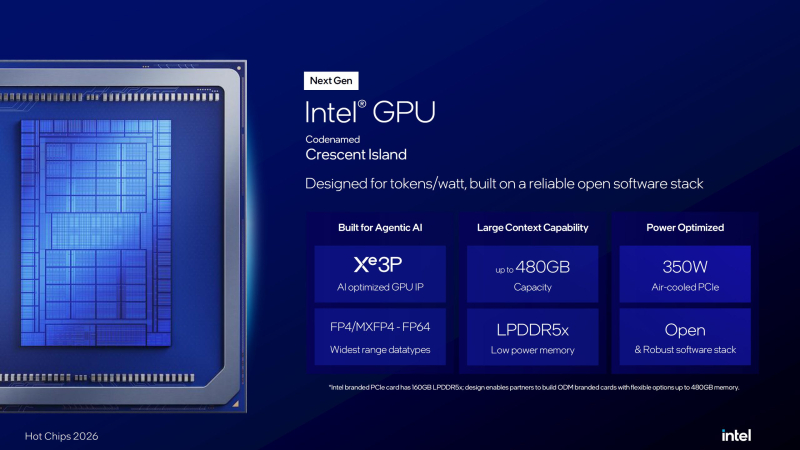
At the same time, Crescent Island is not designed to compete with the most efficient accelerators for training neural networks, but primarily to cost-effectively execute already trained models. Intel is particularly focused on the cost of tokens and the ability to install new accelerators in existing servers without switching to liquid cooling. The Crescent Island reference PCIe card consumes 350 W and is designed for traditional air cooling.
In fact, Intel is trying to carve out a separate niche in the fast-growing market of artificial intelligence accelerators: Crescent Island offers not maximum computing power, but a combination of large amounts of relatively cheap memory, modest power consumption, and dedicated computing units. This approach is particularly interesting for inference of large models, where the ability to place the entire model and its context in accelerator memory is often as important as peak computational performance.
Intel first released Crescent Island 160 GB LPDDR5X last fall and expanded the platform specifications in the spring to allow partners to create versions with up to 480 GB of memory. The first accelerator samples will reach customers in the second half of 2026. Intel has not disclosed data on Crescent Island’s performance or when it will begin volume deliveries.
If you find an error, select it with your mouse and press CTRL+ENTER.