
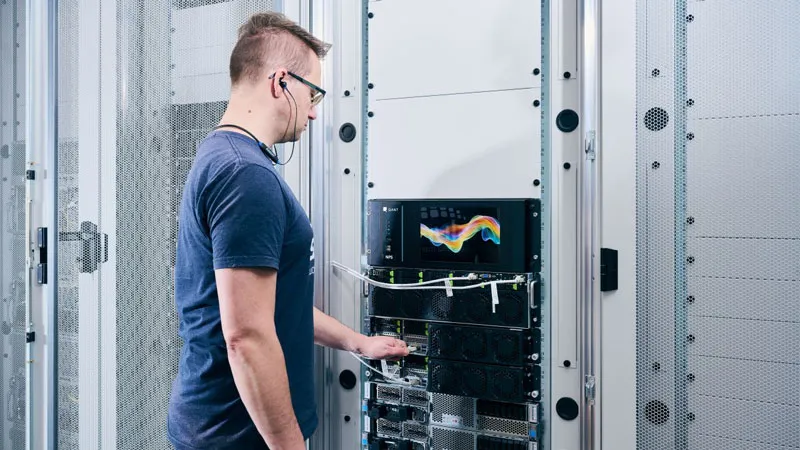
Karlsruhe Institute of Technology (KIT) Start learning A different approach to high-performance computing that uses light to perform a series of operations. The system is based on the photon processor of the German company Q.ANT. Unlike traditional CPUs and GPUs that use electric current to pass through transistors to perform calculations, photon accelerators use light signals directly to process data, thus saving time and reducing consumption.
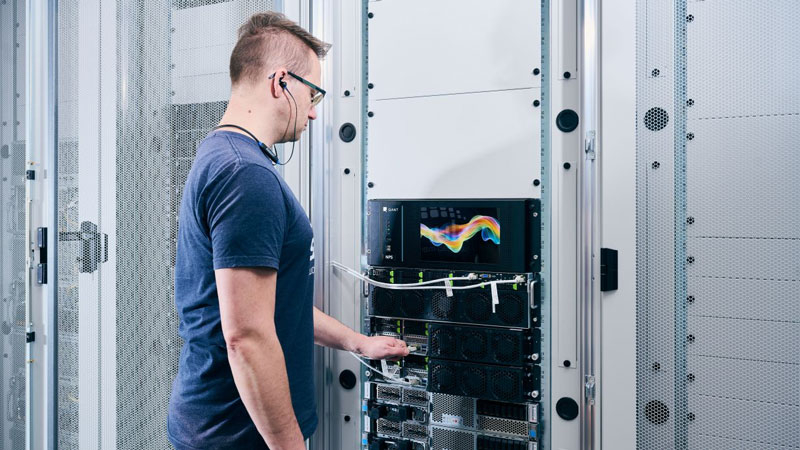
Photo credit: Cynthia Ruf/KIT
Let us emphasize right away that the Q.ANT Photon processor and the platforms based on it do not mean abandoning traditional CPUs and graphics processors. Developers are creating a hybrid architecture where CPUs, GPUs, and photonic NPUs (native processing units) will perform operations that each processor is best suited for.
Physically, the calculation process is as follows: the digital data is converted into optical signal parameters (usually phase and amplitude), and then the light enters the photonic integrated circuit. It uses optical waveguides and interferometers to control the amplitude and phase of light waves. As waves travel along different light paths, they interfere with each other, like ripples on water, and perform specified mathematical operations in the process. This principle applies particularly to matrix computations, which are a fundamental part of neural network operations. The photodetector then converts the result back into an electrical signal.
The main advantage of this architecture is not the speed at which light travels, but the ability to perform many operations simultaneously. The optical path can convert an entire set of signals at once and perform calculations directly as the light passes through the photonic chip. This allows you to significantly reduce the number of data transfer operations between memory and computing units – one of the main sources of energy consumption in modern AI systems.
Q.ANT estimates that for certain artificial intelligence tasks, its photonic technology can improve energy efficiency by 30 times compared with traditional CMOS electronics. At the same time, lasers, modulators, photodetectors, and control electronics still require electricity, so we’re not talking about a complete rejection of electricity in favor of light, but about a more economical way to perform individual operations.
Researchers at Karlsruhe Institute of Technology not only intend to test the effectiveness of the technology under laboratory conditions, but also as part of a real computing infrastructure. During the course of the experiment, scientists will determine which tasks are more profitable to move to photon accelerators and which tasks are left to electronic processors. This approach is particularly interesting for artificial intelligence, as the amount of matrix operations continues to grow and the energy consumption of data centers is becoming a serious challenge. In the future, such hybrid systems could combine traditional CPUs and GPUs with photon and quantum accelerators, distributing computation between them depending on the nature of the specific task.
Note that current implementations of photonic processors primarily perform linear operations, but the company is working to create processors with the ability to convert light pulses nonlinearly, which is also important for the operation of neural networks.
If you find an error, select it with your mouse and press CTRL+ENTER.