

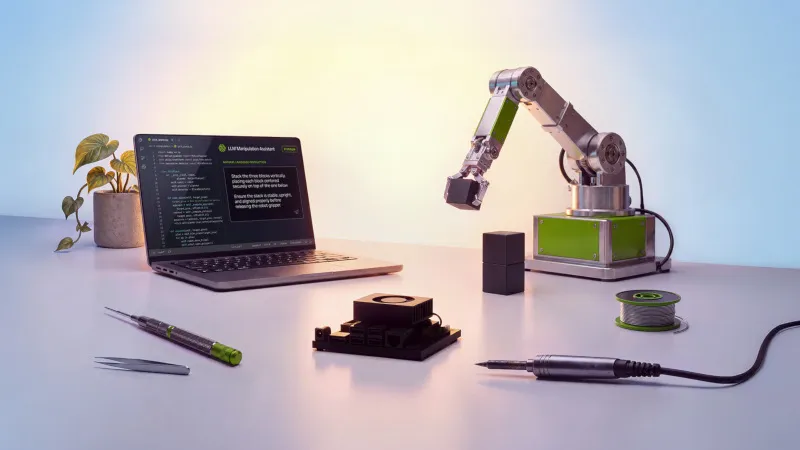
Nvidia demonstrated the platform jetson dwarf ears 2 – Compact entry-level computer for running artificial intelligence models locally and can be used as the main computing unit for robots and other autonomous devices.
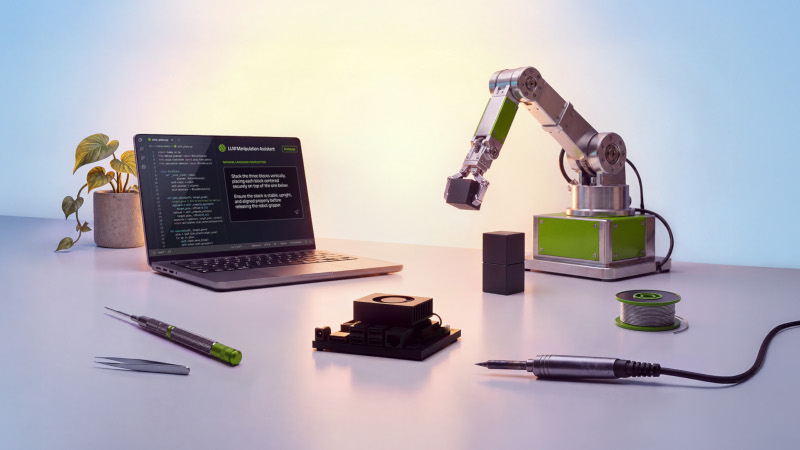
Image source: nvidia.com
The capabilities of modern small and medium-sized AI models are already approaching last year’s flagship models. According to Nvidia, tasks that a year ago required models with 600 billion to 1 trillion parameters can now be solved with more compact models that can run directly on the Jetson Orin Nano 2.
The new platform becomes an entry-level link in Nvidia’s proposed infrastructure for robotics development. Omniverse and Cosmos are used for modeling and testing, the DGX system is used for training models, and Jetson acts as the “brain” of the robot, running the trained model directly on the device. Jetson Orin Nano 2 is equipped with an eight-core Arm processor and 8GB of memory, with a performance of 78 trillion operations per second (TOPS).
Compared to the Jetson Orin Nano Super, the new platform delivers twice the performance through improved tensor cores and increased memory bandwidth. In addition, in 15W power limit mode, Jetson Orin Nano 2 consumes 40% less power with the same peak performance. The platform is compatible with existing Nvidia software stacks and is also designed for developers already using the Orin family of solutions.
Jetson Orin Nano 2 lets you run large language and visual language models natively, optimized to run on limited memory. These include Nvidia Cosmos and Nemotron, Google Gemma 4 and Alibaba Qwen 3. This approach allows bots to perform some AI tasks directly on the device without having to turn to a cloud service for every request.
Cognex, Doosan Bobcat, Matic and Wing have already expressed interest in the Jetson Orin Nano 2. Alphabet-owned Wing is exploring the possibility of using the platform in its delivery drones. Matic Robots plans to use it in cleaning robots, which will use Jetson’s computing power to achieve conversational AI, gesture recognition, precise mapping and semantic understanding of home environments. All of this should increase the robot’s degree of autonomy.
Manufacturers of carrier boards, software and hardware solutions, and reference systems are also cooperating with Nvidia, including AAEON Technology, ADLINK Technology, Advantech, Aetina, Antmicro, Aptiv, Auvidea, AVerMedia, Connect Tech, Seeed Studio and many other companies. Based on the Jetson Orin Nano 2, partners will be able to create systems for navigation, recognition and interaction with objects, robot safety and autonomous control.
Nvidia Jetson Orin Nano 2 modules and development kits will be available in the first half of 2027.
If you find an error, select it with your mouse and press CTRL+ENTER.